The first foreign journalists in Shanghai were those working for locally-based newspapers like the North China Daily News. But by the 1920s and 30s, large numbers of foreign correspondents had descended on Shanghai and other Chinese cities, providing an unprecedented supply of information about China to the outside world. Many journalists were drawn by Shanghai’s reputation for the high-life, not least the alcohol-fuelled parties of the original Shanghai FCC. But worker unrest, civil war and Japanese invasion could not be ignored: many correspondents became deeply committed to reporting the plight of the Chinese people – following the Nationalist government inland, or making their way up to the Communist-held areas. Some paid for their commitment with their lives, like the Daily Telegraph man shot dead by snipers in Shanghai’s old city, and the Reuters correspondent tortured by the Japanese military. Yet many remained, providing a vivid record of the end of Japanese rule, and ultimately covering the Communist takeover of Shanghai. Paul French, author of Through the Looking Glass – China’s Foreign Journalists from Opium Wars to Mao, will discuss the history of foreign correspondents in Shanghai.
Venue details: Maya, inside Shanghai Grand Plaza, 568 Julu Lu, between Xiangyang Bei Lu and Shaanxi Nan Lu (6289 6889)
Admission: Members free; Non-members 60 RMB (Free snacks provided)
Having mentioned George Chinnery yesterday it seemed a good follow up to note that of course the old boy is buried in Macao in the old Protestant Cemetery, also known as the East India Company Cemetery.
A few posts derived from a rather wet and soggy day in Macao last week.
It’s virtually impossible to divorce Macao from the great painter George Chinnery – his work is so often so redolent of old Macao in its Portuguese incarnation. Nice that they still remember the old curmudgeon in Macao too. I happened to be strolling round the back streets and stumbled across these mosaics that had been erected on a wall remembering some of Chinnery’s images of bygone Macao.
If you want to see them yourself they’re on Travessa do Meio near to Senado Square.
The Hong Kong Standard reports that the horribly misnamed bunch of cultural philistines and vandals the Urban Renewal Authority (URA) in partnership with their cronies in the property and land development business have carved up the “redevelopment” of Lee Tung Street in Wan Chai, formerly better known as Wedding Card Street.
It seems that Hopewell Holdings, best known for the incredibly ugly Hopewell Centre, will lead the redevelopment along with the equally barbaric Sino Land. The Wedding Card Street development comprises 88,500 sq ft and will include all the usual horrors so beloved of Hong Kong’s rapacious property developers – 1,000 luxury residences, a themed shopping mall and (we’ll wait and see if this actually happens) just three preserved and refurbished buildings.
Most ridiculously Wedding Card Street is already history – it was raised in December 2007 and is now just an empty site – it is too late to save it as you can see from the pics opposite. Yet the “themed” element will be a “Wedding City”. Looking at the images of what will be there in the Standard it’ll basically be just another shopping mall with plenty of private open space, the inevitable mob of security people in black suits with earpieces and repetitive dreariness.
The destruction of Lee Tung Street marks yet another victory for the property developers and yet another loss for Hong Kong’s heritage and local communities. Family run businesses established for generations gone; Starbucks and all the other drab chains installed. Whither Hong Kong.
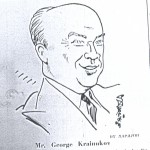 George Krainukov (who later changed his name to Crane) was one of the great pioneers of the newsreel among the foreign press in China. He did more than most, including the print journalists, to bring home the reality of the deteriorating situation in China in the later 1930s. Krainukov was a White Russian émigré to Shanghai who’d arrived in 1932. In 1937 he was to largely outshine the competition with what many thought was the best footage of the carnage from the Japanese bombing of Shanghai for Universal Newsreel. And so the other day I came across this 1941 cartoon of Krainukov by the great White Russian Shanghailander cartoonist Sapajou for the North-China Daily News. The cartoon honoured the fact that Krainukov was imminently to leave Shanghai for the USA.
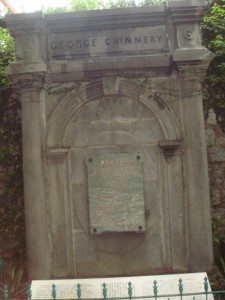 Having mentioned George Chinnery yesterday it seemed a good follow up to note that of course the old boy is buried in Macao in the old Protestant Cemetery, also known as the East India Company Cemetery.
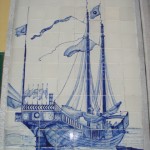 It’s virtually impossible to divorce Macao from the great painter George Chinnery – his work is so often so redolent of old Macao in its Portuguese incarnation. Nice that they still remember the old curmudgeon in Macao too. I happened to be strolling round the back streets and stumbled across these mosaics that had been erected on a wall remembering some of Chinnery’s images of bygone Macao.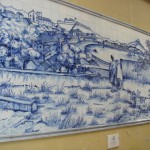
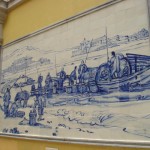 If you want to see them yourself they’re on Travessa do Meio near to Senado Square.
 The Hong Kong Standard reports that the horribly misnamed bunch of cultural philistines and vandals the Urban Renewal Authority (URA) in partnership with their cronies in the property and land development business have carved up the “redevelopment” of Lee Tung Street in Wan Chai, formerly better known as Wedding Card Street.
 Most ridiculously Wedding Card Street is already history – it was raised in December 2007 and is now just an empty site – it is too late to save it as you can see from the pics opposite. Yet the “themed” element will be a “Wedding City”. Looking at the images of what will be there in the Standard it’ll basically be just another shopping mall with plenty of private open space, the inevitable mob of security people in black suits with earpieces and repetitive dreariness.