RAS Shanghai & Suzhou – James Palmer on Unnatural Disasters: The Tangshan Earthquake and the End of Maoism – May 12
Posted: May 10th, 2012 | No Comments »James Palmer on Tangshan at the RAS in Shanghai and, below, in Suzhou….
RAS WEEKENDER
Saturday 12 May 2012 at 4.00pm
Tavern, Radisson Plaza Xingguo Hotel 78 Xing Guo Road, Shanghai
兴国宾馆上海市兴国路78å·
JAMES PALMER
on
Unnatural Disasters: The Tangshan Earthquake and the End of Maoism
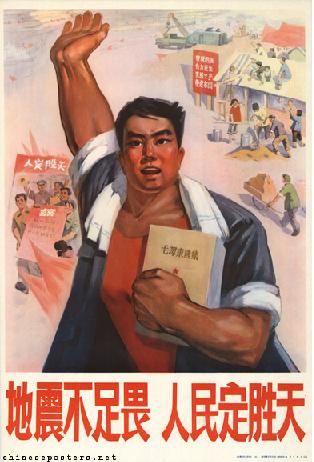
On July 28, 1976, the city of Tangshan was obliterated by the worst natural disaster in modern Chinese history, killing at least 250,000 people. In Beijing, the dying Mao, whose long illness had politically paralyzed the country, was wheeled into a shelter as buildings shook around him. But the quake was only one in a long series of calamities for China in the 1960s and 1970s. Politics and nature interacted to rock the foundations of the country, expose the gulf between the Chinese people and their leaders, and eventually end 30 years of Maoism.
This talk will discuss the events around the disaster and how the power struggle of the 1970s still echoes in Chinese politics today.
James Palmer is the author of Heaven Cracks, Earth Shakes: the Tangshan Earthquake and the Death of Mao’s China. His previous book, shortlisted for the John Llewellyn Rhys prize, was The Bloody White Baron. In 2003, he won the Spectator’s Shiva Naipaul prize for travel writing. He lives and works in Beijing.
Entrance: RMB 30.00 (RAS members) and RMB 80.00 (non-members). Those unable to make the donation but wishing to attend may contact us for exemption, prior to the RAS Weekender event. Membership applications and membership renewals will be available at this event.
RSVP: “Reply” to this email or to RAS Bookings at: bookings@royalasiaticsociety.org.cn
N.B. RAS members will have booking priority until 10 May 2012.
Sunday, March 13, 2012, 2pm
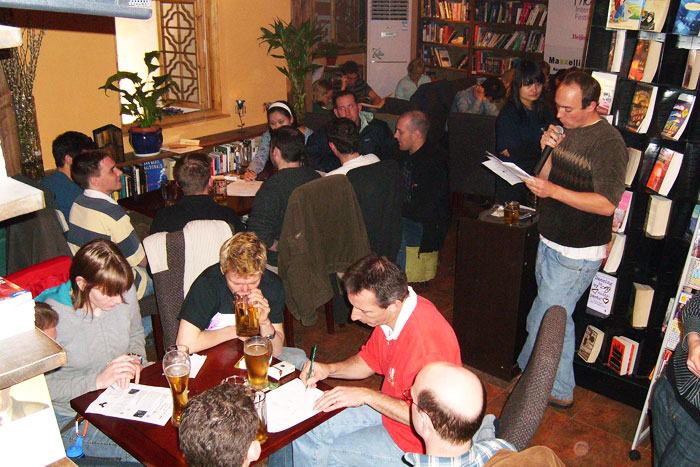
After a fine lunch at the Bookworm join the Royal Asiatic Society in Suzhou to discover how the Tangshan Earthquake of 1976 accelerated momentous change in modern Chinese politics and society. James Palmer, author of “Heaven Cracks, Earth Shakes: the Tangshan Earthquake and the Death of Mao’s China”, explains the impact the tragedy had on Chinese society and politics then and now.
When an earthquake of historic magnitude leveled the industrial city of Tangshan in the summer of 1976, killing more than a half-million people, China was already gripped by widespread social unrest. As Mao lay on his deathbed, the public mourned the death of popular premier Zhou Enlai.
Anger toward the powerful Communist Party officials in the Gang of Four, which had tried to suppress grieving for Zhou, was already potent; when the government failed to respond swiftly to the Tangshan disaster, popular resistance to the Cultural Revolution reached a boiling point.
“In Heaven Cracks, Earth Shakes”, acclaimed historian James Palmer tells the startling story of the most tumultuous year in modern Chinese history, when Mao perished, a city crumbled, and a new China was born.
Palmer’s previous book, shortlisted for the John Llewellyn Rhys prize, was “The Bloody White Baron”. In 2003, he won the Spectator’s Shiva Naipaul prize for travel writing. He lives and works in Beijing.
At the Suzhou Bookworm. Tell your taxi driver the intersection of Wu Que Qiao and Shi Quan Jie. Or, take the subway to the Lindun Lu stop in downtown Suzhou and take a 10 minute ride by pedicab or five-minute taxi ride to the Bookworm. It’s a fifteen minute walk due south from the Lindun Lu subway station: Gongyuan Lu (across from the old Sofitel Hotel – now Marco Polo), cross Shi Zi Jie to Wu Que Qiao. The Bookworm will be on your left at the intersection of Wu Que Qiao and Shi Quan Jie.
50 rmb for members; 90 rmb for non-members. Includes one glass of wine or beer. For more information or membership applications, contact Bill Dodson at bdodson88@gmail.com.
Leave a Reply