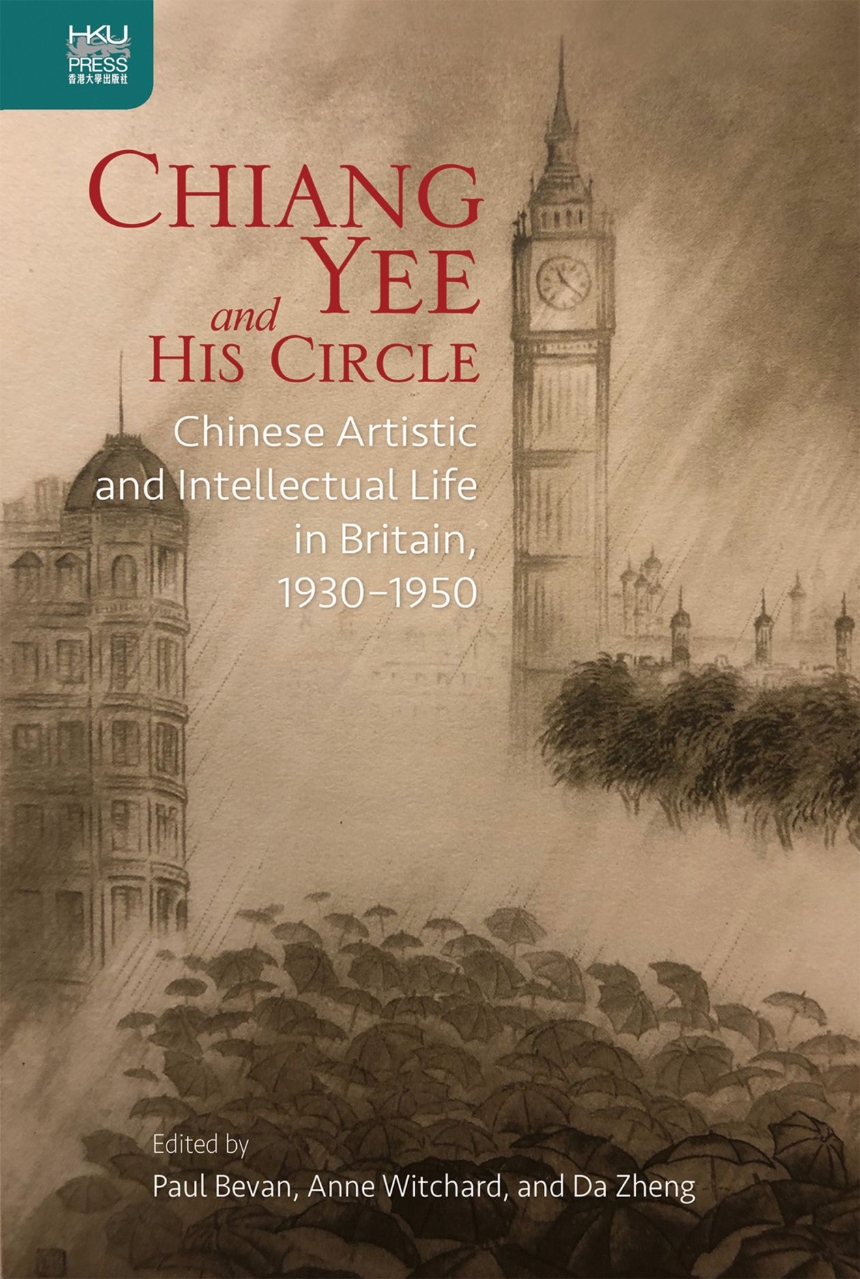
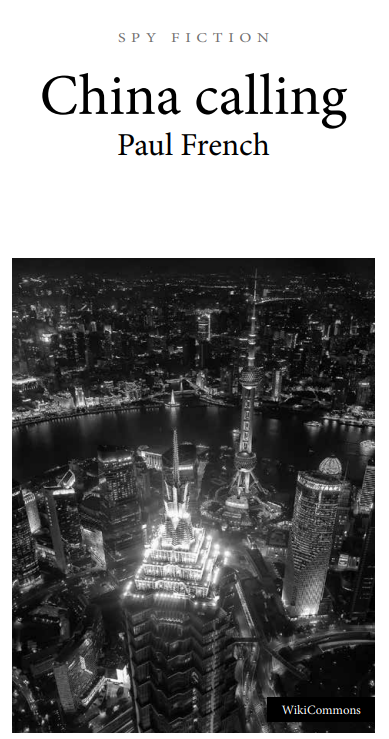
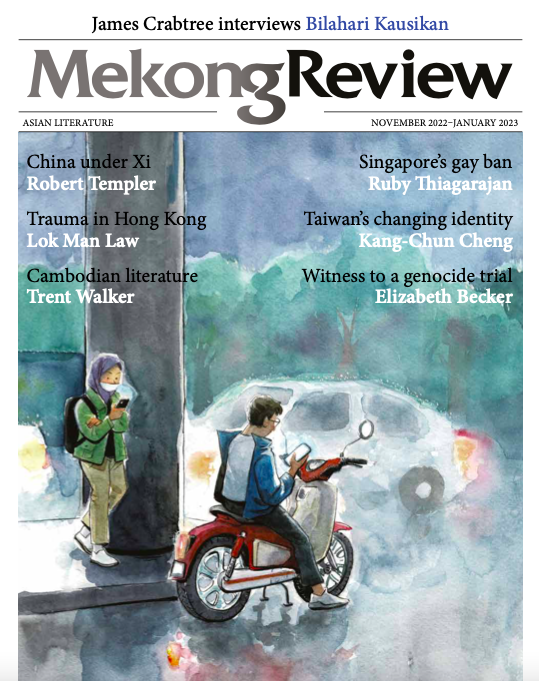
Chiang Yee and His Circle celebrates the life and work of Chiang Yee (1903–1977), a Chinese writer, poet, and painter who made his home in London, England during the 1930s and 1940s. It examines Chiang’s relationship with his circle of friends and colleagues in the English capital and assesses the work he produced during his sojourn there. This edited volume, with contributions from eleven distinguished scholars, tells a story of a Chinese intellectual community in London that up to now has been largely overlooked. It portrays a dynamic picture of the London-based émigré life during the years that led up to the war and during the conflict that was the catalyst for many of them moving on. In addition, the book broadens our understanding of cultural interactions between China and the West in Hampstead, one of the most vibrant artistic communities in London.
The new edition of the Mekong Review is out – all excellent content as ever – and I have a rather tongue-in-cheek piece on the history of China and the spy novel and the problems implicit in crafting a good espionage tale in the era of Xi Jinping. The Mekong Review is a subscription publiction (in paper and online) and well worth supporting – click here.
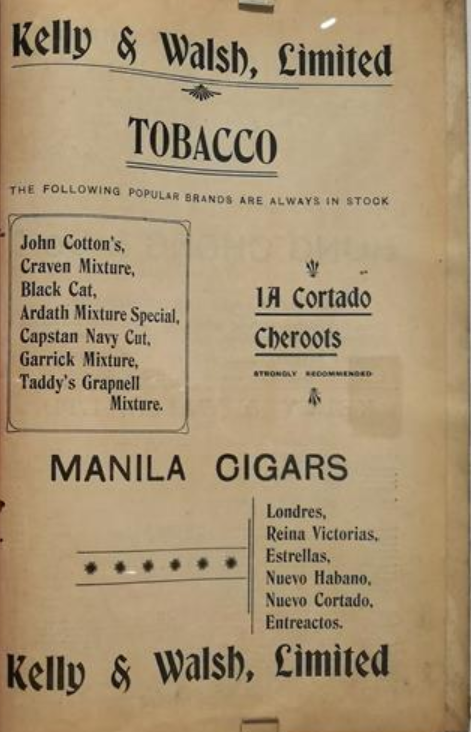
Seems the notion of keeping a bookshop afloat by selling a whole range of other products – greeting cards, wrapping paper, toys, sweets, stationery, whatever – is not that new. The venerable booksellers of Singapore, Shanghai and Hong Kong, Kelly & Walsh, were selling cigars alongside books. This advert from 1911.
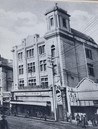
Last year I wrote a Long Read for theSouth China Morning Post weekend magazine on the old Shanghai Academy founded and run by the artist Liu Haisu. The Academy was housed in the same building for many decades on rue Bard (now Shunchang Lu), which is sadly slated for demolition at some point soon. You can read the article here.
Anyway, a few new pictures (to me at least) of the old rue Bard and the Shanghai Art Academy….
Rue Bard, French Concession, 1920s
Front entrance of the Shanghai Art Academy, Rue Bard, French Concession, 1920s
An exhibition of student work, first floor gallery, Shanghai Art Academy, Rue Bard, 1920s
A good long review of Joseph Sassoon’s The Global Merchants by Jordyn Haime for the Tablet magazine, with a few quotes from me too! Click here to read. And, by the way, my own review of the book for the South China Morning Post is here.
Tom Pellman’s novel The Soul of Beijing (from the good people at Camphor Press in Taiwan) out this December is a nuanced and intricate portrait of near contemporary Beijing…
New Year fireworks illuminate the Beijing night, but all twenty-year-old Panzi can think about is the mysterious former classmate who has just burst back into his life. Impulsive, spontaneous, and full of compassion, Xiao Song is like no one he has ever known – the first person who has made Panzi feel whole since his father’s suicide.
Across town and a thousand social strata away, the son of Beijing’s vice mayor and his gilded friends tear through the night in a cherry-red Ferrari, swerving off the road and into Xiao Song’s life. Panzi rushes to the scene just as a barely conscious Xiao Song is whisked away and evidence of the crash scrubbed out of existence.
The police stonewall Panzi. His mother tells him to let sleeping dogs lie. Desperate and unwilling to give up, he enlists a hard-nosed trainee journalist and a loser expat English teacher in his search. They comb Beijing – from homeless shelters to gaudy faux-French penthouses – inching closer to the truth about Xiao Song, the crash, and the soul of the city itself.
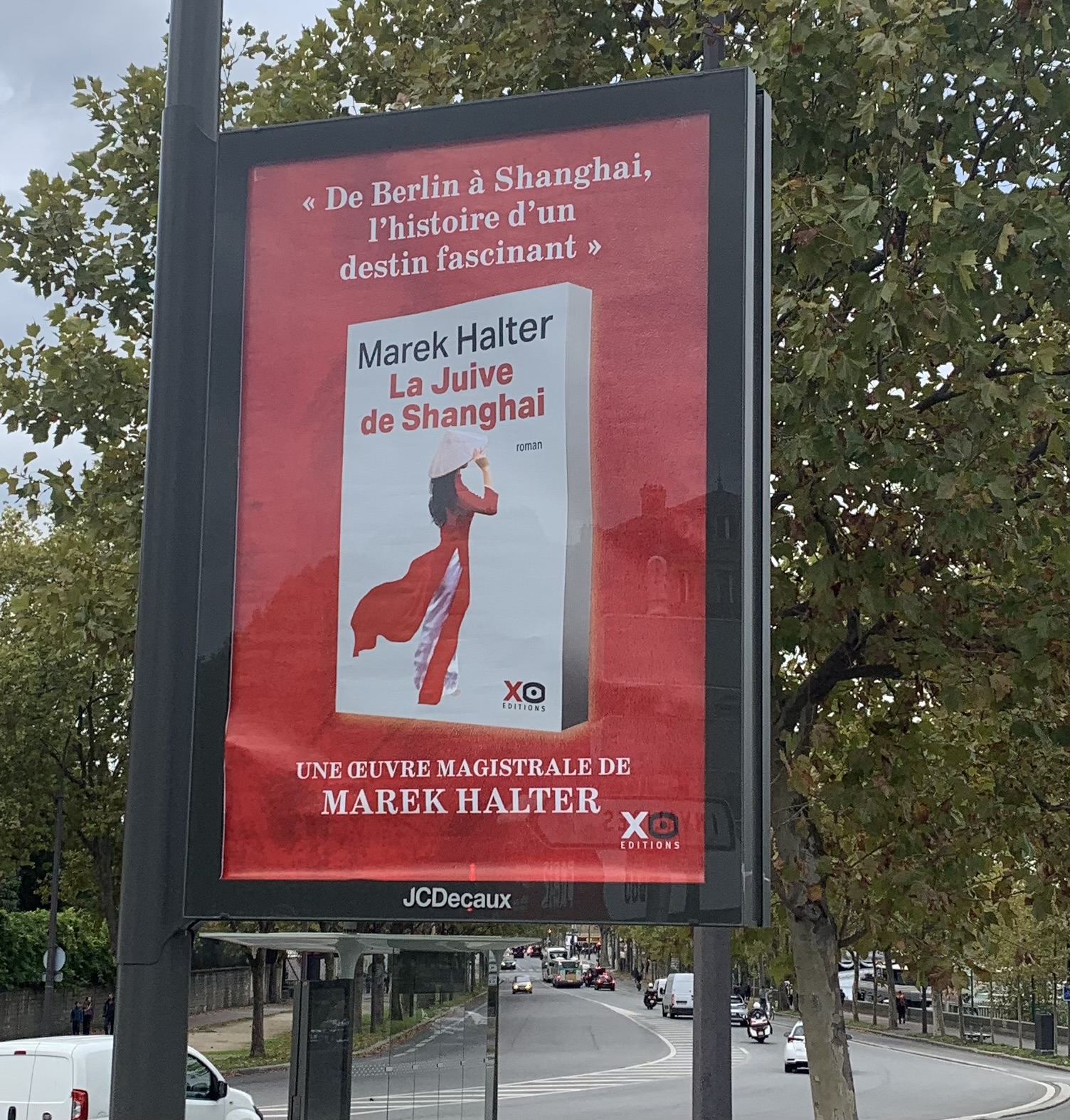
Fantastic marketing all along the Seine in Paris for Marek Halter’s new novel of the Shanghai Jewish ghetto –La Juive de Shanghai... A rough translation of the publisher’s book blurb below, though I can’t explain why the woman on the cover is dressed in a traditional Vietnamese Ao Dai garment, which would have been pretty rare to non-existent in 1940s Shanghai.
Berlin, 1937. Ruth, juive et talentueuse couturière de 22 ans, se lie d’amitié avec Clara, jeune résistante allemande. Pourchassées, elles décident de rejoindre une destination inattendue : Shanghai, où des milliers de juifs se sont réfugiés. Clara est la première à partir pour la Chine. Ruth, elle, doit traverser l’Europe entière… jusqu’en Sibérie. Grâce au consul japonais de Lituanie, elle obtient un visa pour Kōbe, le grand port du pays du soleil‑levant. Parvenue enfin à Shanghai – ville bouillonnante où se côtoie un monde interlope d’espions, de trafiquants d’opium et de résistants –, elle y retrouve miraculeusement Clara, devenue agente des communistes. La suite ? C’est Bo Xiao-Nao, la fille de Ruth, qui la raconte. orpheline, elle tombe sur un carnet tenu par sa mère. En le feuilletant, elle découvre, bouleversée, le destin fascinant de celle qu’on appellera à jamais la Juive de Shanghai…
The Frida Kahlo exhibiton at the Palais Galliera in Paris reveals this Chinese skirt and shawl that was in her wardrobe. Apparently acquired on her first visit to San Francisco and the city’s Chinatown in 1930-1931. Kahlo wrote back to her father in Mexico City: ‘Imagine, there are 10,000 Chinese here, in their shops they sell beautiful things, clothing, and handmade fabrics of very fine silk.’