John D Wong’s Hong Kong Takes Flight (Harvard University Asia Center) is a great background on the history of aviation – China Clippers, Kai Tak, the 1930s, 40s and 50s – as well as a discussion about the dreary state of aviation and travel to and from Hong Kong today. I interviewed John for the China Britain Business Council magazine, Focus. Click here to read my Q&A with him.
Yesterday I posted about the late nineteenth/early twentieth centry Shanghai silversmith’s Luen Wo. Here’s some more Luen Wo items worth posting I think…
A 19th Century Chinese Qing Dynasty silver and zitan wood decorative desk stand bearing marks for Luen Wo of Shanghai. The stand having a central two stepped pen stand in the form branches adorned with floral accents flanked by inkwells to each side having embossed character and floral panel sides. Pen rest to the front with pierced floral lattice worked borders with all being raised on bun feet supports. Impressed Luenwo marks stamp to base with wax seal and collection paper label. Measures 15cm x 22cm x 11cm. Total weight 955 grams.
A pair of Chinese silver Fish Servers, marked for Luen Wo, Shanghai, both with hollow cast handles, depicting a Chinese landscape with buildings and figures. The blade engraved with fish, and the fork engraved with a lobster, 11in L (28.5 cm)
A CHINESE SILVER BOWL ON STAND, decorated with a floral design, marks to base, approx weight 750g, Dia 21 cm
CHINESE ROSE BOWL. of circular form, with a pierced scroll border, embossed on the body with a dragon and resting on a wavy foot,
silver dragon napkin ring
silver pepperettes decorated in relief with continuous pagoda terrace scenes and chrysantheums
Swing Handled Pedestal Basket
silver teapot featuring figures in a garden scene, wisteria and bamboo
Referring back to previous posts on Shanghai silvesmithing – here on Tuck Chang and here on Zeewo (Zee Wo), I have also mentioned Luen Wo, also a Shanghai based decorative silversmith producing for the local tourist and foreign market. Below a lovely early 20th century silver page turner with a relief handle with large chrysanthemum flowers and leaves, while the blade has an engraved dragon to one side and Chinese characters to the other (the whole thing being 25 cm long, 109 grams)…
Luen Wo was one of the bigger silversmiths in the city and also traded in jewellery, diamonds and embroideries. The major designer for the company was Ning Zhao Ji whose work is usually accompanied by the mark “LW”. Luen Wo started earlier than many other Shanghai silversmiths (and like many others probably moved to the city from Guangzhou), around 1880, and also actively targeted the South East Asian Chinese disapora market with items decartaed to particularly appeal to the Peranakan community of the Malay States and Singapore at the time.
I am particularly taken with this silver namecard case (below) embossed with scenes of figures in landscapes with bamboo palm building and similar deisgn on the reverse.
(there are two other posts on Shanghai silversmiths that may interest readers – on Tuck Chang here and on Zeewo here)
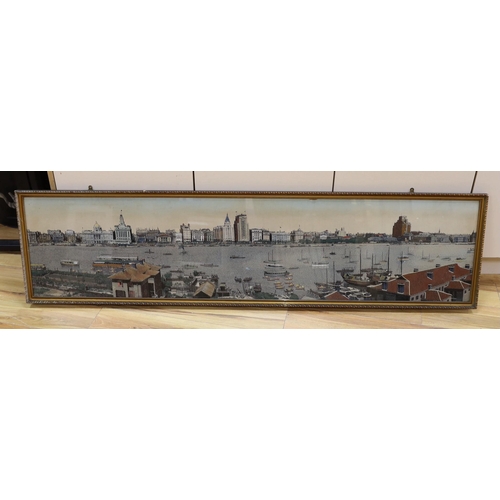
I know very little about this framed Chinese-made machine-weaved panorama of the Shanghai Bund. AS the Bank of China building is there (#23 Bund), the most recent construction on the Bund shown I think then this was made some time after the building’s completion in 1937. And that’s all I know…
(some additional information received later:
From George Godula in Shanghai – ‘These were mass-produced in the 30s as tourist souvenirs.’
From Helen Wang in London: For more, search for 老织锦画 丝织风景画 都锦生丝织厂 (Tu Chin Sheng / Du Jin’sheng Silk Factory) 启文丝织厂 (Qi Wen Silk Factory)
A new issue with a great new cover too of Lao She’s London classic, Mr Ma and Son…Translated by William Dolby, with an introduction by Julia Lovell.
Mr Ma and his son Ma Wei run an antiques shop nestled in a quiet street by St Paul’s Cathedral in London, where, far from their native Peking, they struggle to navigate the bustling pavements and myriad social conventions of 1920s English society. The Mas must negotiate love, money, misunderstandings and the London smog, aided and hindered by a cast of brilliantly drawn characters: their well-meaning landlady Mrs Weddeburn, her carefree daughter Mary, old China hand Reverend Ely and his formidable wife.
Both a bitingly funny satire of Sino-British relations, and an emotionally powerful story of the experience of Chinese immigrants to the United Kingdom at the turn of the twentieth century, Mr Ma and Son is a compelling, witty novel from one of China’s most celebrated writers.
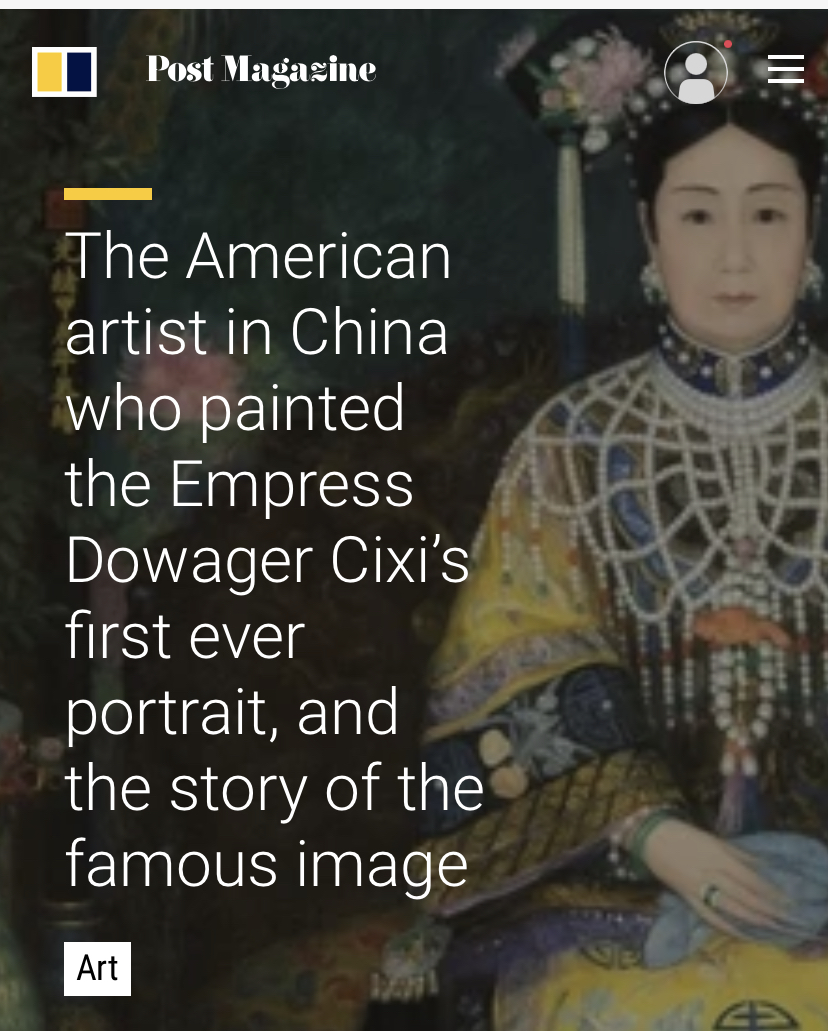
A piece by me in this weekend’s South China Morning Post weekend magazine on the relationship between the Empress Dowager Cixi and the American artist Katharine Carl who painted her portrait for the 1904 St Louis EXPO – the first formal portrait of Cixi to be painted. Click here
This exhibition presents works of art from the Museum’s collection that were produced between 1949 and 1999 in mainland China. Chairman Mao declared the founding of the People’s Republic of China in 1949 and until his death in 1976, art was subject to strict political controls.
Oil painting replaced the centuries-old tradition of ink landscape painting, and the Socialist Realist style adopted from the Soviet Union remained influential until the late 1970s. Pictorial woodblock printing developed from a folk craft to an increasingly creative medium used for both propaganda purposes and more subtle landscapes.
During the Cultural Revolution (1966–76) political images and messages were also produced in the historic media of woven or embroidered silks and papercuts.
From 1978, the Reform Era ushered in new possibilities as China re-engaged with the world, and artists encountered ideas and cultural practices from elsewhere.
Brush and ink, however, had never ceased to be used, and the scrolls and albums exhibited here include works by some of modern China’s most distinguished painters.
I’ve been very fortunate to receive a proof copy of Caroline Moorehead’s new biography of Edda Mussolini (out October 27 2022). It’s excellent, as expected. My interest is of course largely in the 30 months or so Edda spent in China in the early 1930s, largely in Shanghai where her husband Count Galeazzo Ciano was Consul General. Ciano (later Mussoilini, his father-in-law’s Foreign Minister and then, after Musolini’s death, arrested and executed by firing squad) had of course, earlier, served as an attache at the Italian Legation in Peking. The book has a lot of interesting info on Edda’s time in Shanghai, her husband’s constant philandering, her affair with Zhang Xueliang (the Young Marshall) and their lives in Shanghai and Peking.
Obviously China stuck with Ciano in many ways….they acquired a lot of furniture and rugs for insdtance that followed them back to Italy. Then, in October 1936 Ciano visited Hitler at Berchtesgarden as Italian Foreign Minister, ostensibly to discuss Italian-German relations in relation to the Spanish Civil War. According to Moorehouse Hitler later told an aide that he had loathed the smell of Ciano’s Chinese aftershave lotion….
Now my question – a dig at Ciano’s China sojourns? Or did Ciano stay loyal to a Chinese brand of aftershave? Anyone know?