Cafe Parisien was one of those places that seemed to be always there. Down on the Avenue Eduard VII (the French side of Avenue Edward VII – not Yan’an Lu down towards the Bund) it was arguably the first place to ever book a jazz band in Shanghai around 1919 – the Cafe Parisien Orchestra with piano player Harry Kerrey (who remained at the venue till 1923). It’s ballroom was popular for events and dinner-dances – the Rotary Club would rent out the whole venue annually.
Katie Stallard’s Dancing on Bones looks like a fascinating study…
Dancing on Bones is the story of how the leaders of China, Russia, and North Korea manipulate the past to serve the present and secure the future of authoritarian rule.
History didn’t end. Democracy didn’t triumph. America’s leading role in the world is no longer assured. Instead, authoritarian rule is on the rise, and the global order established after 1945 is under attack. This is the phenomenon Katie Stallard tackles in Dancing on Bones, probing the version of history that leaders in China, Russia, and North Korea teach their citizens.
These three states consistently top the list of threats to the global order and US national security. All are governed by autocratic regimes. All have nuclear weapons and believe that the era of American hegemony is fading. All three share a sense of historical grievance, rooted in the wars of the last century – specifically World War II and the Korean War – that their leaders exploit to shore up popular support at home and fuel increasingly aggressive foreign policy. Decades after the real guns fell silent, these wars rage on in China, Russia, and North Korea, reimagined in popular media, public memorials, and patriotic education campaigns. This is not history as it was, but as the current rulers need it to be. Since coming to power in China, Xi Jinping has almost doubled the length of the war with Japan, Vladimir Putin has brought back bombastic military parades through Red Square, and Kim Jong Un has invested vast sums in rebuilding war museums in his impoverished state, while historians who try to challenge the official line are silenced and jailed. But this didn’t start with the current leaders and it won’t end with them.
Drawing on first-hand, on-the-ground reporting, Dancing on Bones is the story of how the leaders of China, Russia, and North Korea manipulate the past to serve the present and secure the future of authoritarian rule. If we want to understand where these three nuclear powers are heading, we must understand the stories they are telling their citizens about the past.
China-Britain Business Council magazine Focus is celebrating 50 years since the start of ambassadorial relations between China & the UK – I’ve dug up a few old stories – here’s how package holidays to China started & some memories from early PRC tourist, author Penelope Fitzgerald – click here to read…
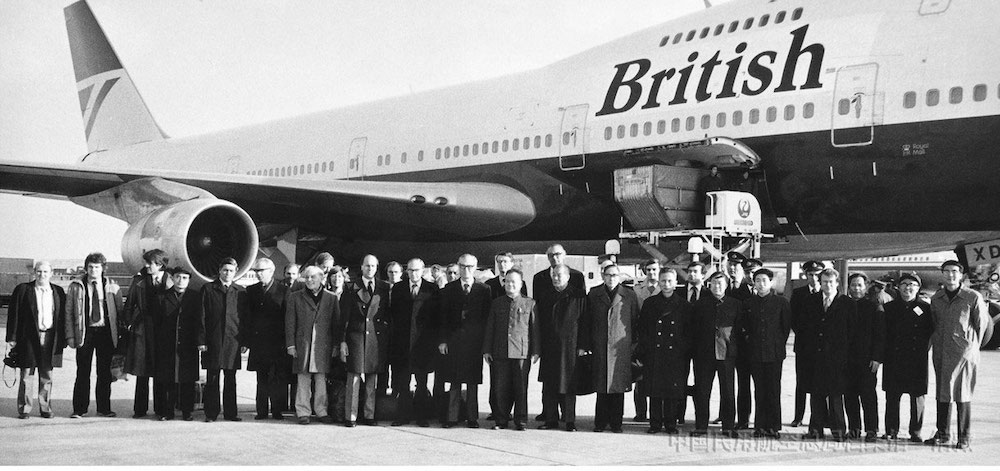
The China-Britain Business Council online magazine Focusis celebrating 50 years since the establishment of ambassadorial relations between China & the UK – I’ve dug up a few old stories – here’s the story of British Airways first flight to Beijing in 1980 – click here to read
Arrival at Beijing Airport, 1980
Inaugural service advert – nicely worded ‘permitted’ and still somewhere between Peking and Beijing as the official name for the Chinese capital’s airport.
This exhibition’s photos show Hong Kong during consecutive periods, as it was seen around the middle of the last century. The images span some thirty years of great change: from the postwar recovery in 1946 – 1947, through the resilience of the 1950s, to the resurgence of the 1960s – 1970s. The photos were taken by three photographers. In the order of their Hong Kong work they were: Hedda Morrison, Lee Fook Chee and Brian Brake. Each had markedly different life backgrounds and photographic objectives.
Hedda Morrison’s Hong Kong photos, like her prior work in China and later images of Southeast Asia, reflected her high regard for ordinary people. Thus, in 1955 some of her photos were published in the classic, life celebrating New York photobook The Family of Man.
Brian Brake held similar values. But whereas Morrison photographed mostly separate images, Brake created highly crafted, pre-envisioned photo stories. His photo-led stories were widely published in many contemporary photo magazines, notably LIFE International and National Geographic.
Lee Fook Chee, as a person and photographer, was far different to Morrison and Brake. Lacking their comfortable origins, and also their photographic training, he harnessed his personal resolve and the ability to take photos for selling to tourists who visited Hong Kong.
Yet all three, in their own way, recorded Hong Kong during its modern, crucible decades – thus passing on to our present times the photographic heritage seen in this Asia Society Hong Kong Center exhibition.
Recovery, Resilience, Resurgence is curated by Edward Stokes who founded The Photographic Heritage Foundation.
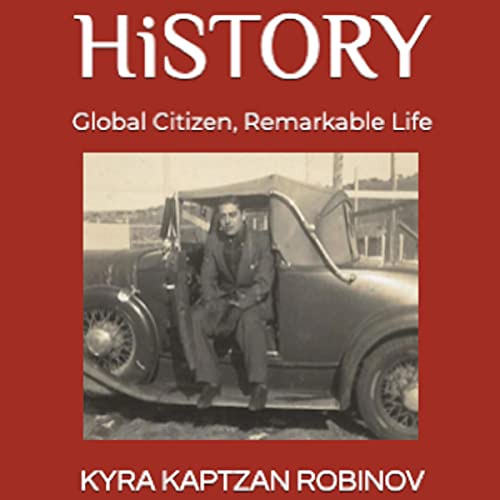
In 1920, at the age of eight, Moisye Kaptzan spent months hiding in squalid pigsties and opium dens after Bolsheviks murdered his father and hunted the surviving family during the Russian Revolution’s aftermath. Three years later, when the Great Yokohama Earthquake flattened that Japanese city, eleven-year-old Moisye was buried under rubble as his house crashed down upon him. Trapped in Shanghai as a young man during WWII, he outwitted brutal Japanese occupiers while assisting Jewish refugees running from Hitler. Undaunted by disasters, Moisye Kaptzan relied on his keen understanding of human nature and fluency in multiple languages to thrive throughout these tumultuous times. A tale of grit, perseverance and survival…this is HiSTORY.
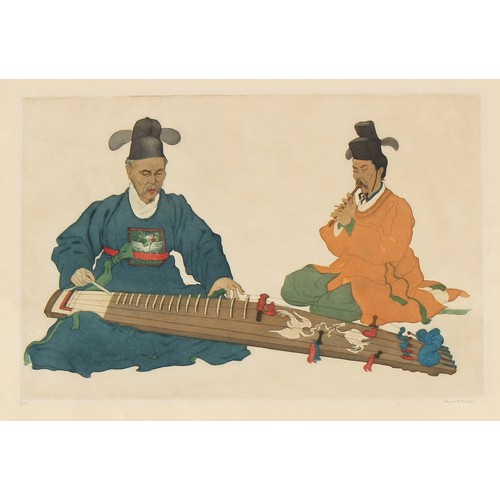
I’ve mentioned the Scottish artist Elizabeth Keith (1887-1956) a couple of times in passing when talking about the American artist Bertha Lum (here in Destination Peking) and Katharine Jowett (here in theSouth China Morning Post), both Peking-based women artists in the inter-war period. Keith was a print-maker and watercolorist whose works were significantly influenced by her travels to Japan, China, Korea and the Philippines. I mention her because her work, like Lum’s, Jowett’s and other female foreign artists who worked in Asia, their work does not come up for sale often. But I did note this forthcoming sale of two Keith works – a woodblock titled Court Musicians, Korea (1938) and another woodblock, with bamboo frame, Portrait of a Lady in Jolo, Sulu (Philippines) (1924).
The woodblocks are up for online auction:
Sale Description: Chinese, Japanese, Indian & Islamic Ceramics & Works of Art; Persian & European Carpets, Rugs & Textiles; and Antique Furniture & Objects Sale Date: 14/05/2022