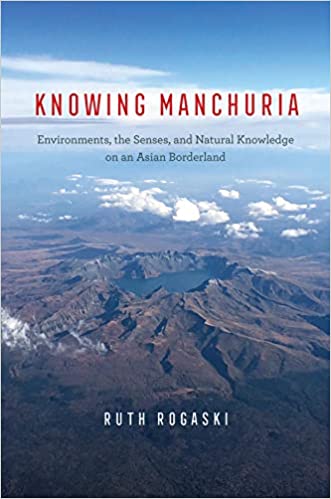
Ruth Rogaski’s Knowing Manchuria is a fascinating new study of the region mixed with some very strange tales…
According to Chinese government reports, hundreds of plague-infected rodents fell from the skies over Gannan county on an April night in 1952. Chinese scientists determined that these flying voles were not native to the region, but were vectors of germ warfare, dispatched over the border by agents of imperialism. Mastery of biology had become a way to claim political mastery over a remote frontier. Beginning with this bizarre incident from the Korean War, Knowing Manchuria places the creation of knowledge about nature at the center of our understanding of a little-known but historically important Asian landscape.
At the intersection of China, Russia, Korea, and Mongolia, Manchuria is known as a site of war and environmental extremes, where projects of political control intersected with projects designed to make sense of Manchuria’s multiple environments. Covering more than 500,000 square miles, Manchuria’s landscapes include temperate rainforests, deserts, prairies, cultivated plains, wetlands, and Siberian taiga. With analysis spanning the seventeenth century to the present day, Ruth Rogaski reveals how an array of historical actors―Chinese poets, Manchu shamans, Russian botanists, Korean mathematicians, Japanese bacteriologists, American paleontologists, and indigenous hunters―made sense of the Manchurian frontier. She uncovers how natural knowledge, and thus the nature of Manchuria itself, changed over time, from a sacred “land where the dragon arose” to a global epicenter of contagious disease; from a tragic “wasteland” to an abundant granary that nurtured the hope of a nation.
Had a great conversation with Adam Brookes about his new book Fragile Cargo, arranged by the Royal Asiatic Society Beijing, who have now loaded it up on Youtube if anyone’s interested…
China in A Time of Turbulence: through the Lens of Popular Culture, 29 October 2022 at 13:00.
The Chinese society underwent a series of turbulent events in the late 19th Century and early 20th Century. There were continuous internal rebellions and external conflicts, and the country witnessed the collapse of its last imperial dynasty and established a new republic which brought profound social changes. Little has been studied how this part of history was reflected in popular culture.
At this event we are introducing two books, observing China at the time from two unique perspectives.
Cartooning China: Punch, Power & Politics in the Victorian Era by Amy Matthewson –
This book explores the series of cartoons of China and the Chinese that were published in the popular British satirical magazine Punch over a 60-year period from 1841 to 1901.
Filled with political metaphors and racial stereotypes, these illustrations served as a powerful tool in both reflecting and shaping notions and attitudes towards China at a tumultuous time in Sino-British history. A close reading of both the visual and textual satires in Punch reveals how a section of British society visualised and negotiated with China as well as Britain’s position in the global community. By contextualising Punch’s cartoons within the broader frameworks of British socio-cultural and political discourse, the author engages in a critical enquiry of popular culture and its engagements with race, geopolitical propaganda, and public consciousness.
The Adventures of Ma Suzhen: ‘An Heroic Woman Takes Revenge in Shanghai’ by Paul Bevan – This comic novel was written during a highpoint in the popularity of xia “knight-errant” fiction. It is an action-packed tale of a young woman who takes revenge for her brother, Ma Yongzhen, a gangster and performing strongman, who has been murdered by a rival gang in China’s most cosmopolitan city, Shanghai. After publication of the book in 1923, the character of Ma Suzhen appeared on stage, and subsequently in a film made by the Mingxing Film Company. The book version translated here, displays a delightful combination of the xia and popular“Mandarin Ducks and Butterflies” genres, with additional elements of Gong’an “court case” fiction. The translation is followed by an essay that explores the background to the legend of Ma Suzhen – a fictional figure, whose exhilarating escapades reflect some of the new possibilities and freedoms available to women following the founding of the Chinese Republic.
If you’re in Shanghai on October 31 there’s a get together of ol Shanghai folks for halloween – and i’ll be there via zoom to talk about murder, mayhem & some of the ghosts of the old city
Peter Harmsen’s Darkest Christmas is out soon from Casemate Publishers….
“One single, crucial 24 hours—Christmas Day 1942. A world hanging in the balance. Peter Harmsen masterfully reveals the raging war across the globe through the hopes and fears of its inhabitants whether soldier, civilian or prisoner. A broad canvas, yet one that repeatedly becomes incredibly personal and often heart-wrenching. Among the vast library of books on World War II Darkest Christmas stands out as uniquely poignant and original.”
A lovely copy of Shanghai of To-day (yes, they hyphenated it), published in 1927 as a souveneir of 38 plates of photographs of the International Settlement. Published by the great Shanghai, Singapore and Hong Kong publishing house Kelly & Walsh.
It also included an introduction by OM Green, then the editor of the North-China Daily News. Green was perhaps the paper’s most strident and opinionated (some would say hardline) leader in its history andwas to serve as editor through to 1930 and remain active in writing about China until after the Second World War. Green was a forceful apologist for the British position in Shanghai and continued his advocacy of British superiority long after he left the paper and the city.
The Marvellous Book, written and self-published by Star Talbot, was a hundred Studies of different types of Chinese Porcelains. It was also a marvellous item in itself, at least at its first printing in Shanghai in 1930 where each edition came in gilt decorated silk and the plates had tissue guards. The first edition was limited to a thousand copies. Talbot, an independently wealthy collector of Chinese porcelain from about 1900, included notes on each of the photographs in English, Chinese, Italian, Japanese, Spanish, French and German. The book gives the address of 249 Nanking Road, but whether this was Talbot’s home, office, showroom (or combination of all three) I do not know. The book is pretty rare now.
the author-curator himself posing with two porcelain lions
The China Project kindly suggested i might like to abridge a chapter from my collection Destination Peking (Blacksmith Books) for their readers. I thought perhaps the chapter on Lev Karakhan, the first Soviet Ambassador to China might be interesting and offer some background on the ever rocky Russia-China relationship…You can read it here