My thanks to Hugues Martin, prolific and long time blogger at Shanghailander on all things old Shanghai and especially Francophile Shanghai. A post of his from 2006 (! – sorry, must have missed that) alerted me to Guy Brossellet’s Les Francais de Shanghai book (fortunately still available, as here on Amazon). Here also is Hugues’s post on the title….
Hermann W. Breuer (1884 – 1973) ging 1906, mit 22 Jahren, für das Bremer Übersee-Haus Melchers & Co. als Kaufmann nach Shanghai und empfand sich bald als »Sohn des Reiches der Mitte«. Seine Geschichte steht exemplarisch für das schwierige schöne Leben der deutschen Kaufleute in der internationalen Handelsmetropole Shanghai während der ersten Hälfte des 20. Jahrhunderts. Sie beginnt in einer Zeit kolonialer Ansprüche und endet mit dem Neubeginn des deutsch-chinesischen Austauschs, den Breuer als Vorsitzender des Ostasiatischen Vereins Bremen mit prägte. Unterhaltsam und mit großer Kenntnis wird erzählt vom Reisen und Alltagsleben in China, von Fahrten mit der Transsibirischen Eisenbahn und auf Ozeandampfern, von neuen Kommunikationsmitteln, von Briten, Amerikanern und Chinesen, die Breuer im Job, in Clubs, beim Sport begegneten. Mut und Nächstenliebe bewies Breuer angesichts der Kriege und Umbrüche in China, des deutschen Nationalsozialismus in Shanghai, der Probleme russischer und jüdischer Flüchtlinge. Inspiriert von Briefen und Fotografien im Familienbestand durchforschte die Autorin Archive in Deutschland und China, sprach mit letzten Zeitzeugen. Sie lässt die Leser teilhaben am detektivischen Zusammenfügen von Puzzlesteinchen zur Lebensgeschichte eines sympathischen Menschen. Erzählt mit Empathie, Humor und Sinn für die Details des Alltags, ist diese Biografie eine echte Entdeckung.
Hermann Breuer who worked for many years in Shanghai for Melchers & Co., Christine Maiwald, his new biographer (see tomorrow’s post here) very kindly sent me some images to post associated with Hermann’s story….
Hermann, when first in Shanghai, at home in 1907
Shanghai Racecourse and Bubbling Well Road postcard, 1930
On International Podcast Day 2021 I offer you a BBC Radio 3 & BBC Sounds Peking Noir & a RTHK3 Strangers on the Praia (Finalist NYC Radio Awards BTW)for your consideration…
Gloria Swanson at home in 1960 by Jack Mitchell, who photographed her many times throughout her career. Don’t know the backstory to these shots but clearly Gloria’s choice of a porcelain Chinese teacup, a black silk with gold moons blouse and an apparently blackwood Chinese style frame in the background indicate a tastes for things Chinese…
Dora Batty’s illutration for London Underground in 1926 encouraging Londonders to use the tube to get out into the country has a nice chinoiserie touch in the Qing-inspired blouse. Batty (1891-1966) was a British designer, working in illustration, poster design, pottery and textiles. I know of no connection between her and China so assume she was simply reflecting 1920s chinoiserie-inspired fashion trends.
Sorry to hear of the death of Jonathan Mirsky earlier this month. He was always a fascinating and combative interlocutor on matters China and, for me, a witness to a China i was just too young to experience. My own personal memory of him is after he kindly reviewed a book of mine favourably for The Literary Review we had lunch several times at the restaurant in John Lewis on Oxford Street overlooking Cavendish Square. I assume he was a regular as he knew all the staff by the name and it seemed everyone stopped by his table to say hi.
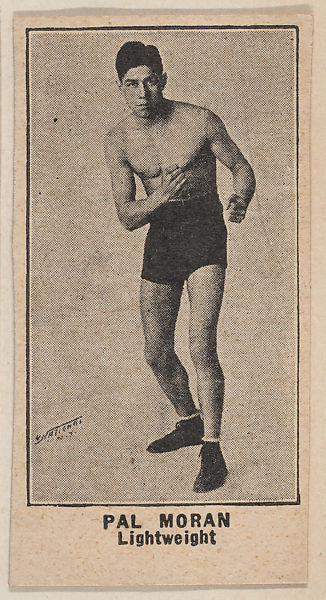
In the 1920s Pal Moran was a noted lightweight boxer in the USA. There are endless accounts of his fights against most of the great American lightweights of the decade. Fighting out of New Orleans, 5’6″ described as a ‘strong, rugged boy’ Moran, was born Francis Paul Miorana and known by the 1930s as Paul Morgan. He was a pro between 1914 to 1929 – he won 48 (with 13 KOs), lost 40 (KOed 4 times) and drew 14 – not a bad record. he fought all over the USA.
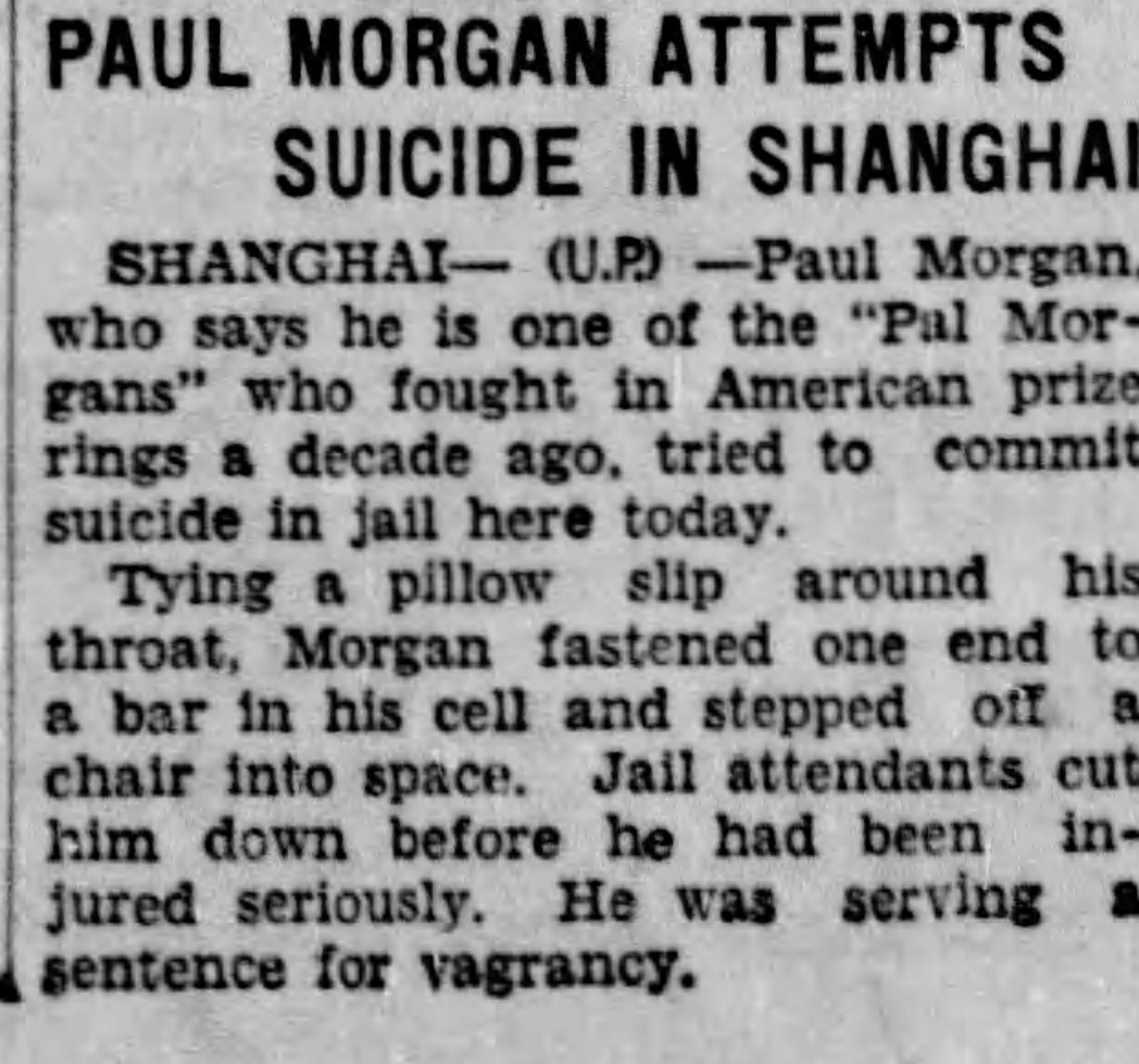
And then, after retiring from the ring in 1929 he somehow ended up in Shanghai. How he got from New Orleans to Shanghai and what he was doing in the city I do not know. But in February 1935 he was given a 30-day sentence for vagrancy to be served at the Amoy Road jail. There, on about March 13th 1935 he was found having tried to hang himself with a knotted pillow slip in his cell tied around his neck and around a window bar. He then kicked away chair beneath him. However, thre guards got to him before he expired.
I know nothing of what happened to Pal Moran after this incident. One boxing site on the internet records that he died in 1977 at 79 – I hope so, but i don’t know for sure why he was in Shanghai, how he ended up vagrant and what happened to him in the years after his suicide attempt.
But a slice of old Shanghai history all the same… I’m posting anyway to see if any more comes to light….