How things comes around….ten years ago I posted on the floor plan for the 1910 Nanyang Industrial Exposition – here. 2010 was the year of the Shanghai Expo, which got some excited but was a heritage and preservation disaster for the city as cadres took advantage of the hype and central government support to bulldoze vast swathes of the city, especially Yangpu (including much of the city’s neglected industrial architectural heritage), Tilanqiao (including a lot of the former Jewish ghetto) and Hongkou, (particularly key unique parts of the former Japanese Concession).
Anyway, a big thanks to a teacher from Nanjing Tech University who read the post and sent me some pictures of some remaining animal head sculptures that remain on the grounds of the Uni and probably (though someone out there may know better) orignally came from the USA.
Apparently they were marked as a Chinese mythical creatures. There also remains a cement parasol- covered rest/seating area (below too)…
Ornate silversmithing is a craft that once proliferated in Shanghai but has all but disappeared a long time past now. Perhaps the best known local silversmith of the late nineteenth/early twentieth century was Tuck Chang, sometimes referred to as the ‘Wang Hing of Shanghai’ (Wang Hing was a notable silversmith and antiques dealer in Canton/Guangzhou earlier on) and often marked “TC”. The firm was in operation from roughly 1890 to 1915. Though other silversmiths existed at the same time, such as Luen Wo, Yat Sen, Sing Fat (mostly run by Cantonese craftsman and merchants who had moved to Shanghai after learning the trade in Canton) and others, TC was the best known among the foreign community.
Tuck Chang employed a team of silversmiths catering mostly to the Shanghailander and tourist trade with silver trophies, tea sets and high quality gift items (such as the silver spoon and box pictured below). The company was Chinese but being based in Shanghai was very aware of European trends and tastes incorporating elements of the Beaux Arts, Arts and Crafts and Art Nouveau styles, though often combining these with Chinese traditional motifs – classic Shanghai hai-pai brought to silversmithing.
Some examples of Tuck Chang’s work below (the internet will yield many dozens of examples)…
(there are two other posts on Shanghai silversmiths that may interest readers – on Zeewo here and on Luen Wo here)
Silver spoon
Silver centrepiece stem bowl – c.1900
silver beaker – c.1900
silver bowl
silver ladies dressing set
set of six cast silver dragon tea spoons, 11cm, 78gm
A Chinese silver photograph frame, maker Tuck Chang & Co, Shanghai, the frame decorated with a dragon, 10 x 6.5cm, together with a silver model of a street vendor 5cm high
white metal circular vanity box decorated with repousse dragon motifs,
Chinese silver comport, stamped ‘Tuck Chang’, Shanghai, 1870-1920. Decorated with a large dragon in relief
Chinese silver and hardwood tea tray, by Tuck Chang & Co Ltd, Shanghai. the simulated bamboo silver handles stamped TC
Chinese toilet box embossed with chrysanthemums, foliage & an insect – Tuck Chang – c.1900
For over 50 years from the late 1890s there was a Kowloon Hotel on Hankow Road in Hong Kong. More surprising to find a Kowloon Hotel on Harold Road, Cliftonville, Margate in Kent in the 1920s and 1930s. Managed by a CF Grandy, who I can only assume was returned from Hong Kong and thought he’d name his new establishment after a Hong Kong icon of the time…though I can find no trace of a CF Grandy in Hong Kong at any point. I can’t find a house number for the property on Harold Road but any Margate people care to wander along the street and speculate i’d love to locate it more precisely?
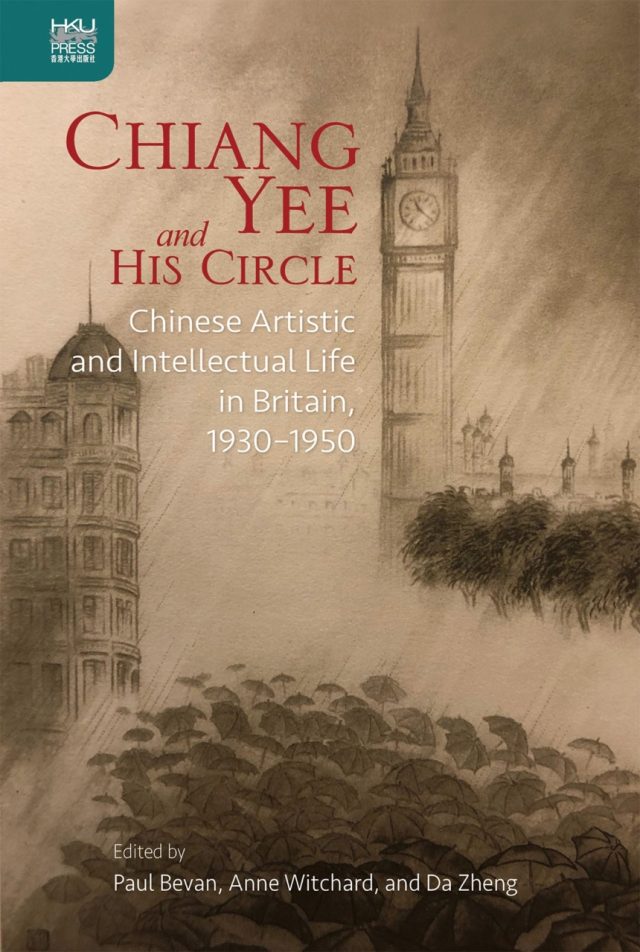
An interview with Paul Bevan, Anne Witchard, and Da Zheng on Chiang Yee and His Circle: Chinese Artistic and Intellectual Life in Britain, 1930–1950. Hong Kong: Hong Kong University Press, 2022. Click here.
An oil on canvas of Chinese junks at Shanghai from 1913 by Arnesen…
Vilhelm Karl Ferdinand Arnesen was born in Flensburg in 1865. The son of Captain Georg Arnesen, he was introduced to marine subject matter at an early age. His father built model ships and introduced young Vilhelm to the rigging and construction of ships. He received his formal training at the Danish Academy in Copenhagen from 1882-1888. He exhibited for the first time in 1885 with the Decembristerne, and then the Charlottenborg’s spring and autumn exhibitions. While attending the Academy he was given the honour of accompanying the Danish Royal family on their travels abroad. Arnesen himself made numerous sea voyages over his life time, traveling extensively throughout Europe, the United Kingdom, and East Asia. He quickly became a renowned marine painter and received many medals from the Danish Royal Academy. He also exhibited at the World Expo in Chicago in 1893. Vilhelm Arnesen’s paintings are exhibited today in museums in Copenhagen and Aalborg, Denmark. He died in 1948 in Copenhagen.
Here’s one more Arnesen…Junks at Sea (date unknown)….
Excellent news that a grant from will mean that Isamu Noguchi’s live-work space, located across the street from his namesake museum in New York City, will undergo much-needed renovations to become accessible for public tours. More details here from The Art Newspaper.
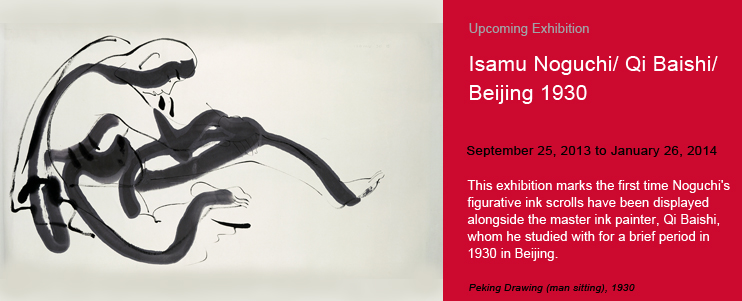
And a good chance for me to note that back in 2013 i spent some time at the museum as part of their then exhibition “Beijing 1930” that looked at the six months or so Noguchi spent in Beijing in 1930 and his collaborations with the Chinese artist/calligrapher Qi Baishi. I spoke at the museum on the milieu of Peking in 1930 and the international circle of acquaintances Noguchi made while in the city. That essay by the way is included as part of my book Destination Peking (Blacksmith Books)…
And, while the Beijing 1930 exhibition is finished, the catalogue remains (here) and is a good read with a lot of the art from Noguchi’s Peking sojourn.
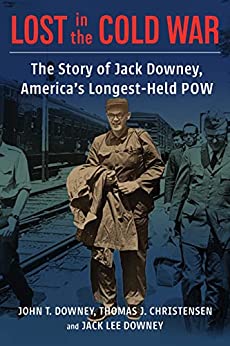
Lost in the Cold War is the memoir of CIA officer held in Manchuria for 23 years after being captured during the Korean War…
In 1952, John T. “Jack” Downey, a twenty-three-year-old CIA officer from Connecticut, was shot down over Manchuria during the Korean War. The pilots died in the crash, but Downey and his partner Richard “Dick” Fecteau were captured by the Chinese. For the next twenty years, they were tortured, put through show trials, held in solitary confinement, placed in reeducation camps, and toured around China as political pawns. Other prisoners of war came and went, but Downey and Fecteau’s release hinged on the United States acknowledging their status as CIA assets. Not until Nixon’s visit to China did Sino-American relations thaw enough to secure Fecteau’s release in 1971 and Downey’s in 1973.
Lost in the Cold War is the never-before-told story of Downey’s decades as a prisoner of war and the efforts to bring him home. Downey’s lively and gripping memoir—written in secret late in life—interweaves horrors and deprivation with humor and the absurdities of captivity. He recounts his prison experiences: fearful interrogations, pantomime communications with his guards, a 3,000-page overstuffed confession designed to confuse his captors, and posing for “show” photographs for propaganda purposes. Through the eyes of his captors and during his tours around China, Downey watched the Great Leap Forward, the Cultural Revolution, and the drastic transformations of the Mao era. In interspersed chapters, Thomas J. Christensen, an expert on Sino-American relations, explores the international politics of the Cold War and tells the story of how Downey and Fecteau’s families, the CIA, the U.S. State Department, and successive presidential administrations worked to secure their release.
In The First British Trade Expedition to China, Nicholas D. Jackson explores the pioneering British trade expedition to China launched in the late Ming period by Charles I and the Courteen Association. Utilizing the vivid perspective of its commander Captain John Weddell, this study concentrates on the fleet’s adventures in south China between Portuguese Macao and the provincial capital, Guangzhou. Tracing the obscure origins of Sino-British diplomatic and commercial relations back to the late Ming era, Jackson examines the first episodes of Sino-British interaction, exchange, and collision in the seventeenth century. His analysis constitutes a groundbreaking study of early modern British initiatives and enterprises in the coastal areas of south China.