The Exhibition Vanessa Bell: A World of Form and Colour is on at Charleston in Lewes, East Sussex until September 21. A few Chinese-related notes….
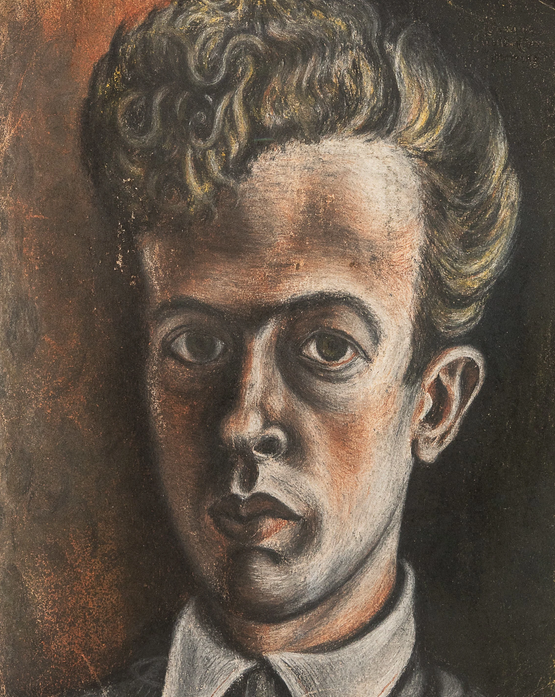
Among the whole exhibition there is only one picture featuring Bell’s son Julian – though there is a large portrait of Bell as a young man painted by Vanessa placed prominently above her bed at Charleston. Nursery Tea (1912) shows Vanessa’s two young children, Julian (b. 1908) and, on the left, Quentin (b. 1910) with two nursemaids, almost certainly at the Bell family home, 46 Gordon Square. Julian is of course interesting to China Rhyming because in 1935 he went to China to teach English at Wuhan University where he had an affair with Ling Shuhua, the wife of Professor Chen Yuan (better known by his pen-name, Chen Xiying). It all blew up into a massive scandal, Bell returned home, went to Spain and was killed in the Civil War. Ling Shuhua (who incidentally grew up and became involved in the May 4th/New Culture Movement) on Shijia Hutong in Peking at the same time Wallis Simpson lived there briefly) later lived in England for many years. She communicated by letter with Vanessa’s sister Virginia Woolf, though they never met, but did become friends with Vita Sackville West – and hence a firm line of contact between China’s New Culture Movement and the Bloomsbury Group.
The Exhibition Vanessa Bell: A World of Form and Colour is on at Charleston in Lewes, East Sussex until September 21. A few Chinese-related notes….
Included within the exhibition is Vanessa’s painting View from Gordon Square, 1909. It’s the view from the front windows of 46 Gordon Square in Bloomsbury and show three apples in a Nankeen dish/bowl. The dish actually belonged originally to Sir Leslie Stephen and his wife Julia, Vanessa’s parents. Vanessa had moved to Gordon Square with her sister Virginia and brothers Thoby and Adrian in 1904.
The question is (for this blog at least) was the Nankeen bowl from China or a Chinoiserie item made in England. The Staffordshire potters Minton, following Spode, were producing “Nankeen Semi China” from the early 1800s inspired by genuine Chinese Nankeen porcelain.
Battersea Bookshop (Unit 74, Battersea Power Station, Circus Road South, London SW11 8B) – August 13th – I’ll be talking to Annelise Finnegan (Academic Director of Translation & Interpreting and Clinical Associate Professor, NYU) about her new translation of Tie Ning’s My Sister’s Red Shirt (Sinoist Books)
Zhang Yueran’s Woman, Seated (Sceptre), translated by Jeremy Tiang….
In Women, Seated, we enter the world of an elite Chinese family: A life of luxury, limitless power, and around-the-clock service, which includes their trusted nanny Yu Ling.
Slipping in and out of the shadows, careful to speak deferentially, meticulous in her care of their only son Kuan Kuan, Yu has served the family for years and knows their secrets. But little do they suspect that Yu has secrets of her own.
In the pressure-cooker political environment of China, the fates of even the most powerful families can reverse overnight. When Kuan Kuan’s father and grandfather are arrested and his socialite mother goes on the run, Yu is left behind to make a series of life-changing choices.
Will she be able to outrun her own past? How far will she go to claim what she considers her due?
A range of German illustrated postcards covering Weihai, the Kiautschou Bay Leased Territory, Tsingtao (Qingdao), the Boxer Rebellion and German East Asian Expeditionary Corps dating back to 1898. These seem to have been produced in China, in Shandong and Peking, for mailing back to Germany, or collecting, mostly be members of the Ostasiatichen Expeditiekorps.
There are few pictures of the interior of the old Hong Kong Hotel (closed 1952) on Pedder Street. I think this is because it was, as Wallis recalled, dark, gloomy and a bit depressing, while the food at Gripps (the hotel’s restaurant) was universally described as awful, “British inspired” and as remembered by Wallis, “boiled, boiled and then boiled again”. Still, apart from the Repulse Bay Hotel where she’d briefly stayed, it was the best the colony had to offer in 1924. And there was this impressive awning….
On this 80th anniversary of WW2 we’re remembering one of the key opening salvos of the global conflict – August 14 1937, the devastating and confused bombing of Shanghai’s downtown districts, at that time the worst aerial carnage the world had seen…. what became known as “Bloody Saturday”
PAUL FRENCH ON BLOODY SATURDAY Tuesday August 12, 8pm REGISTER: https://jinshuju.com/f/UCk0Ef Or email info@historic-shanghai.com
We’ll be reconstructing the events of that day from eyewitness accounts, newspapers, and photographs to see what happened when the streets became battlegrounds, the Cathay and the Great World (Da Shijie) took direct hits, how the city and its people responded, and how it changed Shanghai forever and is an integral part of the descent into total global war.
(You can read my Penguin China Special as a Kindle e-book or paperback here….