China-Britain Business Council magazine Focus is celebrating 50 years since the start of ambassadorial relations between China & the UK – I’ve dug up a few old stories – here’s how package holidays to China started & some memories from early PRC tourist, author Penelope Fitzgerald – click here to read…
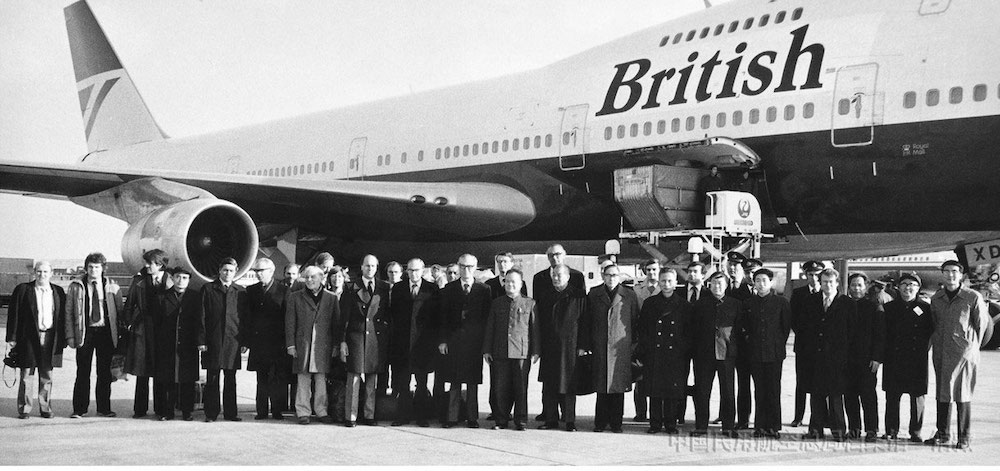
The China-Britain Business Council online magazine Focusis celebrating 50 years since the establishment of ambassadorial relations between China & the UK – I’ve dug up a few old stories – here’s the story of British Airways first flight to Beijing in 1980 – click here to read
Arrival at Beijing Airport, 1980
Inaugural service advert – nicely worded ‘permitted’ and still somewhere between Peking and Beijing as the official name for the Chinese capital’s airport.
This exhibition’s photos show Hong Kong during consecutive periods, as it was seen around the middle of the last century. The images span some thirty years of great change: from the postwar recovery in 1946 – 1947, through the resilience of the 1950s, to the resurgence of the 1960s – 1970s. The photos were taken by three photographers. In the order of their Hong Kong work they were: Hedda Morrison, Lee Fook Chee and Brian Brake. Each had markedly different life backgrounds and photographic objectives.
Hedda Morrison’s Hong Kong photos, like her prior work in China and later images of Southeast Asia, reflected her high regard for ordinary people. Thus, in 1955 some of her photos were published in the classic, life celebrating New York photobook The Family of Man.
Brian Brake held similar values. But whereas Morrison photographed mostly separate images, Brake created highly crafted, pre-envisioned photo stories. His photo-led stories were widely published in many contemporary photo magazines, notably LIFE International and National Geographic.
Lee Fook Chee, as a person and photographer, was far different to Morrison and Brake. Lacking their comfortable origins, and also their photographic training, he harnessed his personal resolve and the ability to take photos for selling to tourists who visited Hong Kong.
Yet all three, in their own way, recorded Hong Kong during its modern, crucible decades – thus passing on to our present times the photographic heritage seen in this Asia Society Hong Kong Center exhibition.
Recovery, Resilience, Resurgence is curated by Edward Stokes who founded The Photographic Heritage Foundation.
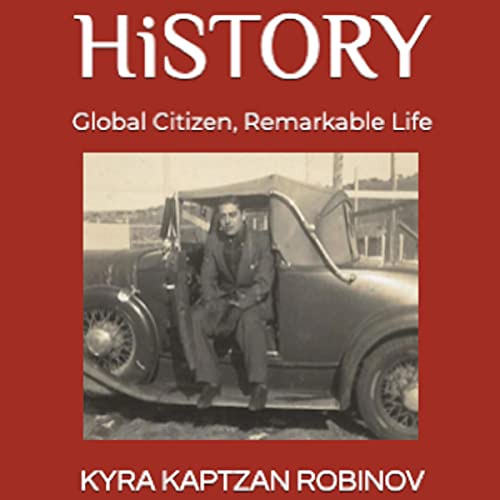
In 1920, at the age of eight, Moisye Kaptzan spent months hiding in squalid pigsties and opium dens after Bolsheviks murdered his father and hunted the surviving family during the Russian Revolution’s aftermath. Three years later, when the Great Yokohama Earthquake flattened that Japanese city, eleven-year-old Moisye was buried under rubble as his house crashed down upon him. Trapped in Shanghai as a young man during WWII, he outwitted brutal Japanese occupiers while assisting Jewish refugees running from Hitler. Undaunted by disasters, Moisye Kaptzan relied on his keen understanding of human nature and fluency in multiple languages to thrive throughout these tumultuous times. A tale of grit, perseverance and survival…this is HiSTORY.
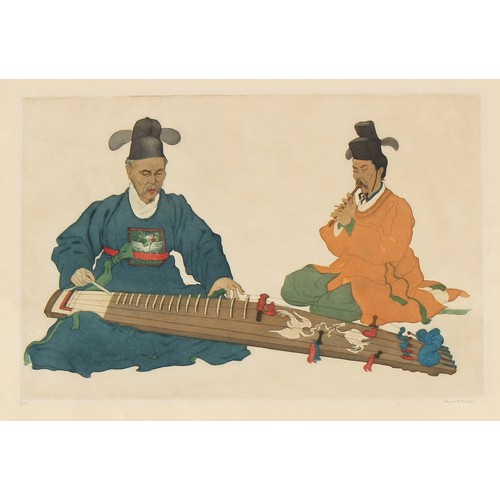
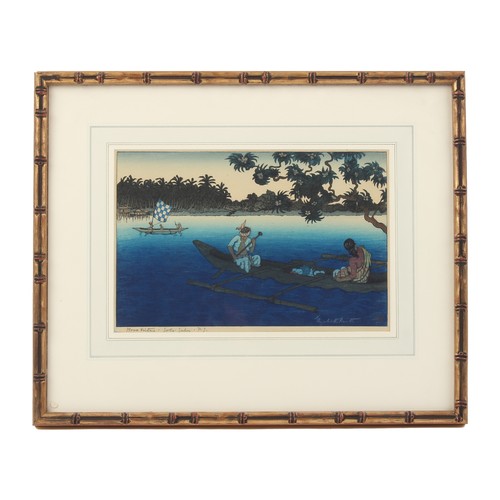
I’ve mentioned the Scottish artist Elizabeth Keith (1887-1956) a couple of times in passing when talking about the American artist Bertha Lum (here in Destination Peking) and Katharine Jowett (here in theSouth China Morning Post), both Peking-based women artists in the inter-war period. Keith was a print-maker and watercolorist whose works were significantly influenced by her travels to Japan, China, Korea and the Philippines. I mention her because her work, like Lum’s, Jowett’s and other female foreign artists who worked in Asia, their work does not come up for sale often. But I did note this forthcoming sale of two Keith works – a woodblock titled Court Musicians, Korea (1938) and another woodblock, with bamboo frame, Portrait of a Lady in Jolo, Sulu (Philippines) (1924).
The woodblocks are up for online auction:
Sale Description: Chinese, Japanese, Indian & Islamic Ceramics & Works of Art; Persian & European Carpets, Rugs & Textiles; and Antique Furniture & Objects Sale Date: 14/05/2022
This is an in-depth study of the intellectual, technical, and artistic encounters between Europe and China in the late eighteenth century, focusing on the purposeful acquisition of information and images that characterized a direct engagement with the idea of “China.”
The central figure in this story is Henri-Léonard Bertin (1720–1792), who served as a minister of state under Louis XV and, briefly, Louis XVI. Both his official position and personal passion for all things Chinese placed him at the center of intersecting networks of like-minded individuals who shared his ideal vision of China as a nation from which France had much to learn. John Finlay examines a fascinating episode in the rich history of cross-cultural exchange between China and Europe in the early modern period, and this book will be an important and timely contribution to a very current discussion about Sino-French cultural relations.
John Finlay is an associate scholar with the Centre d’études sur la Chine moderne et contemporaine (CECMC).
I’ve been meaning to ut this up for a while as a curiousity. In 2021 I co-wrote the BBC Radio 3 docu-drama Peking Noir, now a 6-part podcast (available here) about Shura Sosnitsky/Giraldi the mercurial Russian emigre intersex nightclub dancer/owner in Peking. Shura started as a character in my book Midnight inPeking and Peking Noir (co-written with Sarah Wooley) was an attempt to find out more about the character and, to be honest, speculate a bit too.
One major source on Shura was old Pekinger John Blofeld’s 1961 memoir City of Lingering Spendour. In that book he talks about meeting Shura, presenting at different times both as male and female. For Shura’s backstory – raised as a girl in pre-revolutionary Tomsk, fleeing to Harbin and then Peking, aspects of Shura’s dual personality and rumours of criminal lifestyle etc – Blofeld cites a knowledgable friend under the psyeudonym “Bill Luton”. Who was “Bill Luton”?
Bill Luton’s identity is quite important as he reveals a lot of information on Shura, Peking’s 1930s underworld, gay, and Russian emigre community. Can we trust “Bill Luton”? Well, quite possible would be my conclusion. Luton was in reality Robert “Bob” Winter, an American literature scholar who spent many years in China (his full obituary is here). Winter moved to China to teach at Southeastern University in Nanjing in 1923. In about 1926 he moved to Peking to develop the first full-fledged English literature and language program in China at the new Qinghua University. He stayed in Peking after the Japanese invasion in 1937 and so was certainly there throughout Shura’s time in the city and Blofelds. He also returned to Peking in 1946 and stayed after the revolution. Shura returned to the city in late 1945 or 1946, probably from Shanghai, and stayed until the Communist forced his deportation to the USSR after which he disappers (most probably killed soon after arriving back in the coutnry he fled in 1921 or in a gulag).
Robert “Bob” Winter
Winter was gay so would have moved within the 1930s demimonde where Shura was well known. he was connected and a gossip. He was also very left wing and pro-communist though of course this didn’t help him later – in 1968, during the Cultural Revolution, Red Guards ransacked his home, destroyed his books and letters, including some from Ezra Pound, and held him in detention for three months. He eventually died at 100 in 1987 in Beijing.