It appears the Paramount (where, among many other things Nellie Farren once hogged the spotlight and Dapper Joe choreographed the line – see my City of Devils) is to get another makeover (about the fifth in fifteen years i reckon). This time from the force of nature that is Xin Jing. The story from The Economisthere…
NIce to put a photo to a photographer. This portrait of Woosung (Wusong, the port 14 miles from downtown Shanghai) at sunset is from 1914 and appeared in Country Life. It was sent in by KL Murray of Shanghai (Murray worked for the Asiatic Petroleum Company in the Settlement). It appeared in the May 23 1914 edition of the magazine…
“In search of modernity: Chinese visiting Europe, 1870 to 1940†an RASBJ Zoom talk by Ines von Racknitz, followed by QA. Moderated by Katrin Buchholz.
WHAT: “In search of modernity: Chinese visiting Europe, 1870 to 1940â€, an RASBJ Zoom talk by Ines von Racknitz, followed by QA. Moderated by Katrin Buchholz. WHEN: Mar. 17, 2021. Wednesday 7:00-8.00 PM Beijing Standard Time.
MORE ABOUT THE EVENT: Around the turn of the 1900’s, Chinese students, reformers and revolutionaries, artists, scientists and writers discovered Europe for themselves, in search of their own and their country’s identity. They toured various European countries – Germany, Belgium, Austria, Italy, France, — settling there temporarily to study, work, write, or even to pass time in exile, as Zhou Enlai did. In Europe, the travellers from China were met with a mixed welcome: open, racist rejection on the one hand, but also an interest in them as descendants of an ancient foreign culture and representatives of a huge new nation and an economic market on the other. Their experiences of life in Europe often continued to have an impact long after their return to China – and the legacy of their European experiences varied greatly from the lessons Chinese travellers drew from comparable visits to the US or Japan. Following up on our online talk given by Frances Wood about Chinese living in the UK during 1950s, this RASBJ conversation with an outstanding expert in this field, Ines Eben v. Racknitz, will take a look at the varied experiences of Chinese travellers especially in France and Germany before the Second World War.
MORE ABOUT THE SPEAKER: Ines Eben v. Racknitz studied sinology, comparative literature and religious studies in Germany, the US and at Renmin university in Beijing and currently works as an Associate professor of Chinese history at Nanjing university. She has written a book on the China expedition of 1860, and the looting and burning of the Yuanmingyuan;  her current research is in the cultural history of Qing China, cartography and all things Manchu.
HOW MUCH: This event is free and exclusively for members of the RASBJ and other RAS branches. If you know someone who wants to join the RASBJ in order to attend this talk, please ask them to sign up via our website at https://rasbj.org/membership/ at least 48 hours before the event.
Not quite China Rhyming’s usual historical period but often harking back to the early part of the twenty first century, Te Pin Chen’s (former WSJ China correspondent) collection of short stories, Land of Big Numbers, bring to life many of the voiceless of recent Chinese history – migrant workers, back yard engineers, nail house residents, dissidents, emigres, stock market hopefuls, gig economy workers….Each one of the ten stories is fascinating….
A brother competes for gaming glory while his twin sister exposes the dark side of the Communist government on her underground blog; a worker at a government call centre is alarmed one day to find herself speaking to a former lover; a delicious new fruit arrives at the neighbourhood market and the locals find it starts to affect their lives in ways they could never have imagined; and a young woman’s dreams of making it big in Shanghai are stalled when she finds herself working as a florist.
These are just some of the myriad lives to be evoked in The Land of Big Numbers, a collection of stories which – sometimes playfully, sometimes darkly – draws back the curtain on the realities of modern China and unveils a cast of characters as rich and complicated as any in world literature. With virtuosic brilliance, Te-ping Chen sheds light on a country much talked about but little understood and announces the birth of a bright new star in the literary firmament.
Ming Sung Steamers were offering trips to ‘Progessive Szechuan’ in the 1930s with sailings from Shanghai to Chongqing via the ports of Nanjing, Wuhan, Yichang and Wanxian (the latter two being at either end of the scenic Three Gorges (that didn’t survive the Communist Master Builders sadly).
Ming Sung was based in Shanghai (though most of its steamers were Clydeside built) and obviously very much onboard with the Nationalist Government who pushed the ‘Progressive’ Sichuan line. Ming Sung, which had become China’s largest private shipping concern by the late 1940s, didn’t survive post-1949 and their ships were taken over by Chiang Jiang Maritime Bureau, though some Ming Sung ships (they owned about 100 shallow draft steamers in 1947) and staff made it to Taiwan to start over. Ming Sung built its fleet up by buying many second hand ships from all over – the Calulu below being originally a Hamburg-based cargo ship, then an Australian owned ship out of Brisbane, briefly registered in Hong Kong and then with Ming Sung in Shanghai from 1933 to its scrapping in 1937.
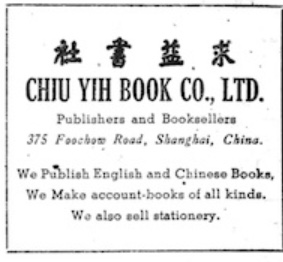
Chiu Yih Books of Shanghai were publishers, printers, distributors and retailers of books in Chinese, English and other foreign languages before 1949. They specialised in business texts, particularly those that helped the Shanghai businessman exporting. For instance, their Samples of English Letters for Chinese Letter Writers, by Chen Kwan Yi and Whang Shuh, published by Chiu Yih Book Company, of Shanghai, was a bestseller. They also published a lot of specialist books such as the scintillating sounding A Comprehensive Treatise on Inorganic and Theoretical Chemistry.
They were also based on Foochow Road and, of course, today’s renamed Fuzhou Lu is still a major book street. There was also another branch of Chiu Yih at 176 Chengdu Road.