In my essay collection Destination Shanghai I wrote about Hollywood Charlie Chan actor Warner Oland’s visit to Shanghai in 1936 where, despite playing yellowface on screen, he was feted by film fans and the local Chinese mayor. More detials in that book (and you can hear an abridged versuon of the chapter here on RTHK3) and in Yunte Huang’s book Charlie Chan: The Untold Story.
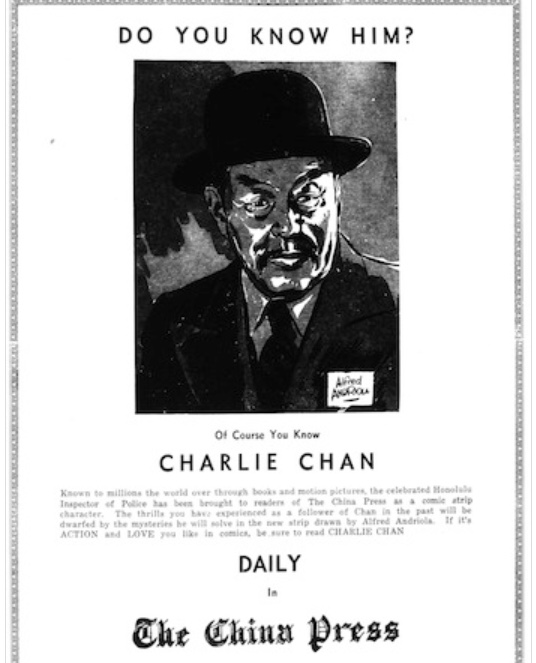
However, i was unaware that there were Charlie Chan excerpts running in the English language Shanghai newspapers throughout the 1930s. Primarily in the China Press, an American-funded and largely staffed daily paper…
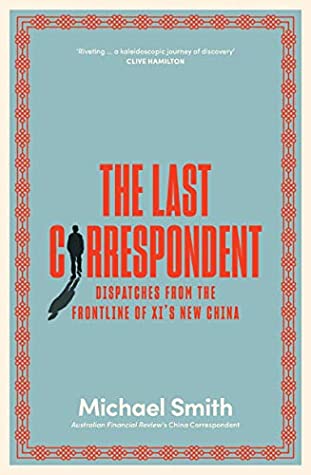
I have always read foreign correspondent accounts on China – contemporary and historical (I even wroter a history of foreign correspondents in China from the mid-19th century to 1949). Michael Smith was, until recently, with the Australian Financial Review in Shanghai and one of the smarter observers so his memoir should be well worth a read…
It was just after midnight when China’s notorious secret police came knocking.
A late-night visit to his Shanghai laneway house by China’s notorious secret police triggered a diplomatic storm which abruptly ended Michael Smith’s stint as one of Australia’s last foreign correspondents in China. After five days under consular protection, Smith was evacuated from a very different China to the country he first visited 23 years earlier.
The late-night visit marked a new twist in Australia’s 50-year diplomatic relationship with China which was now coming apart at the seams. But it also symbolised the authoritarianism creeping into every aspect of society under President Xi Jinping over the last three years.
From Xinjiang’s re-education camps to the tear-gas filled streets of Hong Kong, Smith’s account of Xi Jinping’s China documents the country’s spectacular economic rise in the years leading up to the coronavirus outbreak.
Through first-person accounts of life on the ground and interviews with friends as well as key players in Chinese society right up to the country’s richest man, The Last Correspondent explores what China’s rise to become the world’s newest superpower means for Australia and the rest of the world.
Michael Smith has been covering China for over 20 years and is currently the China correspondent for the Australian Financial Review. He lived and reported from China up until September 2020, when the Chinese government compelled the last Australian journalists to leave the country. He currently resides in Sydney with his partner. Their dog Huey, however, remains in China awaiting his opportunity to be reunited with his family.
“Intoxicating Shanghai”: Art and Literature in Pictorial Magazines during Shanghai’s Jazz Age
Dr Paul Bevan (Departmental Lecturer in Modern Chinese Literature and Culture, University of Oxford)
Date: 3 March 2021Time: 2:00 PM
In Intoxicating Shanghai Paul Bevan explores the work of a number of Chinese modernist figures in the fields of literature and the visual arts, with an emphasis on the literary group the New-sensationists and its equivalents in the Shanghai art world, examining the work of these figures as it appeared in the medium of the pictorial magazine. It undertakes a detailed examination into the significance of the pictorial magazine as a medium for the dissemination of literature and art during the 1930s. The research locates the work of these artists and writers within the context of wider literary and art production in Shanghai, focusing on art, literature, cinema, music, and dancehall culture, with a specific emphasis on 1934 – The Year of the Magazine.
Biography Paul Bevan is Departmental Lecturer in Modern Chinese Literature and Culture at the University of Oxford. From 2018 to 2020 he worked as Christensen Fellow in Chinese Painting at the Ashmolean Museum. Paul has taught modern Chinese literature, history, and visual culture at the University of Oxford, the University of Cambridge, and the School of Oriental and African Studies. His primary research interests concern the impact of Western art and literature on China during the Republican Period (1912-1949), particularly with regard to periodicals and magazines. His research on artists George Grosz, Frans Masereel, and Miguel Covarrubias, all of whom worked for Vanity Fair, has resulted in extensive research on both Chinese and Western pictorial magazines. Paul’s first book A Modern Miscellany – Shanghai Cartoon Artists, Shao Xunmei’s Circle and the Travels ofJack Chen, 1926-1938, Leiden: Brill, 2015, was hailed as “a major contribution to modern Chinese studiesâ€; his second offering: “Intoxicating Shanghaiâ€: Modern Art and Literature in Pictorial Magazines during Shanghai’s Jazz Age was published by Brill in April 2020.
A complex and contradictory graffiti culture has been brewing over the last few decades in one of the least expected settings-China’s capital. Through an unparalleled collection of one local photographer’s images, as well as interviews with 25 prolific artists, see how Beijing has developed its graffiti movement against the backdrop of the once-secluded nation’s rise to global economic might. While Beijing graffiti artists take their cue from the subculture’s Western origins, the local scene has also been highly influenced by both foreign visitors and traditional Chinese art and culture. Profiles of significant artists explore the dynamics of creative self-expression in such a perceivedly authoritarian setting, including the surprising amount of freedom they have to make their art undisturbed compared to Western counterparts. A must for graffiti enthusiasts, Sinophiles, and anyone interested in how this colorful subculture is still growing half a century after it emerged.
Paul French Tuesday, 2 Mar 2021 – 7pm-8pm – Webtalk – The event is free of charge for members. For guests or non members, the registration fee is $50. Please click here .
In this talk, well-known Chinese historian, raconteur and author Paul French talks of the Chinese capital telling numerous true stories of fascinating people who visited the city in the first half of the 20th century.
From Bolsheviks and Nazis, to artists and bank robbers, to English aesthetes, to transplanted New York Bowery Balladeers, he describes that extraordinary era. He asks the major question behind so many of these sojourners’ decisions to remain in the ancient capital – why Peking?
If Shanghai was for those who craved the modern and the novel, then Peking was for those who craved tradition and timeless beauty. Most who journeyed to Peking would have agreed with Emily Hahn, the New Yorker’s correspondent in 1930s China, that the city was a ‘dream world for the aesthete.’
Destination Peking: Revisiting the ‘Foreign Colony’â€
an RASBJ Zoom talk by Paul French, moderated by Jeremiah Jenne and followed by QA
WHAT: “Destination Peking: Revisiting the ‘Foreign Colony'”, an RASBJ Zoom talk by Paul French, moderated by Jeremiah Jenne and followed by QA WHEN: Feb. 24, 2021 Wednesday 7:00-8:00 PM Beijing Standard Time
TO BUY THE BOOK: There’s a discount for members of RAS in Beijing and RAS China in Shanghai who wish to buy the book from Hong Kong and have it delivered free to mainland China. Use coupon code RB21 at checkout on www.blacksmithbooks.com to get 10% off Destination Peking, with free delivery. Online payment options include credit cards, Paypal, Alipay and Wechat Pay.
MORE ABOUT THE AUTHOR: Paul French lived and worked in China for many years. He has written a number of books, including a history of foreign correspondents in China and a biography of the legendary Shanghai adman, journalist and adventurer Carl Crow. His true crime book Midnight in Peking was a New York Times Bestseller, a BBC Radio 4 Book of the Week, a Mystery Writers’ of America Edgar award winner for Best Fact Crime, and a Crime Writers’ Association (UK) Dagger award for non-fiction. His Kirkus-starred book City of Devils: A Shanghai Noir focuses on the dancehalls, casinos and cabarets of wartime Shanghai. Both Midnight in Peking and City of Devils are being adapted for film and TV. He occasionally works in audio drama with recent productions including Peking Noir for BBC Radio 3, and the twelve-part Audible Original, Murders of Old China. His 2020 researched-novella about the Jewish refugees who left Shanghai for Macao during World War Two, Strangers on the Praia, is currently being developed as a Sino-Australian co-produced movie from his own script.
HOW MUCH: This event is free and exclusively for members of the RASBJ and other RAS branches. If you know someone who wants to join the RASBJ in order to attend this talk, please ask them to sign up via our website at https://rasbj.org/membership/ at least 48 hours before the event.
HOW TO JOIN THE EVENT ON ZOOM: Register at least 24 hours beforehand by clicking:     https://zoom.us/meeting/register/tJYqdemrqDouHtyfJDfUk3SpboEwWuDX1o-m After registering you’ll receive a confirmation email with the login link and passcode; use them to log in 10 minutes before the talk is slated to begin. (If you don’t seem to have received a confirmation email, please check your spam folder.)
I’ll be discussing opportunities for UK people and companies in China’s creative sector – publishing, movies, tv, audio, licensing and all that good stuff – with my former editor at Penguin China Jo Lusby for the China-Britain Business Council – February 23rd 2021 on zoom – you don’t have to be a member of the CBBC to join in, they’ve made it totally open….(and it’s a good time for Europe and Asia)…
The UK is a world leader in the development of creative content, which is reflected in both the volume and breadth of creative exports to China including, books, films, TV shows, documentaries, computer games to name but a few. Books, movies, TV, audio are all areas where Chinese consumers want to hear what the world has to say. The opportunities are as limitless as our imaginations – from history to science-fiction; from publishing to CGI.
Nevertheless, the Chinese market come with challenges for the industries including content quotas, censorship, and cultural differences. Join Paul French and Jo Lusby as they discuss navigating the challenges and creating content that is going to gain traction in China including:
What is the opportunity for UK creative companies in China?
What types of content is most likely to succeed in China?
What are the alternate models for UK creatives to work in or with China?
What are some of the challenges for UK Creative Industries and how can these be overcome?
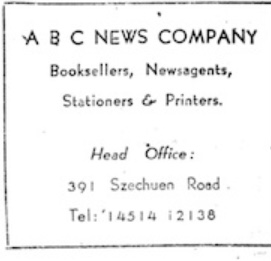
The ABC News Company had several branches around the International Settlement that popped up over the interwar years. Their major branch and offices were always at 391 Szechuen Road (Sichuan Lu)……