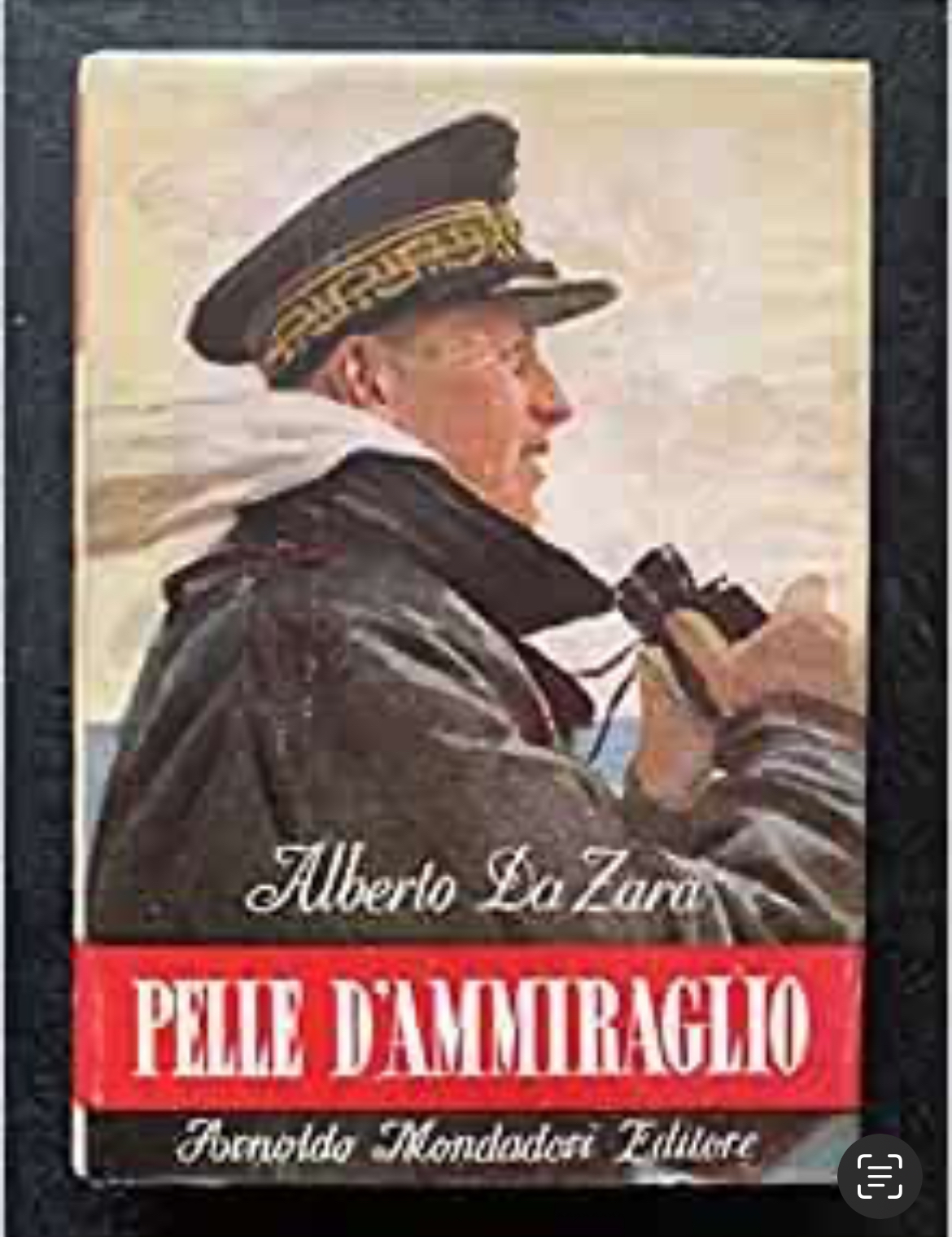
Wallis’ grand love affair in Peking was with Italian naval officer Alberto de Zara. She mentions him obliquely in her memoirs, but in his 1949 autobiography (Pelle D’Ammiraglio – Skin of an Admiral) da Zara fondly recalls Wallis and their summer together in 1925…. It’s never been translated into English….
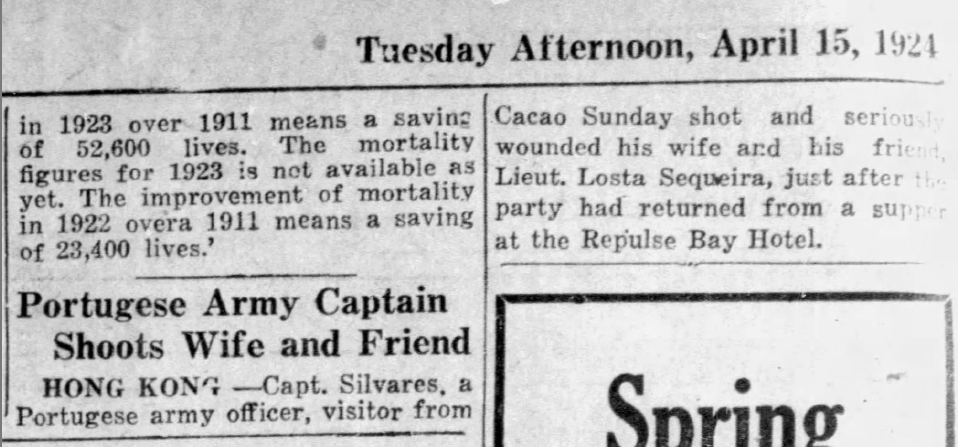
On April 12,1924 Captain Silvares of the Portuguese army in Macao shot his wife, Mrs Silvares and a certain Lieutenant Sequeira, a fellow Portuguese army officer, in Hong Kong. Here’s what happened….
Captain Silvares came across to Hong Kong from Macao. His wife had sailed across a couple of days before. They were to have a little weekend break from his army duties in the Portuguese colony in the neighbouring British colony. But somehow Silvares found out that his wife had had supper that evening with a colleague of his Lieutenant Costa Sequeira, in Hong Kong to catch a liner to Europe and redeployment back in Portugal.
The couple had gone out to the famously romantic spot of the Repulse Bay Hotel for supper and, who knows, perhaps more? Moonlight across the bay, the gentle lapping of waves, a decent wine list, some rather comfortable rooms…
Discovering them together Silvera was, not unsurprisingly angry. In the ensuing argument Silvera shot both his wife and Sequeira, wounding them requiring a trip to the hospital. Silvera was arrested by the Hong Kong Police. All pretty obvious you might think – Mrs Silversa indulging a little bit of exmarital fun with Lieutenant Sequeira; her hsuabnd catches her, flies into a rage and attempts to shoot the pair of them dead? Case closed.
But it seems the British wanted nothing to do with a Portuguese menage-a-trois or unseemly Latin crimes de coeur. Sequeira was released and allowed to board his liner to Europe and go about his business (his arm in a sling) while Captain and Mrs Silvares were escorted to the dock, put on the next ferry to Macao and told to not return to Hong Kong anytime soon. The police recorded it all as an unfortunate ‘accidental discharge’ of Silvare’s pistol in an enclosed space leading to some minor wounding. Potentially tricky inter-colony problem solved.
Yea, right…. I’ve not been able to find what eventually happened to the Silvares’, their marriage or Sequeira but I think we can safely assume ‘accidental discharge’ was the least of the rpoblems at repulse Bay that evening in 1924.
I’ve blogged before about the well maintained cluster of art deco apartments and shops at 190-204 and 210-212 Prince Edward Road West. I’ve also written about this areas modernist and art deco traditions for the South China Morning Post weekend magazine (here) and I also include 190-204 and 210-212 Prince Edward Road West on my Voicemap walking tour of art deco Kowloon.
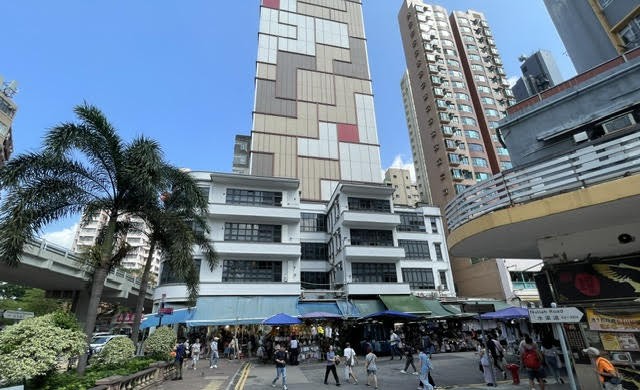
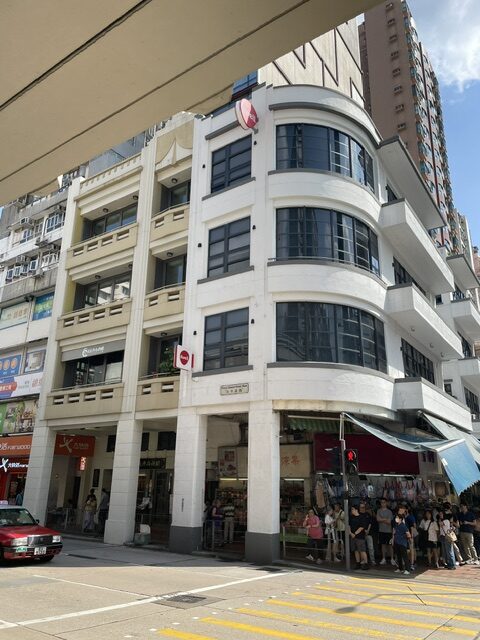
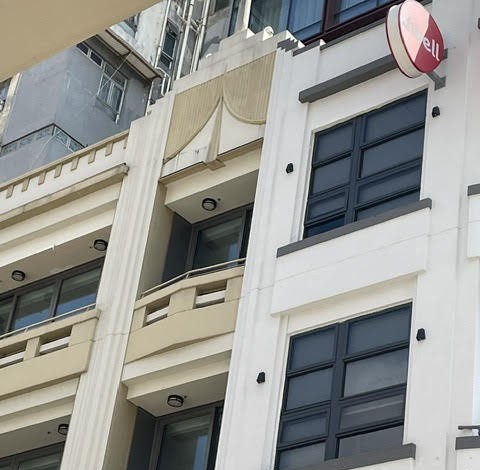
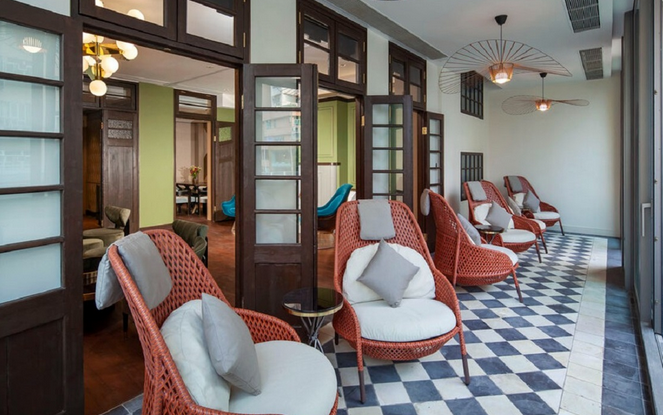
But I’d also like to mention the smaller art deco building further towards Mongkok East at 179 Prince Edward Road West by the junction with Nullah Road. It too has been quite well maintained with the restored façade in front of a 20-storey rear extension and the creation of a boutique hotel (Hotel 1936).
Given the similarity in style between the two buuildings quite close to each other I think we can assume 179 was, like 190-204 and 210-212 Price Edward Road West a project of the Franco-Belgian developer Crédit Foncier d’Extrême-Orient, who also built St Teresa’s Church nearby.
The building fronting onto Nullah Road with the new extension behind
Like the larger art deco buildings on Prince Edward Road it features street level retail space and arcading
Also with balcony and window art deco stylings and flourish
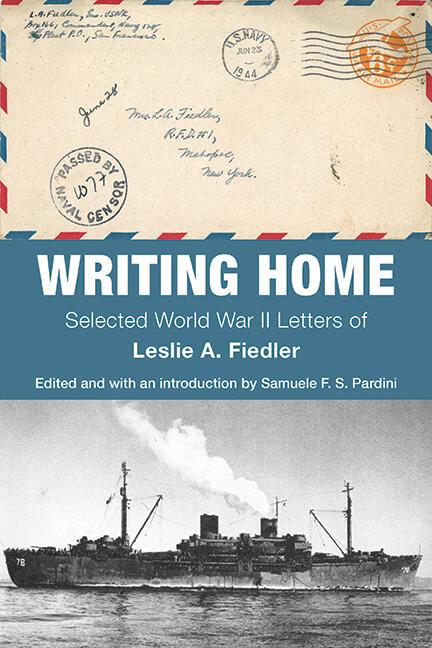
Writing Home: Selected World War II Letters of Leslie A. Fiedler (State University of New York Press) contains a large number of utterly fascinating letters from China. These are all letters written by Leslie Fiedler to his wife Margaret from May 1944 to December 1945 while he was stationed around Asia and in China as an intelligence officer during World War II.
The letters in Writing Home offer a glimpse into a crucially formative period in the life of Leslie A. Fiedler, one of the greatest literary critics and American public intellectuals of the twentieth century. Written to his wife and two sons between May 1944 and December 1945, while he was serving as a cryptologist and translator for the Office of Naval Intelligence, they contain firsthand accounts of his experiences in various locations in the Pacific Theater, including Hawai’i, Iwo Jima, Okinawa, Guam, and China. Constrained by Navy censors from writing directly about his work as an intelligence officer, he writes, instead, on a variety of themes, events, places, and war situations, including the ethical contradictions between a war fought for and in the name of freedom on the one hand and the oppression of indigenous Hawai’ians and prisoners of war on the other. He also questions the mainstream, European-centered view of the war and provides new insights into the role of Jewish servicemen in World War II. Finally, the letters document the beginning of the formation of American intellectual life in the years preceding the Cold War, forcing us to rethink certain premises of American exceptionalism in the second half of the twentieth century. Taken together, they offer a unique and fascinating immersion into history through the eyes of one of the makers of post–World War II American literary culture.
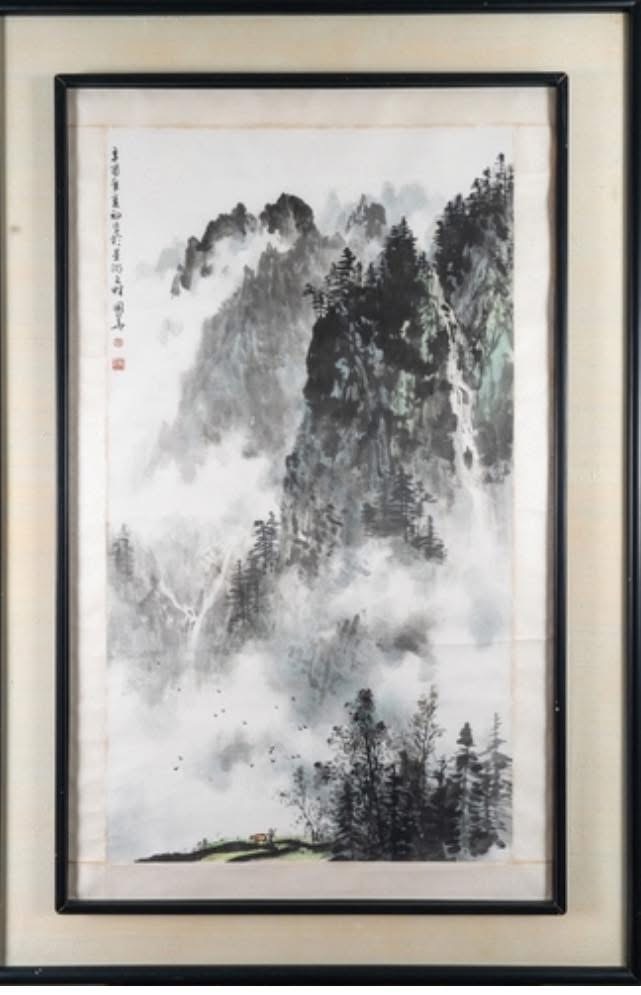
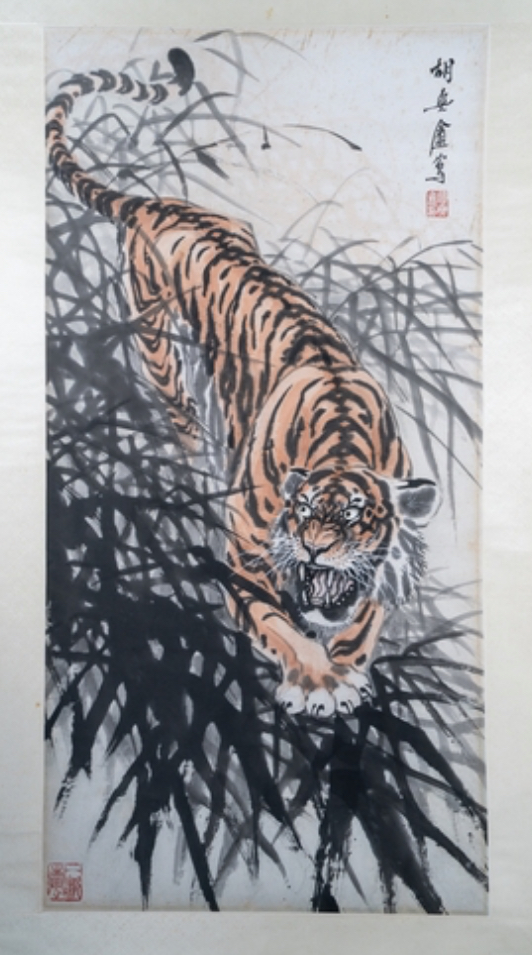
A couple of curiosities up for auction, a scroll painting with a little mystery we can soon solve I reckon (sorry not really my period) – “Late 20th Century, Landscape with Mountains, a Boy and Ox, Ink and wash on paper, Signed ‘Li ?’ Any ideas on the artist?
The painting was given to Mrs Thatcher on her trip to China in 1982 after a visit to the Beijing Fine Art Academy. Her estate has just put it up for sale.
Hu Shuan’an (1916-1988), Roaring Tiger Scroll, give to Thatcher by the Chinese. The Thatcher archive records though are not sure if she got this one in 1979 from Premier Hua Guofeng on his visit to London or in 1982 after her visit to the Beijing Art Academy. Anyway, they’ve put it up for sale….
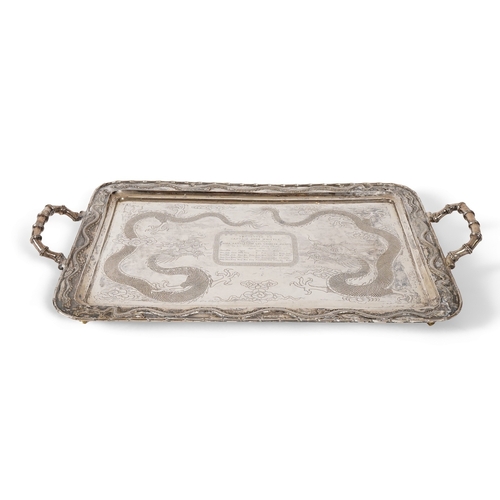
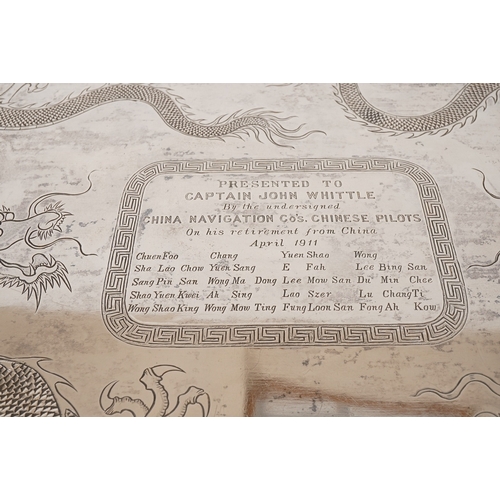
An early 20th century Chinese white metal two handled rectangular tea tray, by Luen Wo of Shanghai, with engraved presentation inscription, ‘Presented to Captain John Whittle by the undersigned China Navigation Cos. Chinese Pilots on his retirement from China, April, 1911’. Whittle had been a Captain with Swire’s China Navigation since at least the 1880s, most notably commanding the well known China coastal passenger and cargo steamer Tamsui.
WHAT: Author Paul French introduces “The World of the Peking Aesthetes” during a small-group RASBJ dinner in the former residence of Peking opera star Mei Lanfang
WHEN: Monday, Oct 27, 2025, from 7:00-8:45 PM Beijing Time. Doors open at 6:45 PM.
WHERE: Qingyun Huai 49 Yan Laofangu Master Ji (or “Banquet 1949”), Qingyun 23 Artistic Center, Neiyuan, Dongcheng (青云淮四九宴老饭骨大师技)
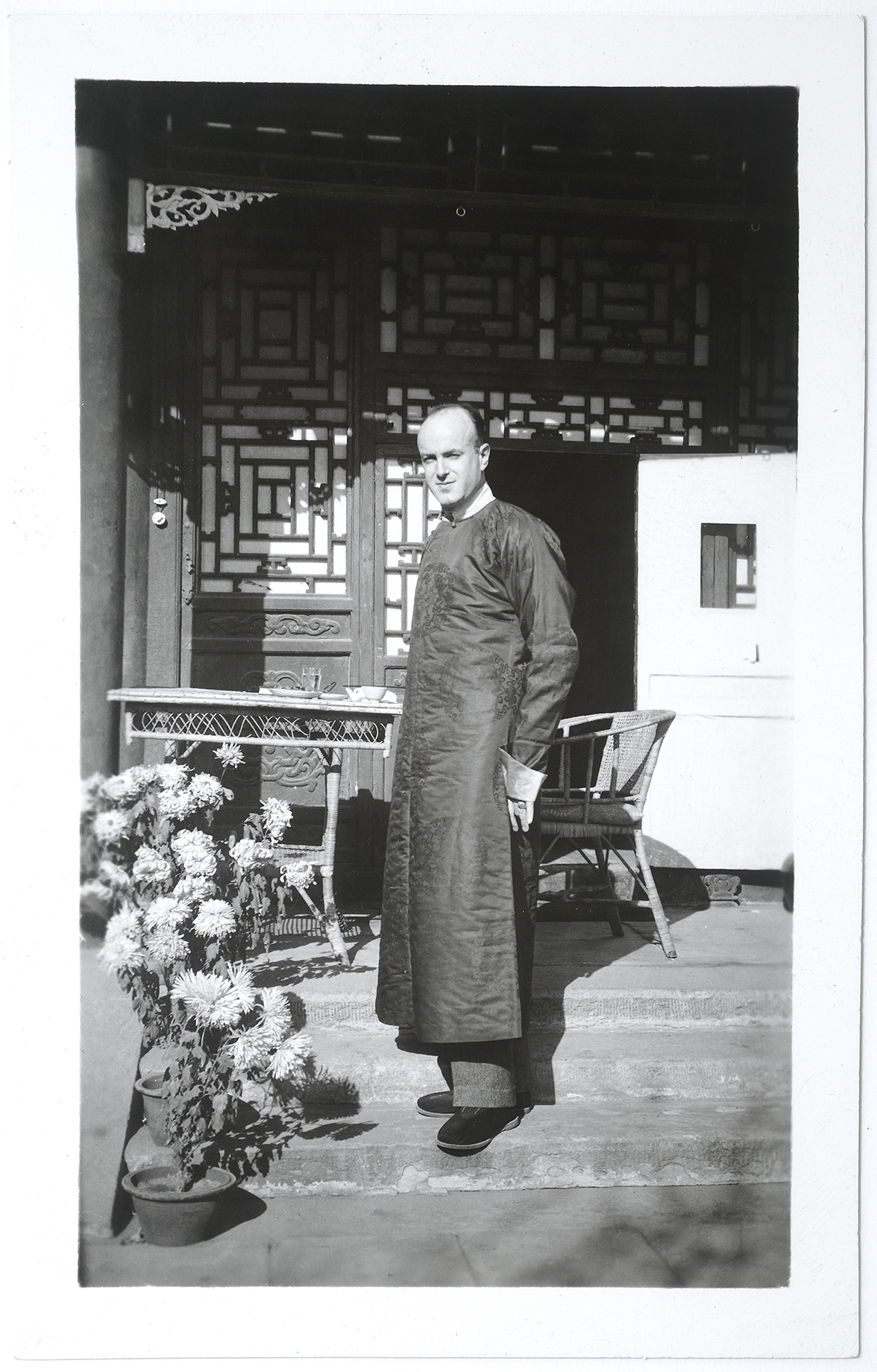
Between the world wars Peking was home to many long-term sojourner aesthetes, European, American and Japanese men and women sensitive to art and beauty. Writers, artists, translators and scholars, though often dilettantes, and occasionally fabulators and frauds. They were invariably of the “lost generation”, often gay, the men independently wealthy and the women newly independent of bad and boring marriages. They made hutongs and former temples their homes, they cultivated their appreciation of Chinese art, style and opera. They wrote, painted and collected. Their fabulous friends visited. They made alliances and close friendships with like-minded Chinese. And they recorded their experiences in memoirs, novels, plays and letters. They were the Peking Aesthetes.
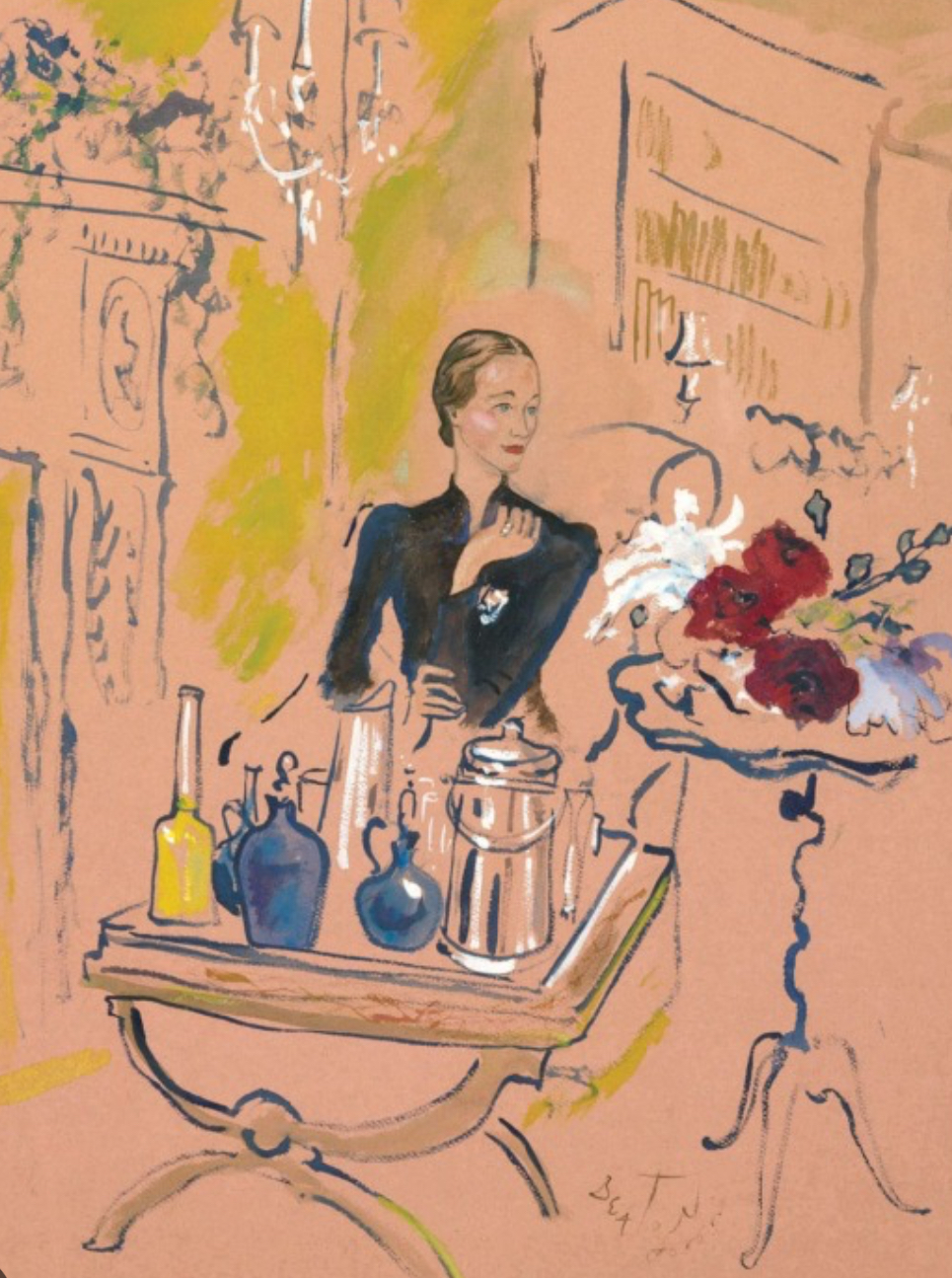
I’ve posted this sketch of Wallis Simpson before – Wallis Simpson Serving Cocktails, London, 20 November 1936, a Cecil Beaton gouache featuring Wallis signature China-inspired chignon hairstyle and Mainbocher interpretation of a qipao. But I hadn’t realised it was owned by the fashion designer Dries Van Noten.
He has apparently loaned it to the new exhibition at London’s National Portrait Gallery, Cecil Beaton’s Fashionable World (on until January 26 2026) so we can now all see the original.