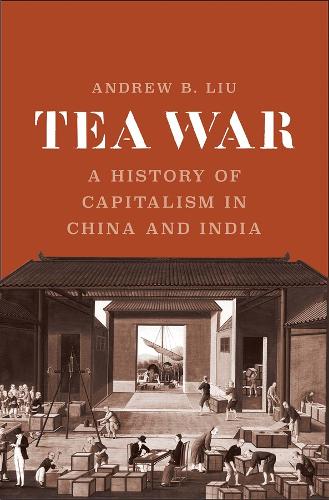
A history of capitalism in nineteenth- and twentieth-century China and India exploring the competition between their tea industries Tea remains the world’s most popular commercial drink today, and at the turn of the twentieth century, it represented the largest export industry of both China and colonial India. In analyzing the global competition between Chinese and Indian tea, Andrew B. Liu challenges past economic histories premised on the technical “divergence” between the West and the Rest, arguing instead that seemingly traditional technologies and practices were central to modern capital accumulation across Asia. He shows how competitive pressures compelled Chinese merchants to adopt abstract, industrial conceptions of time, while colonial planters in India pushed for labor indenture laws to support factory-style tea plantations. Further, characterizations of China and India as premodern backwaters, he explains, were themselves the historical result of new notions of political economy adopted by Chinese and Indian nationalists, who discovered that these abstract ideas corresponded to concrete social changes in their local surroundings. Together, these stories point toward a more flexible and globally oriented conceptualization of the history of capitalism in China and India.
Despite uncertainties and disruptions, RASBJ has seized the opportunity to launch a popular series of online events on Zoom. Since March 9, we’ve had eight wonderful talks – from award-winning author Paul French on “Murders of Old China†to an evocative discussion of Jung Chang’s book about the Soong sisters. Please join the RASBJ! If you follow instructions (below) to become a member you’ll get free access to the ongoing Zoom talks – plus their youTube recordings – as well as the RAS China journal and discounted entry to in-person events and excursions when they resume. Upcoming Zoom talks include: 4/25: Tario Perez Vila on UK and China ties post-1997; 4/29 Joerg Wuttke on EU-China relations and the pandemic (below); 5/4 Prof. Robert Bickers on the Swire story; 5/8 Matthew Hu Xinyu on “Rediscovering Beijingâ€; 5/20 Guiseppe Cuccia on “Turandot and Western opera in Chinaâ€; 5/27: Michael Humphries “Contagion: History and How Covid will End
HOW MUCH: free and accessible to RAS members and affiliates worldwide. If you’re not an RASBJ member but become one by April 27, you’ll be sent the login details for this event. HOW TO BECOME AN RASBJ MEMBER: If you’d like to become an RASBJ member (or, for PRS passport-holders, to become an Associate) please befriend Membership Secretary John Olbrich on Wechat at johnobeijing and send him your name, nationality, mobile number and email address plus the annual subscription amount (or, for Associates, the suggested donation) of RMB 300 for those resident in China, RMB 200 for those resident overseas and RMB 100 for students. See www.rasbj.org for details.
A piece I had published by CNN on the 1910-1911 Manchurian Plague and its subsequent internaitonal conference. Naturally rather limited by the word count so had to slide over many issues and concentrate on those that maybe resonate or make us think about current times….anyway here’s the article…click here
Dr Wu Lien-teh – crucial to solving the riddle of 1910-1911
In Intoxicating Shanghai Paul Bevan explores the work of a number of Chinese modernist figures in the fields of literature and the visual arts, with an emphasis on the literary group the New-sensationists and its equivalents in the Shanghai art world, examining the work of these figures as it appeared in pictorial magazines. It undertakes a detailed examination into the significance of the pictorial magazine as a medium for the dissemination of literature and art during the 1930s. The research locates the work of these artists and writers within the context of wider literary and art production in Shanghai, focusing on art, literature, cinema, music, and dancehall culture, with a specific emphasis on 1934 – ‘The Year of the Magazine’.
The inimitable Peter Hibbard on 1930s Shanghai, the Far East’s most cosmopolitan city, a city that exuded luxury, style and excitement attracting businessmen, thrill-seekers and refugees from across the globe. Nowhere represented this more than Sir Victor Sassoon’s Cathay Hotel (now the Peace Hotel), an Art Deco masterpiece that towers above Shanghai’s Bund and was the heart of the city’s wild social scene. The fortunes of the hotel have since mirrored those of the city, weathering war, revolution and social upheaval. Join Peter as he shares the fascinating stories and personalities behind the city’s most iconic landmark.
Not only is Peter one of the leading authorities on old Shanghai, it’s fair to say he knows a thing or two about historic hotels: he currently serves as Heritage and Archive Ambassador to The Peninsula Hong Kong and wrote Peace at the Cathay, the definitive work on the Peace Hotel, which was published in 2011. He lived in Shanghai for many years, reviving the Royal Asiatic Society, acting as an expert guide and publishing a number of key works on the city’s foreign concession era before he returned to the UK in 2013.
Excellent to see a bio of Tianjin-born Hersey at long last – i’m not aware of another….I haven’t had a chance to read it yet so not sure if it talks about his trips to China, but I’m ordering….
Few are the books with as immediate an impact and as enduring a legacy as John Hersey’s Hiroshima. First published as an entire issue of The New Yorker in
1946, it was serialized in newspapers the world over and has never gone
out of print. By conveying plainly the experiences of six survivors of
the 1945 atomic bombing and its aftermath, Hersey brought to light the
magnitude of nuclear war. And in his adoption of novelistic techniques,
he prefigured the conventions of New Journalism. But how did Hersey—who
was not Japanese, not an eyewitness, not a scientist—come to be the
first person to communicate the experience to a global audience?
I’ve been meaning to post these pictures of the ‘refurbished’ Columbia County Club swimming pool for a year now! The old club, on Columbia Road (Panyu Lu) was a messy chemicals factory for some time – God knows what chemicals they made there – and the pool unused. It is sadly still unused as projects in mopdern China are all about limited access and what you can’t do rather than what you can so a perfectly pool is now just something to walk around past a fairly uninspiring groups of shops and cafes. Oh well, at least it’s open again…So then and then the now…Note the completely unnecessary addition of a decidedly ugly upper tier (to squeeze out a little extra rent I presume) and the over-ornamentation on the resotration of the small fountain. Nice that the original tiling work was retained though, small mercies and all that….