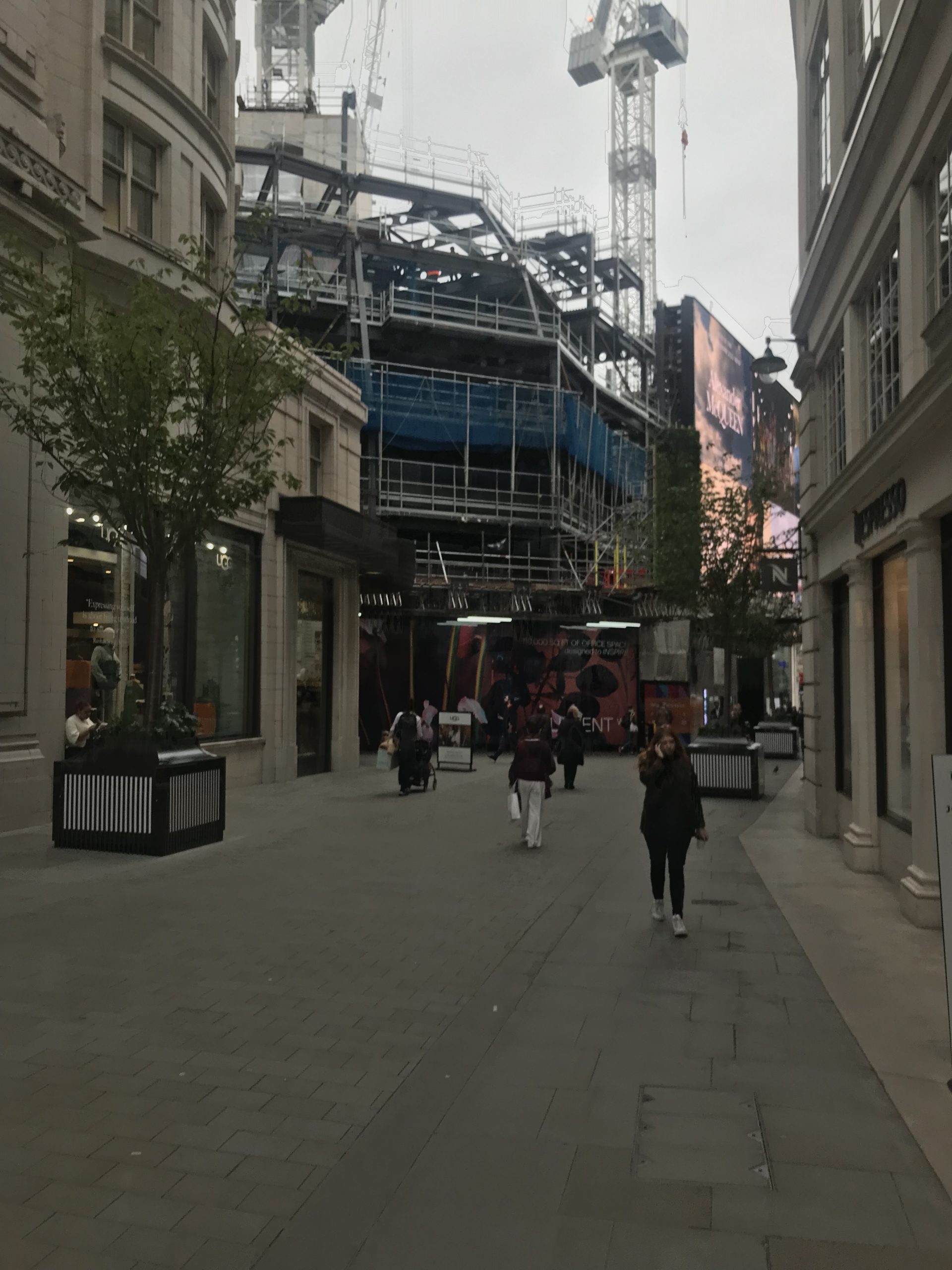
A significant, if little known, piece of British-Chinese heritage disappeared from the map recently in central London. I had noticed some time back, prior to the pandemic, that there had been rather a lot of major clearance on the junction of Shaftesbury Avenue and Denman Street. Walking across Piccadilly Circus this week i noticed that the entire triangular block bordered by Shaftesbury Avenue, Denman Street and the pedestrianised Glasshouse Street, which runs northwest off Piccadilly Circus has been cleared for a new development. This is part of the general (and sadly ongoing) gutting and destruction of Soho between Shaftesbury Avenue, Charing Cross Road, Regent Street and Oxford Street that has been continuing for some years now causing destruction and heritage loss as far as over Charing Cross Road in Denmark Street (once London’s Little Tokyo).
What might not be noticed in this mass clearance (to allow the property developers in to build God only knows what) is that the site of the West End’s first Chinese restaurant (arguably) has gone entirely and for good. The building that comprised 4-6 Glasshouse Street has been demolished. It first opened as a Chinese restaurant in 1909 as this article entitled LONDON’S CHINESE RESTAURANTS in The Queenslander newspaper from July 21st 1932 indicates:
IF we start from the centre of the West-End of London, setting out from Piccadilly Circus, we can take in all the Chinese restaurants of the West-End within half an hour’s walk (writes Townley Searle in his book, “Strange News from Chinaâ€). The Chinese Restaurant in Piccadilly Circus was one, if not the first, to open in their neighbourhood. It was started in 1909 by Mr. Chang Choy, and has continued for 22 years. The premises are, of cource, the most centrally situated of any, and consist of the upper floors of 4 Glasshouse Street. Each floor is decorated in approved Chinese style, in which the Chinese lantern predominates. The food is excellent, as it is in every Chinese restaurant, and if one knows “what to order†there can be no question of disappointment.
I’m afraid i do not have a picture of The Chinese Restaurant – though if anyone does please do get in touch! By the 1930s The Chinese Restaurant was next to several other “ethnic†restaurants including Doveed, a Jewish kosher establishment opened in 1937. The Chinese Restaurant attracted smart shoppers around Regent Street and Piccadilly with tables on the first floor that looked out onto the street and became places to see and be seen. The restaurant claimed to specialise in imperial banquet cuisine, but required at least half a day’s notice to dine and a deposit in advance to cover the purchase of the ingredients. Still, despite the bother, the 1937 edition of Where to Dine in London declared that, “Englishmen who have spent their lives in the East†appreciate the traditional menu. In his 1938 novel Murphy, Samuel Beckett, has his character Neary, an eccentric visiting London from Cork, eat in “…a Chinese restaurant on Glasshouse Street†which perhaps the writer himself knew?
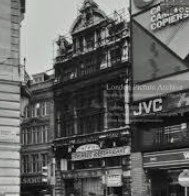
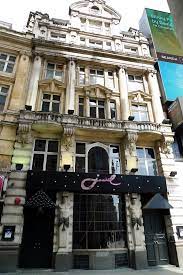
Some time after WW2 The Chinese Restaurant morphed into the Cathay Chinese Restaurant – and that, courtesy of the London Picture Archive, we do have a picture of. Later still, and in it’s last incarnation, it became a cocktail bar called jewel, still using the first floor windows as great people watching seats. By this time its Chinese connection was long gone (except perhaps having a lychee martini on the menu). And now the entire building is gone and with it a key moment in the history of the Chinese in the West End…
The Cathay, here in the 1970s, replaced The Chinese Restaurant with H Samuel, the jewellers, to one side, and a giant Wimpy Bar to the other….Their sign rather obscured the popular arched first floor windows
The last tenant – Jewel Bar, did at least restore the balcony
After the liberation of Shanghai from Japanese occupation in summer 1945 and with the old foreign concession abolsihed Nationalist China established a new Shanghai Telecommunication Administration for the city with offices up on Szechuen Road North (Sichuan Bei Lu)….Here’s the logo. ..
In the Qing dynasty (1644–1911), China experienced far greater access to political information than suggested by the blunt measures of control and censorship employed by modern Chinese regimes. A tenuous partnership between the court and the dynamic commercial publishing enterprises of late imperial China enabled the publication of gazettes in a wide range of print and manuscript formats. For both domestic and foreign readers these official gazettes offered vital information about the Qing state and its activities, transmitting state news across a vast empire and beyond. And the most essential window onto Qing politics was the Peking Gazette, a genre that circulated globally over the course of the dynasty.
This illuminating study presents a comprehensive history of the Peking Gazette and frames it as the cornerstone of a Qing information policy that, paradoxically, prized both transparency and secrecy. Gazettes gave readers a glimpse into the state’s inner workings but also served as a carefully curated form of public relations. Historian Emily Mokros draws from international archives to reconstruct who read the gazette and how they used it to guide their interactions with the Chinese state. Her research into the Peking Gazette’s evolution over more than two centuries is essential reading for anyone interested in understanding the relationship between media, information, and state power.
Emily Mokros is assistant professor of history at the University of Kentucky.
Well done to the The “Little Museum Of Foreign Brand Advertising In The R.O.C.”, a private collection of old Shanghai advertising memorabilia and now they have tracked down every address Carl Crow Advertising Inc ever occupied!… It’s fun…..click here
I’d never seen this cover for Maurice Collis’s biography of Cixi, The Motherly and Auspicious. If you don’t know the prolific Burma and China Hand Collis there’s a few posts on him on China Rhyming (use the search box opposite). As we’re talking covers this one is by the British artist and designer Barnett Freedman. This edition first published by Faber and Faber in 1943. Freedman went on to do more covers for Faber and Collis. Collis had seen Freedman’s work and specifically requested him to design his book jackets. Here’s the Kirkus Review for the book published in the the USA in 1944.
I’m sure many China Rhyming readers enjoy Qiu Xiaolong’s Inspector Chen series of detective novels set in 1990s and slightly later Shanghai. His new book, Becoming Inspector Chen, is a prequal heading back to the era of reform under Deng Xiaoping, when the Shanghai Police Bureau recruited educated young men like Chen….
All this week Destination Peking will be Book of the Week on RTHK3’s Morning Brew radio show. Monday to Thursday with stories about Wallis Simspon, Robert Byron, Barbara Hutton and how the movie Shanghai Express came about. Every day at some time between 11-12 noon, on the RTHK3 Morning Brew Facebook page and they’ll be archived on the RTHK podcast site later. Click here to listen to the first in the series – Wallis Simspon and the Grand Hotel de Pekin (1924).
Dwelling in the World considers family, house, and home in Tianjin to explore how tempos and structures of everyday life changed with the fall of the Qing Empire and the rise of a colonized city. Elizabeth LaCouture argues that the intimate ideas and practices of the modern home were more important in shaping the gender and status identities of Tianjin’s urban elites than the new public ideology of the nation. Placing the Chinese home in a global context, she challenges Euro-American historical notions that the private sphere emerged from industrialization. She argues that concepts of individual property rights that emerged during the Republican era became foundational to state-society relations in early Communist housing reforms and in today’s middle-class real estate boom.
Elizabeth LaCouture is the founding director of the Gender Studies Program at the University of Hong Kong, where she is an assistant professor of gender studies and history.