A small anecdote from Owen Matthews’s biography of Richard Sorge, An Impeccable Spy
1937 – Shanghai is under fire from the Japanese and a Soviet secret agent, Anna Clausen, is told she cannot go there as it may be too dangerous. The secret meeting will be changed to Hong Kong. But despite the danger Anna insists of Shanghai….
‘I don’t like Hong Kong because I have no friends and there is nothing to buy there…’
Hong Kong: safe, but boring…(just one spy’s view!)
As I mentioned yesterday I was looking through German WW2 diplomat Hans-Otto Meissner’s biography of the Soviet spy Richard Sorge – The Man With Three Faces (1955). Meissner is not completely reliable on every detail and gets some basic things wrong but this is his account of how Richard Sorge, newly arrived in Shanghai to establish secret radio links between north and south China met Agnes Smedley…except it was a pre-arranged meeting…Sorge took the name Johnson…
‘The evening he arrived Johnson (Sorge) drove by taxi to a small restaurant on the Nanking Road. He ordered champagne and started reading the New York Times. A few minutes later a woman left the bar and went over to his table.
Sorge/Johnson
“You must be American,” she said. It was a statement rather than a question. “Mind if I join you?” Johnson smiled. “Of course not. Sit down. You were right first time. I am an American. Got in this afternoon and came right up here. A friend of mine in the States warned me about food in China and told me this little place would educate my stomach in easy stages. Have some champagne?”
The woman laughed. “No, thanks. I’ll have a gin sling, if I may. And if you want to keep expenses down you had better drink the same while you are here. Champagne is expensive stuff, you know. Incidentally, my name is Smedley.”
Smedley…
It was a code drawn up in Moscow – Sorge would visit that Nanking Road restaurant and order champagne which he would offer a woman who encountered him – the contact sign. The woman would decline and ask for a gin sling – the counter sign. Sorge and Smedley had met and recognised each other as fellow spies.
I came across this colourful edition of Hans-Otto Meissener’s The Man With Three Faces, his 1955 biography of the Russian super spy who operated in Shanghai and Tokyo, Richard Sorge. It’s not the most detailed biography of Sorge (and there’s a new one out just recently) but Meissner was secretary to General Eugen Ott, the Nazi Ambassador in Tokyo who came under Sorge’s sway and met him a number of times. Indeed Sorge attended Meissner’s wedding in the gardens of the German Embassy in Tokyo…
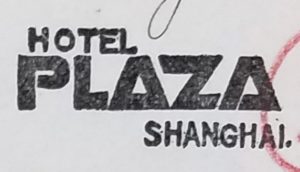
A couple of nice logos from Shanghai’s old Plaza Hotel (courtesy of Doug Clark). The Plaza was at 36 Rue Montauban (Sichuan Nan Lu nowadays) in the French Concession, next to St Joseph’s Church. Quite a contemporary logo and they felt it a good marketing idea to stress that the hotel was ‘absolutely fireproof’.
I’m sure everybody knows but I would just mention that, should you be fortunate enough to be in Washington DC before June 23 you have a chance to see this…
The lives of the Qing dynasty empresses offer a compelling tale of
opulence and influence as told in this first-ever, in-depth exhibition
of the subject. Their vital presence over the 260-year course of the
Qing is brought to light through an unprecedented assembly of
spectacular objects. Featured are royal portraits, paintings depicting
court life, seals and symbols of imperial power, Buddhist sutras and
other objects of religious devotion, along with costumes, jewelry,
tableware, and furniture that were used by the empresses in the imperial
complex known as the Forbidden City.
The empresses’ significance in shaping Qing history is told through
the objects made for, about, and by them. Dispelling a common
misapprehension that the women were passive figures, the exhibition
breaks stereotypes of them as being merely glamorous or subservient
wives. Instead, these women frequently traveled, rode horses, and
performed myriad royal duties, from playing a dynamic role in the
imperial family to being praised as the “Mother of the State.†Many
empresses expressed ambition, displayed intelligence, and some
challenged protocol—even the tradition that “women shall not rule.†The
exhibition allows us to see how the empresses exerted influence in the
arts, religion, politics, and diplomacy. By reclaiming multiple
dimensions of their lives, we also direct attention to the broader issue
that women’s accomplishments are too often left untold.
Most of these artworks are from the Palace Museum, and many have never been exhibited outside of China. This extraordinary exhibition, accompanied by a major catalogue, is organized by the Peabody Essex Museum in Salem, Massachusetts; the Freer|Sackler in Washington, DC; and the Palace Museum in Beijing, China.
Talking a couple of days ago of the French writer Roland Dorgeles and his 1926 On the Mandarin Road travelogue to French Indo-China, here’s his 1928 novel Departure about a Messagerie Maritime voyage on a liner from Marseille to Saigon. It is largely forgotten now but was, apparently, a classic of the popular genre in the 1920s of la litterature d’escale, or port-of-call novels…