One of the things I find myself arguing about on the internet quite regularly is the opening of the Forbidden City and the National Palace Museum to tourists. Many mainland Chinese, and a a fair few foreigners in China, often argue that the Forbidden City was opened up for people to see by the Communist Party in 1949.
Of course this isn’t true. Since 1925, the Forbidden City has been under the charge of the Palace Museum, whose extensive collection of artwork and artifacts were built upon the imperial collections of the Ming and Qing dynasties. And here’s an old ad for any 1920s visitors to Peking who may be interested….
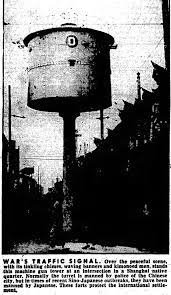
Not sure of the exact location of this machine gun tower, pictured in August 1937, after the Japanese attack on the Chinese/Northern quarters of Shanghai. I think the towers were often adapted traffic towers (such as the one shown below here)….
Here are two ads from the 1930s for Thomas Cook – now sadly no longer (thanks to director and corporate greed) – they graced the Bund in Shanghai and the glorious old Queen’s Building in Hong Kong…
The Queen’s Building, by Statue Square and the then boundary with Victoria Harbour – demolished in 1963…
The story of Hong Kong
is one of almost constant change. From a sleepy fishing community, Hong
Kong has grown into one of the most significant financial and trading
centres of the world.
Hong Kong Island has witnessed massive rebuilding over the years, with the result that much of the colonial-era architecture has been swept away and replaced by skyscrapers. Moreover the first high-rise buildings constructed from the late 1950s onwards are now themselves under threat as the constant requirement for more accommodation – both for people and for businesses – continues. Over the years, photographers have recorded the changing face of Hong Kong: its street scenes, buildings and people. This new book – drawing upon images from a wide range of sources, many of which are previously unpublished – is a pictorial tribute to this lost Hong Kong. Once familiar but now long-gone scenes are recorded, offering a tantalising glimpse back at an era which in chronological terms may be relatively recent, but given the rapidity of change, seems like a distant age.
To see more and order – https://www.blacksmithbooks.com/books/lost-hong-kong-a-history-in-pictures/
Bertram Simpson, aka Putnam Weale, is one of the most interesting foreigners in early twentieth century China. He is best remembered now for his book Indiscreet Letters From Peking By the time of the First World War he was serving as the Daily Telegraph correspondent in Peking from and had devoted himself to writing – a jobbing hack, begging up newspaper work, earning a few coppers stringing for the new-fangled wire services, penning pretty bad sensationalist novels – for instance, The Silver Sutra (1934) featuring dashing adventurers and beautiful women in Mongolia hunting priceless silver and fighting Russian bandits…The book was published posthumously as Simpson was hacked and shot to death in a Tientsin street in 1930…(but that’s another story!)
Architecture is the soul of a city and civilization. Over thousands of years, western architectural history has never recognized the classification of Chinese or East Asian architecture until prominent architectural historians like Zhu Qiqian and Liang Sicheng, through the work of the Society for Research in Chinese Architecture, put it on the map. Throughout China, we can still see the remains of these beautiful ancient structures, some very well-preserved with support from government and civil society organizations, but others left in isolation and dilapidation. How do we interpret the beauty and function of these ancient structures today? And more importantly, how can we continue to preserve their magnificence and dignity for years to come?
ANNIE YANG ZHOU: Annie Zhou is Director of External Affairs at the U.S.-China Green Fund and Executive President of the corporate foundation which focuses on environmental education and action. Previously, Annie worked in financial services, a policy think tank, and founded her own strategy consulting company. She earned her MBA from University of Oxford’s Saïd Business School, MPA from Columbia University’s School of International and Public Affairs, where she serves as an ambassador, and her BBA from George Washington University. She is also on the International Advisory Committee of Miss Porter’s School. PROF. WANG NAN: Wang Nan had received a Bachelor of Architecture in School of Architecture from Tsinghua University in 2001 and PHD in School of Architecture from Tsinghua University in 2008 with Professor Wu Liangyong as the supervisor. He had been lecturer in School of Architecture in Tsinghua University since 2009, teaching the architectural design and urban design courses. He had been the Visiting Professor in Institute of The Forbidden City in Beijing since 2019. He had been the Associate of The Chinese Art Media Lab(CAMLab)of the Department of History of Art and Architecture in Harvard University since 2019. His main research interests are History of Chinese Traditional Architecture and Proportions of Chinese Historical Architecture. MATTHEW HU (HU XINYU): As China Representative of the Prince’s Foundation School of Traditional Arts, Matthew represents the Prince’s School in China, manages all of the School’s Chinese contacts and relationships; and coordinates the School’s activities in China. In November 2013, Matthew and two other friends started an educational project called “the Courtyard Instituteâ€, aiming at increasing visibility of traditional culture education in the public, as well as exploring a new methodology for alternative education. From October 2009 to November 2014, Matthew served for five years in the Prince’s Charities Foundation (China), a sister charity of PSTA, as its China Representative. From July 2006 to March 2009, Matthew worked as the Managing Director of Beijing Cultural Heritage Protection Center (CHP). As the first professional Managing Director of the organization, Matthew set a solid foundation for its development strategy, overall project management and general administration system. In October 2015, Matthew accepted the invitation of Mr. He Shuzhong, the founder of CHP, to take up the role of trustee for the next three years. He is now also playing a leading role for reorganizing a new board for CHP. Prior to joining CHP, Matthew worked for five years in the tourism industry with WildChina Company Limited, handling inbound China travel programs for non-profit and educational institutions. A graduate of the Beijing Second Foreign Language Institute in 1997 with a BA in English Literature, Matthew has over the years developed a focus on Chinese history and religion.
A panel discussion on architecture, preservation and heritage.
WHAT: A panel discussion on architecture, preservation and heritage WHEN: Tuesday Sept. 24 from 7:30 PM to 9:00 PM WHERE: The Beijing Bookworm, Bld 4, Nan Sanlitun Road, Chaoyang District, Beijing tel: 6586 9507 HOW MUCH: RMB 60 (includes one welcome drink); free for members of RASBJ or Bookworm (this does not include a welcome drink)