Destination Shanghai: The Lost, the Wanted, the Famous & the Forgotten Sojourners to China (moderated by NPR’s Rob Schmitz)…23/3/19 – 4pm – M on the Bund, Shanghai…
From the brief but crazy visits of American playwright Eugene O’Neil and British occultist Aleister Crowley, to recruiting spies on the Suzhou Creek while German silent movie stars flee from the Nazis to Hongkou. From the success of the Russian refugee chorus girls who became Hollywood stars and the writers who found their muse on the Bubbling Well Road, to the tragic murders and crimes of passion that characterised the darker side of Shanghai in the first half of the twentieth century. From around the world a fascinating range of people, at one time or another heard the siren call of Shanghai.
And I’ll be moderating the Australian travel writer Richard Fidler in taking about ancient Constantinople – 22/3/19 – 12 noon – M on the Bund…
Richard Fidler is the author of Ghost Empire, a history of the medieval Roman city of Constantinople. A thousand years ago, Constantinople was the greatest and richest metropolis in Europe. People from all over the world described it as a mirror of heaven. The Vikings called it ‘Miklagard’, the Big City. In China, it was known as Fu-Lin, a city of enormous granite walls and fantastical creatures. Positioned on the threshold of Europe and Asia, Constantinople became one of the world’s great centres of trade and culture. Yet the story of the city, and the great empire it ruled over, has largely been forgotten in the West. Richard Fidler and Paul French discuss the story of this lost city, and how its culture continues to haunt the world.
More details on booking tickets and other events – https://yoopay.cn/host/m-restaurantgroup?showevent=1
I missed Patrick Fuliang Shan’s new study of Yuan Shikai when it came out last year – better late than never – well worth a read and a nice bit of colourisation on the cover! (see my post yesterday)….
Yuan Shikai (1859–1916) has been both hailed as China’s George
Washington for his role in the country’s transition from empire to
republic and condemned as a counter-revolutionary. Yuan Shikai: A Reappraisal
sheds new light on the controversial history of this talented
administrator and modernizer who endeavoured to establish a new dynasty
while serving as the first president of the republic, eventually
declaring himself emperor. Drawing on untapped primary sources and
recent scholarship, Patrick Fuliang Shan offers a lucid, comprehensive,
and critical new interpretation of Yuan’s part in shaping modern China.
BiblioAsia is the quarterly journal promoting the collections and programmes of the Singapore National Library, and aims to foster research and learning in the history, arts and culture of Singapore and Southeast Asia. I happen to have an article that may interest some of you in their latest issue (Jan-Mar, 2019)…and no, it’s not about Raffles…
My article is entitled The Singapore Stopover: The Asian Entertainment Circuit, 1920-1940 – Between 1920 and 1940, the city was a favoured pit stop for foreign entertainers and boxers who appeared at the Victoria Theatre and the Happy World. I take a look at the Singapore antics of European exhibition dance duo Joe and Nellie Farren; Bobby Broadhurst (below), an Australian singer; and Andre Shelaeff and others who toured Asia’s boxing circuit, centred on Singapore….
You can download the entire edition with my article here – https://www.nlb.gov.sg/browse/biblioasia.aspx
Some time ago Joanie Shirm was kind enough to share with me some of her father’s letters from Shanghai. She was, at the time, researching he family history. Now she has published it (Potomac Books)….It isn’t all Shanghai; but it is all fascinating…
After the death of Joanie Holzer Schirm’s parents in 2000, she found hundreds of letters, held together by rusted paperclips and stamped with censor marks, sent from Czechoslovakia, Great Britain, China, and South and North America, along with journals, vintage film, taped interviews, and photographs. In working through these various materials documenting the life of her father, Oswald “Valdik†Holzer, she learned of her family history through his remarkable experiences of exile and loss, resilience and hope.
In this posthumous memoir, Schirm elegantly re-creates her father’s youthful voice as he comes of age as a Jew in interwar Prague, escapes from a Nazi-held army unit, practices medicine in China’s war-ravaged interior, and settles in the United States to start a family. Introducing us to a diverse cast of characters ranging from the humorous to the menacing, Holzer’s life story is an inspirational account of survival during wartime, a cinematic epic spanning multiple continents, and ultimately a tale with a twist—a book that will move readers for generations to come.
Daisy Yan Du’s book looks excellent and does start in the 1940s….
China’s role in the history of world animation has been trivialized or largely forgotten. In Animated Encounters Daisy
Yan Du addresses this omission in her study of Chinese animation and
its engagement with international forces during its formative period,
the 1940s–1970s. She introduces readers to transnational movements in
early Chinese animation, tracing the involvement of Japanese, Soviet,
American, Taiwanese, and China’s ethnic minorities, at socio-historical
or representational levels, in animated filmmaking in China. Du argues
that Chinese animation was international almost from its inception and
that such border-crossing exchanges helped make it “Chinese†and
subsequently transform the history of world animation. She highlights
animated encounters and entanglements to provide an alternative to
current studies of the subject characterized by a preoccupation with
essentialist ideas of “Chineseness†and further questions the long-held
belief that the forty-year-period in question was a time of cultural
isolationism for China due to constant wars and revolutions.
China’s
socialist era, known for the pervasiveness of its political propaganda
and suppression of the arts, unexpectedly witnessed a golden age of
animation. Socialist collectivism, reinforced by totalitarian politics
and centralized state control, allowed Chinese animation to prosper and
flourish artistically. In addition, the double marginality of
animation—a minor art form for children—coupled with its disarming
qualities and intrinsic malleability and mobility, granted animators and
producers the double power to play with politics and transgress
ideological and geographical borders while surviving censorship, both at
home and abroad.
A captivating and enlightening history, Animated Encounters will attract scholars and students of world film and animation studies, children’s culture, and modern Chinese history.
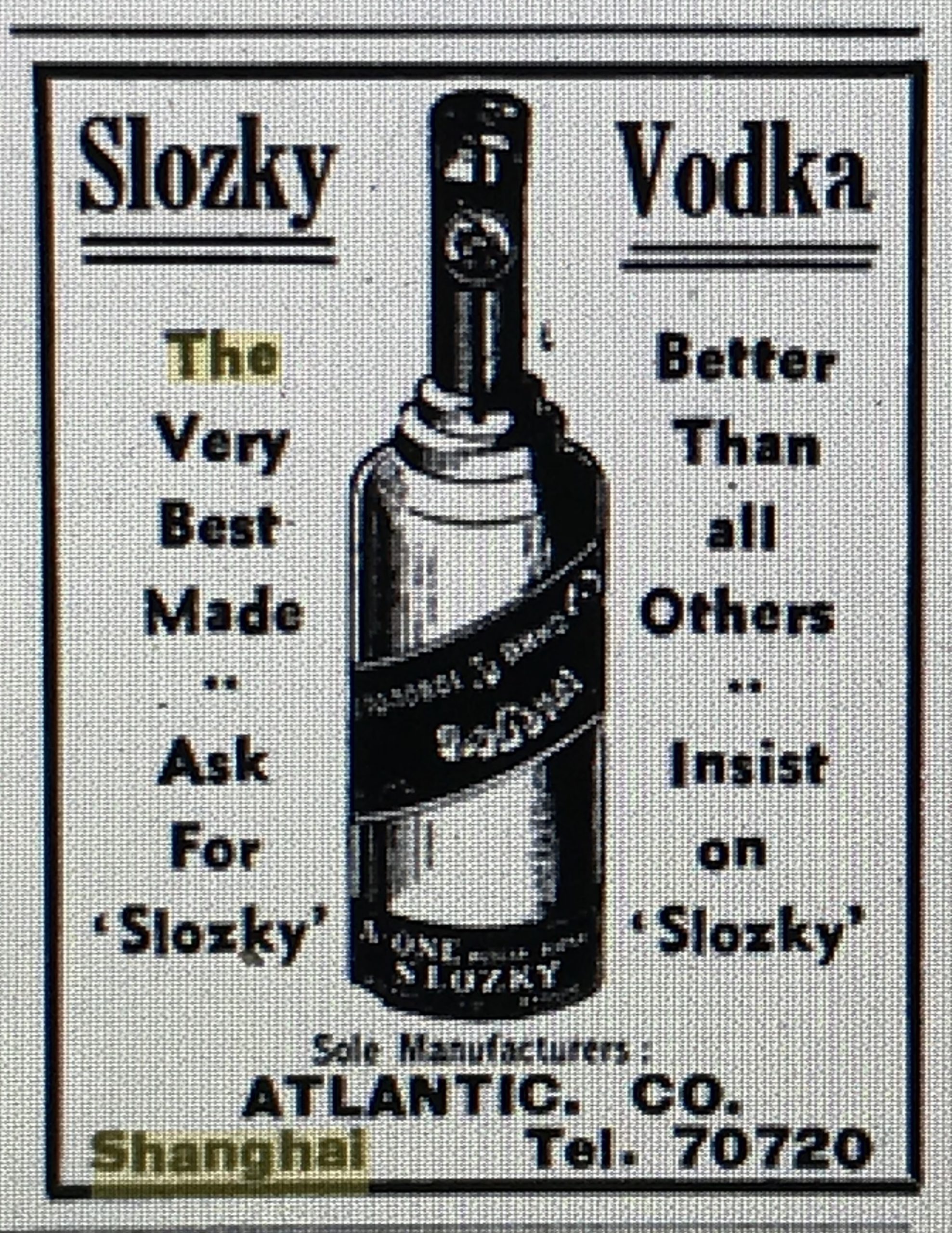
A little mystery here – an advert in Shanghai for Slozky Vodka from the 1930s. The usual sort of marketing – the ‘best’, ‘ask for’ etc. However, I can find no other references to Slozky Vodka from the 1930s or any other time period?
I don’t know the supposed manufacurers – Atlantic Company either. Could it be that someone was brewing up backdoor hooch and selling its as Russian/Polish/whatever vodka in Shanghai to unsuspecting boozers? I know Russian emigres were cooking up various bootleg samogen for their own consumption – but selling it as a branded product?
“I can’t say what made me fall in love with Vietnam – that a woman’s voice can drug you; that everything is so intense. The colors, the taste, even the rain. Nothing like the filthy rain in London. They say whatever you’re looking for, you will find here. They say you come to Vietnam and you understand a lot in a few minutes, but the rest has got to be lived. The smell: that’s the first thing that hits you, promising everything in exchange for your soul. And the heat. Your shirt is straightaway a rag. You can hardly remember your name, or what you came to escape from. But at night, there’s a breeze. The river is beautiful. You could be forgiven for thinking there was no war; that the gunshots were fireworks; that only pleasure matters. A pipe of opium, or the touch of a girl who might tell you she loves you. And then, something happens, as you knew it would. And nothing can ever be the same again.â€