I came across this colourful edition of Hans-Otto Meissener’s The Man With Three Faces, his 1955 biography of the Russian super spy who operated in Shanghai and Tokyo, Richard Sorge. It’s not the most detailed biography of Sorge (and there’s a new one out just recently) but Meissner was secretary to General Eugen Ott, the Nazi Ambassador in Tokyo who came under Sorge’s sway and met him a number of times. Indeed Sorge attended Meissner’s wedding in the gardens of the German Embassy in Tokyo…
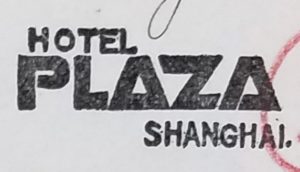
A couple of nice logos from Shanghai’s old Plaza Hotel (courtesy of Doug Clark). The Plaza was at 36 Rue Montauban (Sichuan Nan Lu nowadays) in the French Concession, next to St Joseph’s Church. Quite a contemporary logo and they felt it a good marketing idea to stress that the hotel was ‘absolutely fireproof’.
I’m sure everybody knows but I would just mention that, should you be fortunate enough to be in Washington DC before June 23 you have a chance to see this…
The lives of the Qing dynasty empresses offer a compelling tale of
opulence and influence as told in this first-ever, in-depth exhibition
of the subject. Their vital presence over the 260-year course of the
Qing is brought to light through an unprecedented assembly of
spectacular objects. Featured are royal portraits, paintings depicting
court life, seals and symbols of imperial power, Buddhist sutras and
other objects of religious devotion, along with costumes, jewelry,
tableware, and furniture that were used by the empresses in the imperial
complex known as the Forbidden City.
The empresses’ significance in shaping Qing history is told through
the objects made for, about, and by them. Dispelling a common
misapprehension that the women were passive figures, the exhibition
breaks stereotypes of them as being merely glamorous or subservient
wives. Instead, these women frequently traveled, rode horses, and
performed myriad royal duties, from playing a dynamic role in the
imperial family to being praised as the “Mother of the State.†Many
empresses expressed ambition, displayed intelligence, and some
challenged protocol—even the tradition that “women shall not rule.†The
exhibition allows us to see how the empresses exerted influence in the
arts, religion, politics, and diplomacy. By reclaiming multiple
dimensions of their lives, we also direct attention to the broader issue
that women’s accomplishments are too often left untold.
Most of these artworks are from the Palace Museum, and many have never been exhibited outside of China. This extraordinary exhibition, accompanied by a major catalogue, is organized by the Peabody Essex Museum in Salem, Massachusetts; the Freer|Sackler in Washington, DC; and the Palace Museum in Beijing, China.
Talking a couple of days ago of the French writer Roland Dorgeles and his 1926 On the Mandarin Road travelogue to French Indo-China, here’s his 1928 novel Departure about a Messagerie Maritime voyage on a liner from Marseille to Saigon. It is largely forgotten now but was, apparently, a classic of the popular genre in the 1920s of la litterature d’escale, or port-of-call novels…
This undated postcard is labelled “Shanghai, Hongkew Park” (which is now Lu Xun Park). However, i think it is the old Quinsan Gardens. Hongkew Park was (and remains) far larger than this. True – Quinsan Gardens was a park in Hongkew (Hongkou), but they were too different places….
the mis-labelled card
Quinsan Gardens, or alternatively Quinsan Square, just off Quinsan Road (now Kunshan Hua Yuan Road) was named after the town (often spelt Qinsan or Qinshan) in Zhejiang Province. Actually the Gardens (pictured below – as well as misidentified above) were not entirely a park but a road with a green square for the public.
However, they were a centre of serious do- gooding. The Nurses Association of China was based along the road (10) as well as The China Christian Educational Association and the China Continuation Committee (dedicated to linking up all Christians across China) which was at No. 5 with its Christian Book Room at No. 3, while the China Christian Endeavour Union was at No. 1, run by Mr. and Mrs. Edgar E. Strother (who eventually gave up missionary work in Shanghai to “convert the heathen of New Yorkâ€). Given the presence of all these nurses and missionaries, both believed to be good-hearted, the Gardens became a congregating spot for beggars hoping for plenty of charitable donating from those visiting the local offices.
a correctly labelled postcard of Quinsan Gardens..sadly long gone to redevelopment
French novelist Roland Dorgelès’s 1926 On the Mandarin Road, a journey through Vietnam, Cambodia and other part of French Indo-China. The small American review is rather succinct and does capture the essence of the travelogue…
The North Sichuan Road, like today’s Sichuan Bei Lu, ran from Avenue Edward VII (Yanan Lu), the border between the International Settlement and Frenchtown, as far as the northern edge of the Settlement at Range Road (now Wujin Road). Beyond that it was in Chinese territory, though the Settlement had a lot of sway and the area became known as The Northern External Roads. Around the early 1930s the somewhat substandard Sichuan North Road between Range Road and Hongkou Park (now Lu Xun Park), where it ends, was upgraded with a better roadway, utilities and new housing. It became quite desirable, though a little way beyond the Settlement boundaries, and was on the trolleybus route. Further south Sichuan North Road had long been popular with foreigners and so the northern extension would prove to be while still retaining a very Chinese flavour.
The following is from a piece by Lu Xun called ‘Shanghai Children’ and published in Vol.2, issue 9 of the Shen bao Monthly in September 1933. This translation of the opening two paragraphs is by Andrew F. Jones and appears in the new Lu Xun collection Jottings Under Lamplight (edited by Eileen J Cheng & Kirk A Denton – Harvard University Press)…
‘The newly built section of Sichuan North Road just beyond the boundary of the concessions went quiet for the better part of a year because of the war (i.e. the Battle of Shanghai, Jan-March 1932), but this year (i.e. summer 1933) it’s as lively as ever. The stores have moved back from their safe haven in the French Concession, the cinemas have long since re-opened (including the famous Isis), and you often see lovers walking hand in hand in the vicinity of the park (Hongkou/Lu Xun Park). None of this was in sight last summer.
If you walk into the narrow residential alleys, you’ll see public toilets, cooked rice sold from carrying poles, swarms of mosquitoes flying through the air, groups of children making mischief, dramatic disturbances, richly developed obscenities. It is truly a chaotic little world unto itself. Yet once you come back out to the boulevard, what projects itself into your vision are the spirited and lively foreign children playing and walking down the sidewalk. Somehow it is as if the Chinese children are no longer visible. It is not that they aren’t there, just that with their shabby clothes and dispirited manner they have been reduced to shadows by the others and hardly catch one’s eye at all.’