Posted: August 30th, 2018 | No Comments »
Bill Savadove is a nice guy – really, honestly, I swear it…if you’d ever met him on Blood Alley you can rest assured he’d simply be reporting, not indulging…
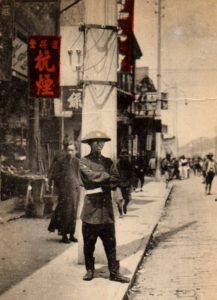
Here Bill takes a walk down the old Blood Alley (now just a truncated and dreary street, but once upon a time….) and recalls its heady past…
click here to read
Posted: August 23rd, 2018 | No Comments »
Tin Hats and Rice – A fascinating new memoir from Hong Kong’s Blacksmith Books – “I can’t visualise us getting out of this, but I want to TRY to believe in a future,” wrote 23-year-old Barbara Anslow (then Redwood) in her diary on 8th December 1941, a few hours after Japan first attacked Hong Kong. Her 1941-1946 diaries (with postwar explanations where necessary) are an invaluable source of information on the civilian experience in British Hong Kong during the second world war. The diaries record her thoughts and experiences through the fighting, the surrender, three-and-a-half years of internment, then liberation and adjustment to normal life. The diaries have been quoted by leading historians on the subject. Now they are available in print for the first time, making them available to a wider audience.

Posted: August 22nd, 2018 | No Comments »
The Mapping of Asia
A collection of fine antique maps from 16th to 20th century including city plans and nautical charts
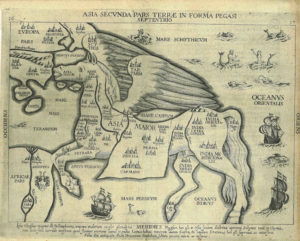
Heinrich Bunting – map of Asia as Pegasus 1646
from 30th August 2018 until 30th September 2018
Wattis Fine Art Gallery
www.wattis.com.hk
Gallery open: Monday – Saturday 11am – 6pm
Posted: August 21st, 2018 | No Comments »
Having offered up a brief factoid about the shared accommodations (quite a while apart admittedly) of Arthur Waley and George Chinnery I offer another – I had not know that Waley also met with Ella Maillart, the Swiss explorer, photographer, author and the woman who crossed China with Peter Fleming back in the thirties (i have blogged about her before – see search engine).
How did Waley (who famously never went to China) know Maillart? Apparently in 1937 Waley was skiing in Kitzbuhel in Austria and had an acquaintance with both Ian and Peter Fleming (who had recently married the film star Celia Johnson who was with him on the slopes) who were there too. Through Peter Waley was introduced to Maillart. Maillart would presumably have been aware of Waley’s translations and he aware of her travels in China.
It appears that after that meeting in Kitzbuhel Waley and Maillart did communicate by letter occasionally. They did also, it seems, meet once more, in the 1950s, when Waley was again in Switzerland and visited Maillart at her home in the Alpine village of Chandolin. A photograph of Waley leaning against her fireplace is mentioned (though appears to be lost).
I’d love to know what they talked about….

Waley on the slopes in Switzerland

Maillart with a parasol
Posted: August 20th, 2018 | No Comments »
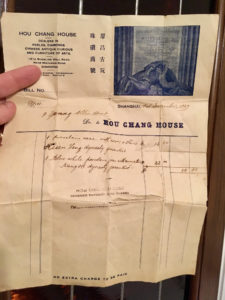
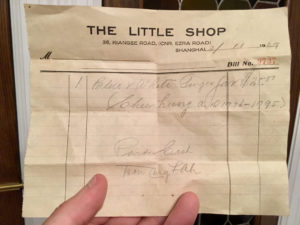
After yesterday’s post on the Little Shop I am grateful, once again, to Mike Franco for also sending me a receipt and a very elaborate receipt it is too) he acquired from old Shanghai’s Hou Chang House – “Dealers in Perles (sic), Diamonds, Chinese Antiques Curious and Furniture of Arts”
The Hou Chang House store was on the Bubbling Well Road (Nanjing West Road) by Moulmein Road (Maoming Road North) – in 1929 someone living in Young Allen Court (still standing on Chapoo Road/Zhapu Road) bought several lovely items. Hou Chang House is shown at No.151 in 1929, but in the mid-1930s they changed all the road numbering on the Bubbling Well Road for some reason and it is later listed as No.1465. And just for the nerds – their telephone number was 38364!
Posted: August 19th, 2018 | No Comments »
Some time back I posted on the Little Shop – an antiques and curios store that used to be on Shanghai’s Kiangse (Jiangxi Road) run by Mrs Boyd…
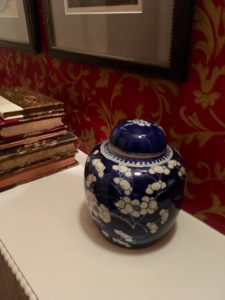
My thanks to Mike Franco in the United States who sent me a picture of a Chinese ginger jar he recently acquired at auction in America and which contained inside the original sales receipt from the Little Shop….
Posted: August 17th, 2018 | No Comments »
George Chinnery died in Macao in 1852; Arthur Waley was born in Royal Tunbridge Wells in 1889. Of course these two men – the painter/roué and the Sinologist/translator (with his own troubled private life not unlike Chinnery) – never met. However, I suspect they inhabited the same space at different times. Here’s the link….
A couple of years ago, reading a biography of Chinnery, I noted that his last studio in London before he sailed for India and began his life in the East was at 20 Brook Street, W1 – the building, originally completed in 1737, still stands and still has a nice top floor with plenty of light for an artist (the reason Chinnery was attracted to the building). I blogged about that building here…

I just happened this week to be reading A Half of Two Lives, the (sort of) autobiography of Alison Grant (then Alison Robinson and finally Alison Waley) who was for many years Arthur Waley’s companion/mistress (he remained attached to the dancer and translator Beryl de Zoete till her death in 1962) and eventually married Waley shortly before his death in 1966. Alison was herself something of an artist and poet and she lived with her husband at 20 Brook Street during the Blitz. She recalls the large windows and it seems Waley did visit her there, though neither I believe notice of it having previously been Chinnery’s studio. I assume she didn’t know as, I also assume, had she then this fact would have interested both Alison and Arthur given their Sinological leanings.


Anyway, here is the building today – you can still see the large windows on the top floor where, for a while, Chinnery painted, and where, for a later while, Alison and Arthur Waley took tea and (it’s a complicated memoir) did whatever!

Posted: August 17th, 2018 | No Comments »
Bespoke Beijing’s next Midnight in Peking Walking Tour takes place on Saturday, August 25th. Perfect for fans of the book, history buffs and those looking for a Saturday night out with a difference!
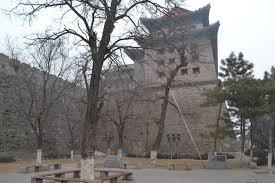
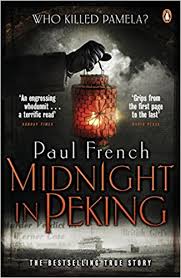
Paul French’s New York Times bestselling murder mystery captured imaginations across the world when it was released. Now, with the help of historian Lars Ulrick Thom, Bespoke brings 1930s Peking back to life through a walking tour like no other. As night falls, you’ll follow in the footsteps of the victim’s father, ETC Werner, as he frantically searched for his daughter, and learn about the shady characters implicated in her killing.
Saturday, August 26th, tickets 388RMB, email info@bespoke-beijing.com