All things old China - books, anecdotes, stories, podcasts, factoids & ramblings from the author Paul French

AFONG, A Photographer in Hong Kong, Wattis Fine Art, Hong Kong – 21/6/18 – 21/7/18

Posted: June 18th, 2018 | No Comments »

AFONG, A Photographer in Hong Kong

a collection of original albumen prints of

Hong Kong, Canton and Macao

c.1860 – 1890

from Thursday 21st June 2018

Afong – Wellington Street, Hong Kong c.1879

The exhibition continues until Saturday 21st July 2018

Wattis Fine Art Gallery
20 Hollywood Road, 2/F, Central, Hong Kong
Tel. +852 2524 5302 E-mail. info@wattis.com.hk

www.wattis.com.hk
Gallery open: Monday – Saturday 11am – 6pm


Rocket Man: Nuclear Madness and the Mind of Donald Trump

Posted: June 11th, 2018 | No Comments »

This new collection of essays – Rocket Man: Nuclear Madness and the Mind of Donald Trump – was just published (rather good timing). The editors asked me to contribute an essay (most are psychologists and psychiatrists looking at President Trump’s relationship and rhetoric concerning the DPRK and his possible state of mind as regards nuclear weapons/attacks). So I did – The Relentless Victim: How Donald Trump Reinforces North Korea’s Narrative


Will President Trump destroy civilization or win the Nobel Peace Prize? Humankind’s survival feels like a jump ball that could go either way. We are perched on a precipice, and the reason we are looking into an abyss of nuclear annihilation is that the American president has unencumbered, unilateral control over the nuclear codes. One thing we know for sure is that the mind of Donald Trump is currently in control of our fate. Never before have the nuclear codes been in the hands of a man who many observers view as unstable and erratic. The twenty-four experts who contributed to this book analyze President Trump’s behavior hoping to provide insights into what may be the most urgent question of our time. What will Trump do with his “big button?”

Table of Contents:
Chapter 1: The Erratic President
-Harry Segal, PhD, Cornell University

Chapter 2: Nuclear Risk is Rising as Donald Trump Goes Downhill
-John Gartner, PhD, Founder, Duty To Warn

Chapter 3: If President Trump Were Airman Trump, I Would Not Certify Him Psychologically Fit to Handle Nuclear Weapons
-Steven Buser, MD, Psychiatrist, Former Major, USAF

Chapter 4: If Trump Were a Policeman I Would Have to Take Away His Gun
-David Reiss, MD

Chapter 5: If Trump Was Entering the Military, He Would Not Receive a Security Clearance
-William Enyart, Former U.S. Congressman & Retired General

Chapter 6: A Man with No Humanity Has the Power to Destroy Mankind
-Lance Dodes, MD

Chapter 7: Trump’s Sick Psyche and Nuclear Weapons: A Deadly Mixture
-Gordon Humphrey, former Republican Senator

Chapter 8: Facing the Truth: The Power of a Predatory Narcissist
-Jacqueline West, PhD

Chapter 9: Trump’s No Madman, He’s Following the Strongman Playbook
-Ruth Ben-Ghiat, Dept. of History, NYU

Chapter 10: The Gospel of War Presidency
-Richard Painter, Former Chief White House Ethics Lawyer
-& Leanne Watt, PhD

Chapter 11: The Greatest Danger to America is Her Commander in Chief
-Joe Cirincione, President, Ploughshares Fund

Chapter 12: Bluffing Us Into the Nuclear Abyss?
-James Blight and Janet Lang, Dept. of History, Univ. of Waterloo

Chapter 13: One Week in August: How a Self-Made Nuclear Crisis Exposed Donald Trump’s Psychopathology
-Seth Norrholm PhD

Chapter 14: The Bully-in-Chief
-Philip Zimbardo, PhD & Rosemary Sword

Chapter 15: American Carnage: The Wars of Donald Trump
-Melvin Goodman, Johns Hopkins

Chapter 16: Taking Trump’s Finger off the Nuclear Button
-Tom Z. Collina, Director of Policy, Ploughshares Fund

Chapter 17: Is Donald Trump a Fascist?
-BÃ¥rd Larsen, Historian

Chapter 18: The Relentless Victim: How Donald Trump Reinforces North Korea’s Narrative
-Paul French, Freelance Writer

Chapter 19: Trump and North Korea: The Offer for Talks Was Impulsive, but Could it Work?
-Stephan Haggard, Director, Korea-Pacific Program

Chapter 20: The Art of the North Korea Deal
-Harry Kazianis, Director of Defense Studies, The Center for the National Interest

Chapter 21: Madman or Rational Actor? Kim Jong-un’s Nuclear Calculus
-Ken Gause, Director, International Affairs Group CNA Corporation

Chapter 22: How Presidential Actions Raise or Lower the Risk of War
-James E. Doyle, PhD Former Nuclear Nonproliferation Analyst, Los Alamos National Laboratory

Chapter 23: Extinction Anxiety and Donald Trump
-Thomas Singer, MD

Afterword: Visions of Apocalypse and Salvation
-Leonard Cruz, MD


Navigating Semi-Colonialism: Shipping, Sovereignty, and Nation-Building in China, 1860–1937

Posted: June 6th, 2018 | No Comments »

Anne Reinhardt’s new book on ships, shipping and nation building in China looks very interesting….

China’s status in the world of expanding European empires of the nineteenth and early twentieth centuries has long been under dispute. Its unequal relations with multiple powers, secured through a system of treaties rather than through colonization, has invited debate over the degree and significance of outside control and local sovereignty. Navigating Semi-Colonialism examines steam navigation—introduced by foreign powers to Chinese waters in the mid-nineteenth century—as a constitutive element of the treaty system to illuminate both conceptual and concrete aspects of this regime, arguing for the specificity of China’s experience, its continuities with colonialism in other contexts, and its links to global processes.

Focusing on the shipping network of open treaty ports, the book examines the expansion of steam navigation, the growth of shipping enterprise, and the social climate of the steamship in the late nineteenth century as arenas of contestation and collaboration that highlight the significance of partial Chinese sovereignty and the limitations imposed upon it. It further analyzes the transformation of this regime under the nationalism of the Republican period, and pursues a comparison of shipping regimes in China and India to provide a novel perspective on China under the treaty system.


Remembering June 4 1989….

Posted: June 4th, 2018 | No Comments »


The Burlington Hotel, Bubbling Well Road

Posted: June 1st, 2018 | 2 Comments »

My eternal thanks to Jamie Carstairs and the Historical Photographs of China project at Bristol University for permission to use this image of the Burlington Hotel.

The Hotel features briefly in my new book City of Devils but, although I had read references to it in various places (not least the Shanghai Municipal Police records as a place of illegal gambling on occasion) I’d never seen a photo of it. It stood  at 135 Bubbling Well Road (now Nanjing Xi Lu) until they changed the numbers in the mid-1930s and it became 1225 (which has led to some confusion over the years as to where it was). It is now sadly under the enormous, and distinctly less appealing, JC Mandarin  Hotel. According to Edward Denison is his essay Chinoiserie: An Unrequited Architectural Affair contained within Anne Witchard’s collection British Modernism and Chinoiserie the hotel’s architects were the British firm of Robert Moorhead and Sidney Halse.

The hotel was around for a long time and may have had several iterations and lots of refurbishments and adjustments. It was one of the first hotels in Shanghai to offer central heating in all rooms (1904) as well as telephones in every suite and modern elevators. A certain Mr Bourke was a long serving manager.

Adverts from the mid-1930s offer single rooms at $8 and doubles for $15 – the hotel accepted Chinese guests. During the ‘Solitary Island’ period the hotel was occasionally a base for Free China hitmen sent into Shanghai by the Nationalists to assassinate supporters of Wang Jing-wei’s puppet collaborationist government. The hotel continued to operate as the Burlington during the war, though seems to have become a little more down-at-heel – they staged boxing matches in the ballroom to attract customers. ITs fortunes continued to fall – indeed during and after the war it was often referred to in memoirs as ‘seedy’ – signs saying ‘NO COOKING IN ROOMS’

You can see a luggage label for the Burlington here on the Picture This site

My post on “Old Bill” Hawkins and the Burlington Hotel gang is here


Image courtesy of David Noyce and Historical Photographs of China, University of Bristol.

When Shanghai Boo-ed Harold Lloyd

Posted: May 31st, 2018 | 2 Comments »

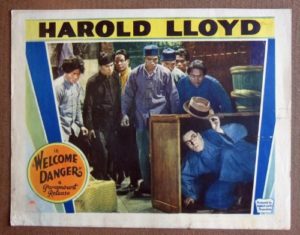
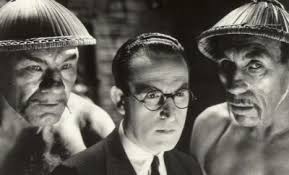
Silent-era comedy star Harold Lloyd’s first talkie Welcome Danger in 1930 was partly set in San Francisco’s Chinatown and featured some very negative portrayals of Chinese people which resulted in loud booing in Shanghai cinemas. This audience outrage, which the Shanghai Municipal Police reported almost turned violent, led to a change in policy in the Settlement. Whereas before the Nationalist government censors in Nanking had been able to censor and ban movies within the Chinese-controlled portions of Shanghai they had not been able to influence screenings within the foreign concessions. However, the Shanghai Municipal Police, concerned with public security (and at the urging of cinema managers fearing a boycott by Chinese patrons), agreed to liaise with the Nanking censors and potentially follow their lead on banning films. Welcome Danger was withdrawn after a short run in the Settlement and an apology issued to Chinese patrons by cinema managers.


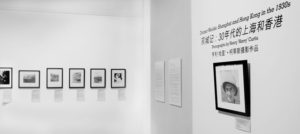
Distant Worlds: Shanghai and Hong Kong in the 1930’s – Museum of Chinese Australian History, Melbourne

Posted: May 30th, 2018 | No Comments »

The Museum of Chinese Australian History is launching a new exhibition that explores amateur photographer Henry (Harry) Curtis adventures in Shanghai and Hong Kong. The photographs taken over eighty years ago are from the Chinese Museum’s permanent collection.

Curtis captivating images reveal his rapport with the people he photographs despite language and cultural differences.

His photographs do not romanticize his subjects; he observes them and relates to them as people. Joyce Agee, Senior Curator, Chinese Museum

Many of the prints in the exhibition were produced by Curtis, a radiographer for British hospitals, and reflect his sophisticated skills in the darkroom.

Through Harry Curtis lens, we experience Distant Worlds and the Shanghai and Hong Kong of the mid-1930s. In less than seven years, these vibrant cities were to be immeasurably changed with the outbreak of WWII.

Dates:  - 
Times: 10am-4pm


The London Launch of Humphrey Hawksley’s ASIAN WATERS:The Struggle Over the Asia-Pacific and the Strategy of Chinese Expansion – 28/6/18, SOAS

Posted: May 29th, 2018 | No Comments »
The Directors of DUCKWORTH PUBLISHERS & RITA PAYNE MEDIA 
 
have the pleasure of inviting you to the launch of
 
ASIAN WATERS
The Struggle Over the Asia-Pacific and the Strategy of Chinese Expansion
 
by HUMPHREY HAWKSLEY
 
The author will be in conversation with television anchor, Stephen Cole, and Dr Kerry Brown, China specialist, King’s College London with contributions from experts in the audience.
 
Thursday 28th June 2018 from 6-7.30pm
Senate Room, First Floor, Senate House, University of London, Malet Street, London WC1E 7HU
 
After the discussion, guests are welcome to stay for a drinks reception where Humphrey will be
 signing copies of the book.
RSVP Eventbrite