Posted: February 25th, 2018 | No Comments »
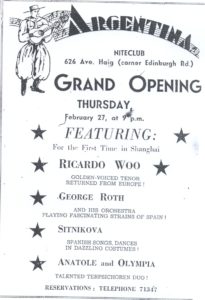
The old Argentina Club stood on the corner of Avenue Haig & Edinburgh Road (Huashan Lu & Jiangsu Lu) – what a nasty bunch of White Russian fascists they were too – their story today on my That’s Shanghai series on the old 1940s gangs of Shanghai…
Posted: February 25th, 2018 | No Comments »
The full line for the Shanghai International Literary Festival 2018 at M on the Bund is now up…click here
I’m there first weekend by the way with City of Devils….
Posted: February 23rd, 2018 | No Comments »
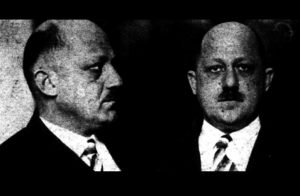
In the run-up to the Asian launch of City of Devils That’s Shanghai are running a daily who’s who of old time organized crime in Shanghai, my list of the Foreign Gangs of 1940s Shanghai…a gang a day for three weeks!! Today, we start with The Swiss….
Posted: February 19th, 2018 | No Comments »
For anyone interested I have somehow allowed myself to get talked into once more tramping the dark alleyways and hutongs of the fox spirit-riddled Peking Badlands and Legation Quarter in late March (during the Beijing Bookworm International Literary Festival) – however, there is an excellent dinner with fine wines at the end of the first walk which should more than compensate….(details from info@bespoke-beijing.com)

Posted: February 16th, 2018 | No Comments »
Down with Traitors – Justice and Nationalism in Wartime China by Yun Xia looks very interesting…
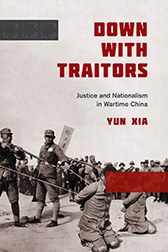
Throughout the War of Resistance against Japan (1931-1945), the Chinese Nationalist government punished collaborators with harsh measures, labeling the enemies from within hanjian (literally, “traitors to the Han Chinese”). Trials of hanjian gained momentum during the postwar years, escalating the power struggle between Nationalists and Communists. Yun Xia examines the leaders of collaborationist regimes, who were perceived as threats to national security and public order, and other subgroups of hanjian-including economic, cultural, female, and Taiwanese hanjian. Built on previously unexamined code, edicts, and government correspondence, as well as accusation letters, petitions, newspapers, and popular literature, Down with Traitors reveals how the hanjian were punished in both legal and extralegal ways and how the anti-hanjian campaigns captured the national crisis, political struggle, roaring nationalism, and social tension of China’s eventful decades from the 1930s through the 1950s.
Yun Xia is assistant professor of history at Valparaiso University.
Posted: February 15th, 2018 | No Comments »
Nostalgia in the Chinese City: Antony Dapiran and Paul French
Kowloon, Hong Kong, Friday 20th April 2018
click here for more details

In this Cha Reading Series event “Nostalgia in the Chinese City”, Cha contributors Antony Dapiran and Paul French will discuss nostalgia in their work and in the Chinese cities where they have lived and worked for many years. Moderated by Cha co-editor Tammy Ho Lai-Ming.
Nostalgia—from the Greek words nostos (‘homecoming’) and algia (‘pain’ or ‘ache)—a yearning for lost time and place, for a past where one perhaps felt more ‘at home’. We may feel nostalgia for our own past, or for earlier times we could not have personally known. And it seems that nowhere is this more sharply felt than in the rapidly developing metropolises of China. Our cities are sites of collective memory, and collective amnesia. Hong Kong, Shanghai, Beijing: all suffer forms of the “culture of disappearance”; all have ambiguous—sometimes wistful, sometimes problematic—relationships with the past. Whether in a tourist packed hutong, an old Shanghai-themed café, a G.O.D. store, or gazing at a lone junk sailing on Victoria Harbour—we encounter nostalgia triggers daily. It can be comforting or confusing, positive or negative. It is political and it is personal. Nostalgia is a community, even if those communities are long gone now.
NOSTALGIA IN THE CHINESE CITY
Date: Friday 20 April 2018
Speakers: Antony Dapiran and Paul French
Time: 7:30-8:45
Venue: tbc
FREE ADMISSION | ALL ARE WELCOME
ABOUT ANTONY DAPIRAN
Antony Dapiran is a Hong Kong-based writer, lawyer and photographer, and the author of City of Protest: A Recent History of Dissent in Hong Kong, published by Penguin. He has written extensively on China and Hong Kong business, politics and culture. A contributing editor of ArtAsiaPacific, his writing has also appeared in publications including the Australian Financial Review, the Sydney Morning Herald, The Australian, South China Morning Post, CNN International, Nikkei Asia Review, Hong Kong Free Press, Chart Collective and the LARB China Channel.
ABOUT PAUL FRENCH
Paul French is the author of the New York Times best seller Midnight in Peking (Penguin), currently being developed as a series for TV. He is visiting Hong Kong to launch his new book City of Devils: A Shanghai Noir (Penguin), centred on the dancehalls, casinos and cabarets of wartime Shanghai.
::::::::::
Cha Reading Series {http://bit.ly/2fnE9EE} takes the online journal out into the physical world. It brings together poets, writers, translators and artists who are in some way or other affiliated with Cha. Readings will take place in various impromptu locations across the city, in public and private rooms, lecture halls, on park benches, in front of billboards, next to a window scratched by tree branches. They will read their work informally or seriously. They will discuss issues, argue, debate and exchange. We also hope to form dialogue and explore specific pertinent topics that inspire or beset the contemporary world. Suggestions for future events can be sent to t@asiancha.com.
Posted: February 14th, 2018 | No Comments »
Now loyal and well read China Rhyming readers will know that Emily “Mickey” Hahn (who was many things, not all them polite to say, as well as a New Yorker correspondent in Shanghai) was famous for walking around Shanghai with her pet gibbon Mr Mills – famously sh would turn up to nightclubs, cabarets and Sir Victor Sassoon’s dinner parties with the awful thing in diapers to try and stop it doing what it invariably did – urinated or masturbated presumably to everyone’s a) great humour or b) chagrin.
But really Hahn was just old hat, just another American gal with a monkey in Shanghai…A good decade before Hahn arrived, in 1927, Anna Mae Morgan had a monkey, Mono, in Shanghai that caused plenty of guffaws and scenes. Actually it was her sons, but still…