Posted: December 21st, 2017 | 1 Comment »
Fear not – I’m not going to plug my own City of Devils: A Shanghai Noir (out March in Asia, May in Oz/NZ, June in the US and July in the UK) – but here’s some other Asia themed books I’ve had a chance to read early and think worth noting now for those who like to pre-order….
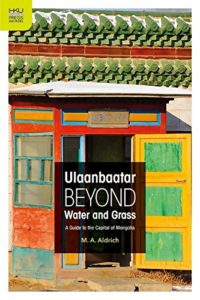 Ulaanbaatar beyond Water and Grass – Michael Aldrich – is the first book in the English language that takes the visitors to an in-depth exploration of the capital of Mongolia. In the first section of the book, M. A. Aldrich paints a detailed portrait of the history, religion, and architecture of Ulaanbaatar with reference to how the city evolved from a monastic settlement to a communist-inspired capital and finally to a major city of free-wheeling capitalism and Tammany Hall politics. The second section of the book offers the reader a tour of different sites within the city and beyond, bringing back to life the human dramas that have played themselves out on the stage of Ulaanbaatar. Where most guide books often lightly discuss the capital, Ulaanbaatar beyond Water and Grass: A Guide to the Capital of Mongolia reveals much that remains hidden from the temporary visitor and even from the long-term resident. Writing in a quirky, idiosyncratic style, the author shares his appreciation and delight in this unique urban setting—indeed, in all things Mongolian. The book finally does justice to one of the most neglected cultural capitals in Asia.
M. A. Aldrich is a lawyer and author who has lived and worked in Asia for nearly thirty years. He has previously published The Search for a Vanishing Beijing: A Guide to China’s Capital through the Ages and The Perfumed Palace: Islam’s Journey from Mecca to Peking in addition to numerous articles on Chinese and Mongolian law. He is currently writing a book about Lhasa.
 Patient X – David Peace – The acclaimed author of Occupied City, Tokyo Year Zero, and the Red Riding Quartet now gives us a stunning work of fiction in twelve connected tales that take up the strange, brief life of the brilliant twentieth-century Japanese writer, Ryunosuke Akutagawa. Haunting and evocative, brutal and surreal, these twelve connected tales evoke the life of the Japanese writer RyÅ«nosuke Akutagawa (1892-1927) whose short story, “In the Grove” served as an inspiration for Kurosawa’s famous film RashÅmon; and whose narrative use of multiple perspectives and different versions of a single event influenced generations of storytellers. Writing out of his own obsession with Akutagawa, David Peace delves into the known facts and events of the writer’s life and inner world–birth to a mother who was mentally ill and a father who died shortly thereafter; his own battles with mental illness; his complicated reaction to the beginnings of modernization and Westernization of Japan; his short but prolific writing career; his suicide at the age of 35–and creates a stunningly atmospheric and deeply moving fiction that tells its own story of a singularly brilliant mind.
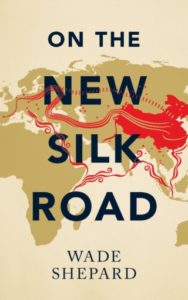 On the New Silk Road – Journeying Through China’s Artery of Power – Wade Shepherd – The Silk Road once served as the vital artery of the ancient world, connecting China to societies across Eurasia and providing immense wealth and prestige. Now, with China once again in the ascendant, it is attempting to restore its place at the centre of global trade, through one of the most ambitious projects of modern times. This ‘New Silk Road’ will use rail lines, highways, pipelines and shipping routes across China, Russia, the Middle East and Central Asia, unifying a region that has been contested for millennia. Having travelled the length and breadth of the future ‘Road’, from its planned starting point in Xi’an, China to its outer reaches in Western Europe, Wade Shepard provides an absorbing account of China’s efforts to make the New Silk Road a reality, and its implications for the world as a whole. Shepard argues that the Road represents the focal point of China’s plans for an alternative economic order which it hopes will rival or even surpass that of the West. On the New Silk Road is the essential account of a crucial turning point in the history of Asia, and of the world.
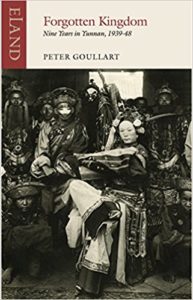 Forgotten Kingdom: Nine Years in Yunnan – Peter Goullart – as reissue of Goullart’s classic tale of how he spent nine years in the all-but-forgotten Nakhi Kingdom of south west China. He had a job entirely suited to his inquiring, gossipy temperament: to get to know the local traders, merchants, inn-keepers and artisans to decide which to back with a loan from the cooperative movement. A Russian by birth, due to his extraordinary skill in language and dialects, Goullart made himself totally at home in Likiang, which had been ruled by Mandarin officials descended from ancient dynasties, and was visited by caravans of Tibetan and Burmese travelling merchants, and such mysterious local highland peoples as the Lobos. In his company we get to hear about the love affairs and social rivalries of his neighbours, to attend magnificent banquets, meet ancient dowagers and handsome warriors as well as to catch the sound of the swiftly running mountain streams, the coarse ribaldry of the market ladies and the happy laughter emerging from the wine shops. Through him we are able to travel back to this complex society, which believed simultaneously and sincerely in Buddhism, Taoism and Confucianism, in addition to their ancient Animism and Shamanism.
Posted: December 20th, 2017 | No Comments »
I wrote my first piece for the Los Angeles Review of Books China Channel last week…the idea being to find some literary/historical-inclined vignettes with a Shanghai angle…and so, as the new film of The Bookshop is being released around the world, I thought I’d go back and look at Penelope Fitzgerald’s 1977 package holiday to China where, bored in a Shanghai hotel room, she started writing The Bookshop….click here to read…
Posted: December 19th, 2017 | No Comments »
I’ve been spotting opium references in popular culture with interest for a few years now (2016, 2015, 2014, 2013 & 2012) – just how opium keeps fascinating us…dope refs were still around in 2017, though I spotted a few less (maybe reflecting my reading/watching habits?), but still…
Chris Cleave in Everyone Brave is Forgiven has wartime morphine addiction and withdrawal while Abir Mukherjee in his great A Rising Man, set in Calcutta in 1919, had his hero, colonial police inspector SamWyndham, hitting the pipe in the city’s Chinatown after getting a taste for morphine in the trenches of France. Wyndham makes it to a second case in A Necessary Evil where his opium addiction gets, if anything, worse…


And of course we knew opium, or at least laudanum, would crop up finally in the excellent Taboo with Mr Hardy (James Delaney) taking a nice big swig….and, to be fair, he needed it after having his head split open by an assassin, slapped and scratched by his sister, beat up a few times and tortured by a variety of horrible practitioners (including the sinister Dr Ling!)…series 2 is apparently on the way. Meanwhile Gerard Depardieu was snorting the white powder in Netflix’s Marseille, as the city’s mayor no less – an addiction he picked up after getting on the morphine as a young man. Of course those ever sniffing Peaky Blinders were back on the “snow” in series 4.

Sadly so far there’s been no opium strictly speaking in The Crown – while Princess Margaret and Tony Snowdon might like a joint and we’ve seen Jackie Kennedy whacked out on Dr Feelgood’s injections, we’ve had little worse from Her Maj than that old Buck House favourite – Dubonnet.
Any other contemporary references in film, TV, books do let me know…

Posted: December 17th, 2017 | No Comments »
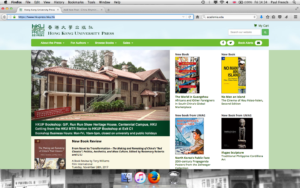
I constantly recommend books from HKUP on this blog and have written a few for them myself….so a new enhanced website is useful….
The new site features more information about HKUP’s books than ever before and makes it much simpler to discover gems on their list that you may have missed. They have ensured that the shopping cart represents state-of-the-art security, so you can make purchases online with confidence. The site contains a lot of information about the Press—for readers, prospective and current authors, instructors, book reviewers, . . . in short, for everyone!
the new website is here…
Posted: December 15th, 2017 | No Comments »
An excellent book from Katherina Zellweger on DPRK poster art….
This catalogue is published to coincide with the UMAG exhibition North Korea’s Public Face: 20th-century Propaganda Posters from the Zellweger Collection.

For most people outside of the Democratic People’s Republic of Korea (DPRK), it may come as a revelation that art is available in North Korea, or that it is a well-developed feature of national culture. As the state guides artistic production, all artists are members of the Korean Artists Federation, and must create a certain number of works each month to receive a salary.
Although the category of ‘Propaganda Artist’ is a lower-ranking designation than ‘People’s Artist’, the propaganda artists are given the vital task of keeping the population informed. Posters first came to prominence during the 1950–53 Korean War and they are still displayed prominently throughout the capital and countryside. Slogans are often taken from statements made by the country’s leadership and from newspaper editorials.
North Korean posters portray a wide variety of topics: from phrases reinforcing party policies to messages reiterating campaigns on culture, public health, education and sports. Works presented in this exhibition primarily illustrate topics related to agricultural development and food production—areas of particular interest based on the years that Katharina Zellweger has addressed food and food security-related issues.
Katharina Zellweger is a Research Fellow at Stanford University. She first visited North Korea in 1995, as the country was devastated by floods that contributed to a massive famine. As an employee of Caritas, the global Catholic organisation, she was among the first international aid workers on the ground. In the following years, she has made more than fifty trips and visited almost all of the country’s provinces, including the hardest-hit areas usually off-limits to foreigners. In 2006, she was offered a position as country director for the Swiss Agency for Development and Cooperation in Pyongyang. For the next five years, she lived in the North Korean capital and oversaw a series of projects. Her five-year tenure in Pyongyang coincided with a period in which North Korea gradually began to experiment with elements of economic reform, including private plots for farmers to grow and sell crops on the open market and the introduction of an incentive system to boost production.
the exhibition is still running at UMAG at HKU….

Posted: December 15th, 2017 | 2 Comments »
Prof. Richard de Grijs on 17th Century Exploration

How do we know where we are, or what time it is? In this era of smartphones and GPS, it’s hard to imagine how 17th century intellectuals answered such basic questions. Even how they communicated with one another – largely through letters – was different in the days before scientific journals. Prof. Richard de Grijs’ new book combines excerpts from many of these letters for the first time in a single volume, exploring how the uptick in world trade in the 17th and 18th centuries gave determinations of location and time strategic importance. In discussing his book “Time and Time Again: Determination of Longitude at Sea in the 17th Centuryâ€, de Grijs will lead us on a journey through time, back to when Europeans scrambled to measure positions at sea, following in the wake of Chinese admiral Zheng He’s voyages across the Indian Ocean.
WHAT: Prof. Richard de Grijs on 17th century exploration
WHEN: Dec. 19, Tuesday, 7:30-9:00 PM
WHERE: The Courtyard Institute, , 28 Zhonglao Hutong, Dongcheng District, Beijing (see map)
HOW MUCH: RMB 30 for RASBJ members, RMB 50 for non-members
RSVP: email communications.ras.bj@gmail.com by Dec. 18 and write “de Grijs†in the header
Posted: December 14th, 2017 | No Comments »
This stuff pisses me off too much to write about sometimes, but here’s some links…
Tina Kanagaratnam and Katya Knyazeva on the bulldozing of Shanghai’s Laoximen district in SupChina….
Andrew Field on the closure of the Astor House Hotel in Shanghai on his blog…
Me on RTHK’s Morning Brew on both these horrible events….
Posted: December 13th, 2017 | No Comments »
Well deserved…a great book….
Dr Edward Denison and Guang Yu Ren for Ultra Modernism in Manchuria
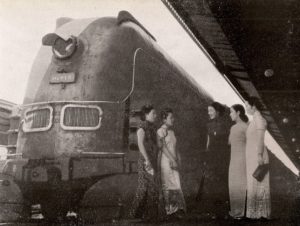 The Asia Express, the South Manchuria Railway’s ‘ultra-modern’ high-speed train at Dalian’s ‘ultra-modern’ railway station with ‘ultra-modern Manchurian girls’.
The awards celebrate the best research in the fields of architecture and the built environment.
The 2017 RIBA President’s Medal for Research was presented to Dr Edward Denison Bartlett School of Architecture, UCL and Guang Yu Ren, Independent Researcher, UK for their project: Ultra Modernism in Manchuria.
The paper explores ‘Ultra-Modernism’, an ideological term employed to describe Japan’s encounter with modernity and its distinction from western precedents/constructed cannons, deemed historically and intellectually impartial.
‘Ultra-Modernism’ refers to the speed and intensity of the development of the north-eastern region of China formerly known as Manchuria before the Second World War, when Japan’s attempts to build an empire throughout the 1930s prompted the construction of more than one hundred towns and cities in a new state they named Manchukuo.
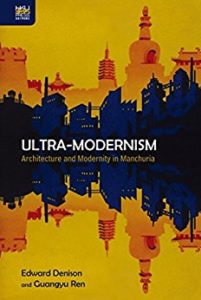
about the book:
History is a record of power. The twentieth century – modernism’s century – was dominated by ‘the west’ and its ‘official’ history is a testament to this dominance of ‘others’.
Modernist history is a canon constructed by, for and of the west, with major consequences for architectural encounters with modernity outside the west, which are routinely overlooked or possess an assumed inferiority; a postulation asserted through inauthenticity, belatedness, diluteness and remoteness, geographically, intellectually, and even racially. Few sites demonstrate this historical and intellectual impartiality more explicitly than the north-eastern region of China formerly known as Manchuria before the Second World War, when Japan’s attempts to build an empire throughout the 1930s prompted the construction of over one hundred towns and cities in a new state they named Manchukuo.
Such was the speed and intensity of Manchukuo’s encounter with modernity and its distinction from western precedents, the Japanese branded it ultra-modernism. Ultra-Modernism in Manchukuo was ideologically ubiquitous and became manifest in urban planning, architecture, transportation, photography and film – all essential facets of modern metropolitan life in Manchukuo.
Among the many new cities developed by the Japanese, the jewel in their imperial crown was the vast new capital of Hsinking (‘New Capital’), the city’s nomenclature echoing the ultra-modernity on which empire was built. Despite the scale, scope and consequences of Manchukuo’s encounter with modernity, its experiences have yet to make a significant contribution to architectural knowledge globally.
After more than a decade of research culminating in the recent publication of the first book to focus exclusively on architecture and modernity in Manchuria, this work not only fills a conspicuous gap in existing architectural knowledge and challenges the modernist canon, but also provides important context to the rising tensions in the region, the seeds of which were sown in Manchuria.