Posted: May 7th, 2017 | No Comments »
“The winter following Japan’s invasion of Manchuria was a difficult one. Biting winds sheared through the small boarding house, and the women stuffed cotton in between the fabric layers of their garments. This thing called the Depression was found everywhere in the world, the lodgers said frequently during meals, repeating what they’d overheard from the men at the market who could read newspapers. Poor Americans were as hungry as the poor Russians and the poor Chinese. In the name of the Emperor, even ordinary Japanese went without. No doubt, the canny and the hardy survived that winter, but the shameful reports – of children going to bed and not waking up, girls selling their innocence for a bowl of wheat noodles, and the elderly stealing away quietly to die so the young could eat – were far too plentiful.â€
An excerpt from Pachinko by Min Jin Lee, published by Head of Zeus in 2017, p.12.

On Tuesday 23rd May, Reflections on the East Asian 20th Century  will take us back in in time with Min Jin Lee – bestselling author of Free Food for Millionaires – who will be presenting her new novel Pachinko for the first time in the UK.
Beginning in early 1900s Korea with Sunja, the prized daughter of a poor yet proud family, whose unplanned pregnancy threatens to shame them, this epic tale – which has been in the making since 1989 when Min Jin Lee was a junior in college – follows a Korean family through eight decades and four generations. Betrayed by her wealthy lover, Sunja finds unexpected salvation when a young tubercular minister offers to marry her and bring her to Japan to start a new life.
So begins a sweeping saga of exceptional people in exile from a homeland they never knew and caught in the indifferent arc of history. In Japan, Sunja’s family members endure harsh discrimination, catastrophes, and poverty, yet they also encounter great joy as they pursue their passions and rise to meet the challenges this new home presents. Through desperate struggles and hard-won triumphs, they are bound together by deep familial roots.
Min Jin Lee will be in conversation with author, literary critic and former Man Booker Prize for Fiction judge Erica Wagner to reveal a profound story which delves into questions of faith, family and identity.
The talk will be followed by a book signing and drinks reception.
To book tickets for this event please click here
General: £10, Concessions: £8, Asia House Arts Members: £5

Posted: May 6th, 2017 | No Comments »
Friday, 12th May 2017
10:00 am – 12:00 pm
Yuyuan Garden
Classical Garden Tour – Shanghai’s Yu Garden
Tour leader and author The Classical Gardens of Shanghai: Shelly Bryant

Most of us have visited Yu Garden more times than we can count. But can a person, especially an expatriate, ever truly “know†Yu Garden? Lou Qingxi, writing in Chinese Gardens (2003) and quoted in The Classical Gardens of Shanghai, states, “the real appreciation of a garden’s beauty comes from an understanding of the general artistic realm behind the scenery presented there, which leads to an understanding of the philosophy and view of life it represents. This intellectual response depends entirely on the viewer’s familiarity with the Chinese traditional of gardening.â€
Join Shelly Bryant as she leads us through Yu Garden and guides us in viewing the familiar scenery through fresh eyes. Shelly is a long-time friend of RAS, a much published poet and translator and author of The Classical Gardens of Shanghai, part of the RAS Monograph Series, published in 2016 by Hong Kong University Press.
Limited to 15. Members, priority registration through Wednesday, May 10.
(Click here to download membership application)
Meeting place instructions on confirmation of RSVP.
RSVP: bookings@royalasiaticsociety.org.cn
ENTRANCE: Members: 200 RMB Non-Members: 300 RMB
VENUE: Yu Garden (Yuyuan Garden); 218 Anren St (Near Shanghai City God Temple) 上海市安人218å· ï¼ˆè¿‘åŸŽéšåº™ï¼‰ Shanghai
Posted: May 5th, 2017 | No Comments »
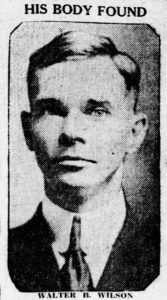
Walter B. Wilson Jr., of Greenvile, NC, was posted to Shanghai in 1920 as an assistant paymaster to the United States Shipping Board in Shanghai. In 1923 he gained a Vice-Consul position as a clerk with the US Consulate in Shanghai – within a year he had been promoted to a vice-consul post. He kept that post till May 1928.
However, it seems that in 1928 he became despondent and depressed. Nobody was quite sure why – his friends and colleagues reported him as being fine and not seemingly overly stressed or depressed. But he was. On May 1 1928, at 6am, he left his lodgings claiming to be heading to the Hungjiao Gold Club. He was seen there, writing a number of letters but then disappeared. After receiving a letter from Wilson a colleague at the Consulate called the police who, concerned about his whereabouts and intentions, searched his rooms. Meanwhile another letter was received by the local newspaper, the American-run China Press – it stated that he intended to take his own life. A search ensued for Wilson, led by the Shanghai Municipal Police and his friends.
On May 8th 1928 Wilson’s lifeless body was found in the Whangpoo (Huangpu) River, ten miles downstream from the Bund. One of his legs was broken and it was assumed the corpse had been hit by a ship’s propeller. Quite why Wilson was so depressed is not clear. He had recently returned from a home leave to the United States – though nobody connected with him in the USA (including his four brothers who had all attended West Point) remembered him as being depressed during his visit.
The inquest didn’t get much further in understanding why Wilson presumably killed himself – it returned a verdict of ‘death by drowning’.
And there’s nothing much else to say really – a sad story where we can only guess at the real causes.
A short while later the note below appeared in the Honolulu newspapers, a certain ‘H.A. Atkinson’ claiming to be a good friend of Wilson’s wished to make contact with his brother who was stationed in Hawaii. The brother attempted to reply to the PO Box but got no reply….
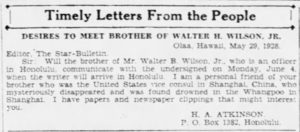
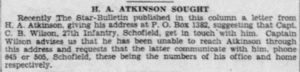
But H.A. Atkinson was not unknown in Honolulu and had contributed some articles to the Honolulu Advertiser. These articles (from 1927 and before) indicate Atkinson was resident in Shanghai, either at the time or before, and was active in local sports – and was described as a ‘sportsman’. He seems to have been an Englishman, from Newcastle, and a keen rugby player. Atkinson was also involved in the Boy Scouts movement in Shanghai and, when visiting Honolulu in 1927, gave a speech on the subject to the Hawaiian scout movement. This was in November 1927 (Atkinson had arrived in the city from Shanghai on the liner Taiyo Maru on November 8 1927) and Atkinson says he is planning to spend at least six months away from Shanghai, resident in Honolulu. This would place Atkinson in Honolulu in May 1928 when he placed the letter in the paper. But why did the PO Box number not work – had Atkinson returned to Shanghai? moved on elsewhere? failed to pay for the box? got the number wrong in the letter? I guess we may never know…
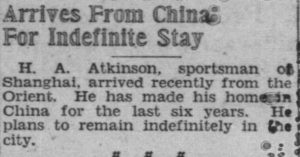
November 15th, 1927 – Honolulu Star-Bulletin
Posted: May 4th, 2017 | No Comments »
Fantastic that Earnshaw Books have reissued Whitey Smith’s great memoir of old Shanghai’s nightclub and jazz scene (with an introduction by Andrew Field too)…as original copies of this book have been as rare as hen’s teeth this is a real addition to most peoples old Shanghai shelf….
I Didn’t Make a Million – Whitey Smith
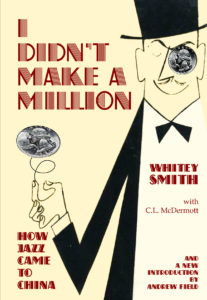
Whitey Smith was a jazz drummer from San Francisco who landed in Shanghai in 1922, just in time to help ignite the Jazz Age in one of the world’s most entertainment-crazed cities. It is said he brought Jazz to China, and that claim is arguably true. This memoir tells the story of his amazing life and adventures in Shanghai nightlife in the 1920s and 1930s, and then as a nightclub owner in Manila and an internee in a Japanese camp during World War II. It is written with great humor, a collection of the great yarns he would have told at the bar through the years.
more details here
Posted: May 3rd, 2017 | No Comments »
Join writer, journalist and public speaker Lijia Zhang for a discussion about the sex trade in Shenzhen through her debut novel Lotus, which is inspired by Zhang’s grandmother’s secret life as a ‘flower girl’. The talk will be chaired by Jemimah Steinfeld, author of Little Emperors and Material Girls: Sex and Youth in Modern China.
Zhang interviewed sex workers in Shenzhen, Dongguang and Beijing when writing Lotus, attempting to make friends with the women she spoke to. However, it proved to be a very challenging task as they moved from city to city, and between massage parlours. She found that through learning more about the lives of the women she interviewed, she could explore China’s growing gap between men and women, urban and rural — as well as the tug of war between modernity and tradition.

As a teenager, Zhang worked in a factory producing missiles designed to reach the United States. In the oppressive routine of guarded compound and political meetings, Zhang’s disillusionment with ‘The Glorious Cause’ drove her to study English. By narrating the changes in her own life, Zhang has chronicled the momentous shift in China’s economic policy. She has given talks about contemporary China at institutions ranging from Stanford to Harvard.
This event has been sponsored by Cockayne Grants for the Arts, a donor-advised fund of the London Community Foundation. It is part of the Sin Cities: Vice & Virtue Across Asia’s Urban Landscapes series.
To book tickets for this event, please click here.
General: £10, Concessions: £8, Asia House Arts Members: £5
Posted: May 2nd, 2017 | No Comments »
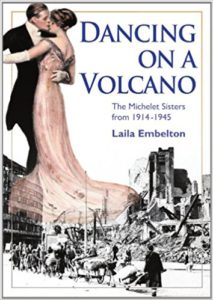
Just a quick mention of a biography that has some details of Norwegians in Peking in the 1920s. Dancing on a Volcano by Laila Embelton is the story of the Michelet sisters (Armgard and Sisi) between 1914 and 1945. Interestingly, for China folk, their father was the Norwegian diolomat Johan Michelet (1877-1964) and their mother was Ingeborg (Omi) von Lambrecht-Benda (a Prussian). Michelet was posted to Peking in 1920 and the book contains some details on the Norwegian Embassy in the 1920s, their extensive house on Shi-jia hutong (Shih-Jia Hutong) and Peking life at the time.
I also note this book because several researchers have contacted me in recent years regarding Danes and Norwegians in Peking (the Norwegian legation in 1920 was the building that had formerly been the Danish legation i think) but I can’t find their contact addresses!! So maybe this might get to them.
Posted: May 1st, 2017 | No Comments »
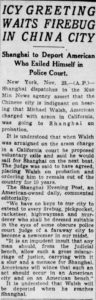
This story caught me eye the other day – from November 1930….Would Shanghailanders tolerate an arsonist coming to live among their ranks??
Here’s what happened…
In San Francisco a man called Michael Walsh set fire to his neighbour’s house. He was arrested and convicted and sentenced to ten years in jail.
Walsh suggested to the judge the novel idea of going into voluntary self-exile in Shanghai for ten year – that is to say, he would leave America for Shanghai and promise not to return for a decade.
Bizarrely, the judge accepted the premise that ten years in Shanghai was the equivalent to ten years in the jug, agreed and ordered Walsh to catch the next boat to Shanghai.
The China Weekly Review and the Saturday Evening Post both slammed the Californian judge as idiotic. However, the trail runs cold there and I can’t find out whether Walsh ever did make it Shanghai.
But consider this if he did – Arriving at the end of 1930 he would have had a great ten year and then been able to go back to America at the end of 1940, thereby avoiding Pearl Harbor, the Japanese occupation of the city and later internment of allied nationals for the duration.
If Michael Walsh did make the trip, slip into the city under the newspaper’s radar and then keep himself-to-himself for a decade then he was a damn lucky fellow.
Posted: April 30th, 2017 | No Comments »
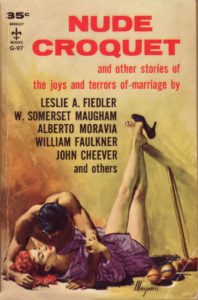
I’ve blogged before about how regularly W. Somerset Maugham got pulped in the 1950s and 60s (see here). here’s another example – Nude Croquet and other Stories of the Joys and Terrors of Marriage (1970). The Maugham story is Force of Circumstance, which originally appeared in short story collection The Casuarina Tree (1926). The story line is, basically, A young woman marries a colonial administrator on home leave from the East and returns with him to his post. She is blissfully happy in her new life until a local woman and her small children begin to hang about the compound, to the increasing displeasure and discomfort of the young woman’s husband. Â
The croquet must be in one of the other stories….