Crime in the City: Manila Noir
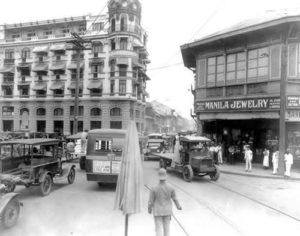
Posted: April 28th, 2017 | No Comments »China Rhyming readers may be interested in the third ‘Crime in the City’ feature I’ve published at Lit Hub – it’s on Manila – here
All things old China - books, anecdotes, stories, podcasts, factoids & ramblings from the author Paul French
China Rhyming readers may be interested in the third ‘Crime in the City’ feature I’ve published at Lit Hub – it’s on Manila – here
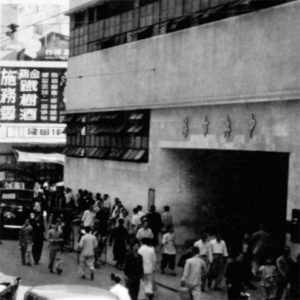
In the mid-1950s, shortly after the communists took power, it seems Picasso’s Dove of Peace became a brief leitmotif around Shanghai. Here’s a picture of Nanking Road in the early 1950s, close by the Park Hotel and the pailou (a version of which still remains) on the north side of the road opposite the old racecourse.
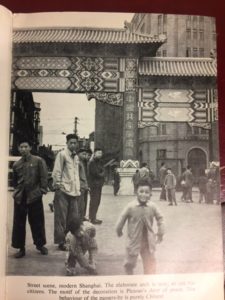
And here you can see the Dove of Peace painted on a cargo ship moored at a Shanghai wharf.
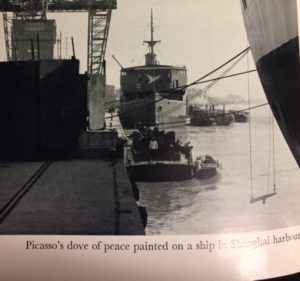
Memoirs and visitors records in the mid-1950s often recall Picasso’s Doe of Peace appearing on stamps, postcards, the covers of magazines and newspapers and even featuring in a popular propaganda song, “Grandma Wants Peace”. Not just in Shanghai but across China.
Actually the regularity of Picasso’s Doves appearance is interesting as it shows the closeness between the USSR and Communist China prior to the Sino-Soviet Split. The Dove was really the symbol of the Moscow-led “peace initiative” aimed against the American and UN presence in Korea. Obviously both China and the USSR were supporting Kim Il-sung’s forces in the North.
Anything with the Dove of Peace does rather handily allow us to date images as being the mid-1950s…
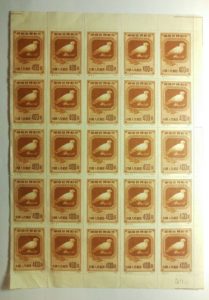
Chinese Dove of Peace stamps
According to the Ogden Standard Examiner in 1929…
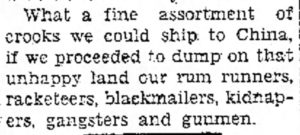
not much changed there then….
Chloe Lai at The Hong Kong Free Press has written an obituary for Hong Kong’s Central Market… it says pretty much all that needs to be said about the Central Market – that it is one of the only pre-war pieces of architecture designed for the community to remain standing – Wan Chai Market went over a decade ago now. It’s being described as a preservation, but is a complete gutting and destruction. Chloe Lai’s piece has more details and I urge you to read that.
The Central Market was never Hong KOng’s most beautiful building – but it was a functional, well designed space completed in 1939 that showed that the government’s Public Works Department could excel itself. It’s destruction later this year will be a sad loss for Hong Kong…



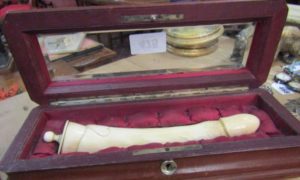
In a rush today, but couldn’t resist posting this – the bizarre Chinese carved ivory ‘ladies companion’….surely an objet every collection of China curios should include….
more here
ALR33 pays tribute to the under-appreciated heroes of world literature – the Translators. This issue features some of the entries and finalists from our collaboration with English PEN on awarding outstanding translations from East and Southeast Asia. For a sampling, read our selection of free-to-view articles, including From the Editors and Shion Miura’s The Handymen of Mahoro, translated by Asuka Minamoto. Also, sample some of the issue’s poetry with Tishani Doshi and Norman Erikson Pasaribu, and enjoy our interview with Margrét Helgadóttir, editor of Asian Monsters, from which we include two stories. Subscribers can read the whole issue online or by downloading eBooks from their accounts.
If you’re already a subscriber, click here to sign in, download your eBook copy and start reading.
If you’re not yet a subscriber, please visit our website to find out more.
Beijing proves, once again, that it has no interest whatsoever in heritage, preservation or architecture as it decides to bulldoze the 1910 built Qinghuayuan Railway Station (details from The Beijinger here). Words cannot describe how horrible this is – though I do hope that those who email me telling me that heritage is now a priority in China and the destruction has stopped in Beijing (and Shanghai and elsewhere) will realise their errors.
Anyway, as we shed a tear in farewell to Qinghuayuan, which managed to survive 107 years, here’s Frank G. Carpenter, the American travellers, author, photographer and journalist, in 1910 passing along the line between Peking and Kalgan (or Zhangjiakou if you must) when he decided to travel on all of China’s new railways….you can click on it to enlarge….

I note that the people at SupChina (no, I don’t understand what that means either) made a little video about the life and career of Anna May Wong. Regular ChinaRhyming readers will know that I never miss a chance to post another picture or anecdote regarding Anna.
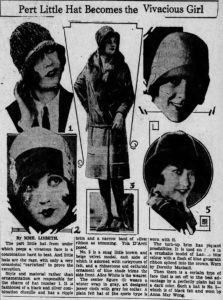
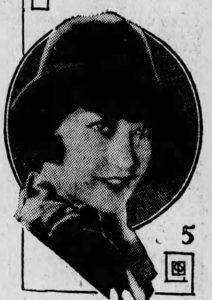
Here, from 1927, is Anna May (bottom right) wearing one of the new seasons hat – dark black felt….The other millinery models are all aspiring silent movie actresses of the time