Posted: March 16th, 2017 | No Comments »
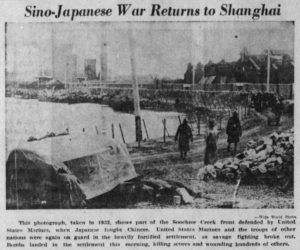
In 1932 US Marines lined the banks of the Soochow (Suzhou) Creek with barbed wire and sandbag embankments to prevent incursions by the Japanese military south into the heart of the International Settlement. They had to do it again in 1937 – both times all the way from up near Jessfield Park and St Johns University down to the Whangpoo River….
Posted: March 15th, 2017 | No Comments »
Pang Likwan’s The Art of Cloning looks like an interesting take on art in the Cultural Revolution…

Cultural production under Mao, and how artists and thinkers found autonomy in a culture of conformity
In the 1950s, a French journalist joked that the Chinese were “blue ants under the red flag,†dressing identically and even marching in an identical fashion. When the Cultural Revolution officially began, this uniformity seemed to extend to the mind. From the outside, this was a monotonous world, full of repetitions and imitation, but a closer look reveals a range of cultural experiences, which also provided individuals with an obscure sense of freedom. In The Art of Cloning, Pang Laikwan examines this period in Chinese history when ordinary citizens read widely, travelled extensively through the country, and engaged in a range of cultural and artistic activities. The freedom they experienced, argues Pang, differs from the freedom, under Western capitalism, to express individuality through a range of consumer products. However, it was far from boring, and filled with its own kind of diversity.
Posted: March 14th, 2017 | No Comments »
Chinese Cinema: A (Brief) Intro to the First Century
by Dr Rob Hemsley
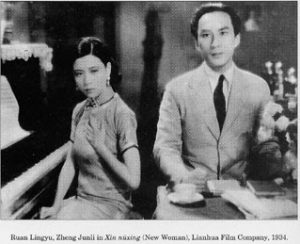
In his talk “Chinese Cinema: A (Brief) Intro to the First Centuryâ€, Dr Rob Hemsley presents an entertaining but also academically grounded overview of how the Chinese film industry has transformed since its earliest days. The history of Chinese cinema is a rollercoaster ride, with themes and genres often shifting in unison with the social and political movements of the time. So jump on board for a trip – enlivened by video snippets — not just through one hundred years of Chinese film, but through one hundred years of Chinese history as well.
WHAT: “Chinese Cinema: A (Brief) Intro to the First Century†by Dr Rob Hemsley
WHEN: Sunday, Mar. 19, 4:00 – 5:30 PM
WHERE: Capital M www.m-restaurantgroup.com  tel (86 10) 6702 2727
3/F, No. 2 Qianmen Pedestrian Street (overlooking Tian’anmen Square)
Beijing 100051ä¸å›½Â 北京市 å‰é—¨æ¥è¡Œè¡—2å·3层 邮编 100051 (尽览天安门全景)
HOW MUCH: RMB 75 per person, which includes a welcome drink
RSVP: please email communications.ras.bj@gmail.com and write “Cinema†in the subject header
MORE ABOUT THE SPEAKER:
Dr Rob Hemsley arrived in the small Chinese city of Lu’an, in Anhui Province, over a decade ago and for the next few years found himself hosting a weekly show on local TV. After that, he worked for international media in Beijing, and in 2015 was hired to teach a number of film-related courses at Tsinghua University. Dr. Hemsley specializes in the study of Film and Religion – which he launched as a course at Tsinghua – and also maintains a strong interest in the Chinese film industry and its tumultuous history.

Posted: March 13th, 2017 | No Comments »
This picture accompanied an article on Harbin’s Russian community in 1936, though I suspect the photograph of the is somewhat older…droshky’s were quite common in the city…

Posted: March 12th, 2017 | No Comments »
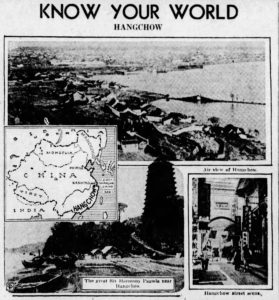
As promised after yesterdays ‘Know Your World – Shanghai’, here is May 1934’s ‘Know Your World – Hangchow’ (or Hangzhou if you prefer)…again,. you can click on the image to enlarge it….
Posted: March 11th, 2017 | No Comments »
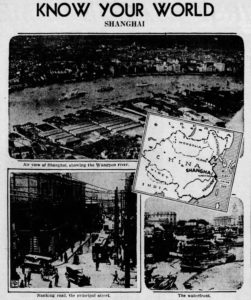
‘Know Your World’ was a US syndicated newspaper column that took different places internationally and showed readers what they were like – simple idea really in the days before google image…in May 1934 it was China’s turn….first Shanghai (you can click the image to enlarge)…and then Hangchow (tomorrows post)….
Posted: March 10th, 2017 | No Comments »
Out of China: How the Chinese Ended the Era of Foreign Domination
Professor Robert Bickers (University of Bristol)
Date:13 March 2017Time: 5:00 PM
Venue: Russell Square: College Buildings Room: G3
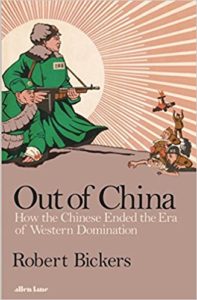
It’s only eighteen years since the end of the era of the Chinese ‘treaty ports’. In 1999 the last foreign-controlled outpost, Macao — the first to have been detached from Chinese control — was formally returned. In this talk Robert Bickers will draw on his new book, Out of China, to highlight key moments in the history of the decline of foreign power in China, its awkward persistence into the 1990s, and its enduring legacies.
more details – here
Posted: March 9th, 2017 | 2 Comments »
I came across this plate in the front of a book the other day at The London Library in St James’s. However this plate is for the Royal Central Asian Society – a brief history of which is below. They had nice digs over at 8 Clarges Street, just off Piccadilly (though the original building is sadly gone and replaced by a rather nondescript modern office thing). The Royal Central Asian Society (originally, The Central Asian Society) became The Royal Society for Asian Affairs (RSAA) around 1975. I can only assume they handed their library over to be Incorporated within the London Library’s extensive collections.

The Central Asian Society was established in 1901. In November of that year, Dr Cotterell Tupp, Captain Francis Younghusband, Colonel Algernon Durand, and General Sir Thomas Gordon convened at Younghusband’s house in Gilbert Street, Grosvenor Square, London, to discuss the response to an informal prospectus they had circulated amongst friends during the previous month. They agreed that sufficient interest had been aroused and decided to formally distribute their prospectus for a new Society. The prospectus (“A Proposal to Establish a Central Asian Society”) began: “At present there is in London no society or institution which is devoted entirely to the consideration of Central Asian questions from their political as well as from their geographical, commercial or scientific aspect, though Societies such as the Royal Geographical and Royal Asiatic Society discuss these subjects incidentally. It is therefore proposed to establish a society to be called the Central Asian Society, with rooms, where those who either have travelled in Central Asia, or are interested in Central Asian questions, could meet one another.”
The “Central Asian questions” to which the Proposal referred derived from the political and diplomatic confrontation between Britain and Russia that continued throughout most of the nineteenth century. The confrontation was played-out in the Central Asian territories that lay between British India and Russia, and came to be known, after Kipling, as the “great game”. Many of the founding members and key figures of the Central Asian Society were active participants in the latter stages of this “game” of empires, as much of the material in the archive reflects.
On 1 January, 1975, the Society changed its name to The Royal Society for Asian Affairs, reflecting a shift of emphasis from narrowly Central Asian matters to an embrace of Asia as a whole. The shift of emphasis had already been marked (in 1970) by the renaming of the Society’s Journal as Asian Affairs. Formerly, Journal of the Royal Central Asian Society, the Society’s Journal has been published continuously since 1914. The present remit of the RSAA is the contemporary economic, political and social developments of every Asian country.