Posted: December 19th, 2016 | No Comments »
Contributions to Kashgar Revisited provide new insights into ongoing research into Uyghur history, linguistics and culture, while building on the scholarly legacy of Gunnar Jarring, the Swedish Turcologist and diplomat…

Edited by Ildikó Bellér-Hann,University of Copenhagen, Birgit N. Schlyter, University of Stockhholm, and Jun Sugawara, Tokyo University of Foreign Studies
Building on the rich scholarly legacy of Gunnar Jarring, the Swedish Turkologist and diplomat, the fourteen contributions by sixteen authors representing a variety of disciplines in the humanities and the social sciences provide an insight into ongoing research trends in Uyghur and Xinjiang Studies. In one way or other all the chapters explore how new research in the fields of history, linguistics, anthropology and folklore can contribute to our understanding of Xinjiang’s past and present, simultaneously pointing to those social and knowledge practices that Uyghurs today can claim as part of their traditions in order to reproduce and perpetuate their cultural identity.
Contributors include: Ildikó Bellér-Hann, Rahile Dawut, Arienne Dwyer, Fredrik Fällman, Chris Hann, Dilmurat Mahmut, Takahiro Onuma, Alexandre Papas, Eric Schluessel, Birgit Schlyter, Joanne Smith Finley, Rune Steenberg Jun Sugawara, Äsäd Sulaiman, Abdurishid Yakup, Thierry Zarcone.
Posted: December 18th, 2016 | No Comments »
Happened to be in the beautiful town of Rye, East Sussex this weekend and noticed this Chinoiserie style porch….

Posted: December 16th, 2016 | No Comments »
The shelf of books on China and the Great War is not yet at groaning but it is decidedly better stacked than it was a few years ago (and a nod to Xu Guoqi for his work prior to the centenary). Of course there is the Penguin China WW1 series available very affordably on kindle (see details here). Now we have Christopher Arnander and Frances Wood with Betrayed Ally to add to the collection…

The Great War helped China emerge from humiliation and obscurity and take its first tentative steps as a full member of the global community. In 1912 the Qing Dynasty had ended. President Yuan Shikai, who seized power in 1914, offered the British 50,000 troops to recover the German colony in Shandong but this was refused. In 1916 China sent a vast army of labourers to Europe. In 1917 she declared war on Germany despite this effectively making the real enemy Japan an ally. The betrayal came when Japan was awarded the former German colony. This inspired the rise of Chinese nationalism and communism, enflamed by Russia. The scene was set for Japan’s incursions into China and thirty years of bloodshed. One hundred years on, the time is right for this accessible and authoritative account of China’s role in The Great War and assessment of its national and international significance
Posted: December 15th, 2016 | No Comments »
Christmas 1924 was the height of the mah jong craze in the USA. A good year for Shanghai manufacturers of set both high-end luxury and low with instructions. One fashionable young lady even took the mah jong craze to her legs with a lovely pair of nylon stockings with mah jong inspired motifs!!


Posted: December 14th, 2016 | No Comments »
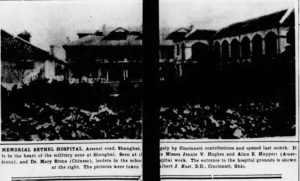
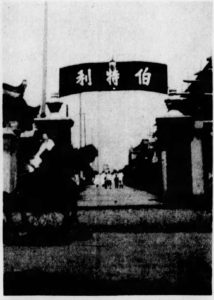
In 1924 the new Bethel Hospital was opened in Shanghai – the hard work of Shi Meiyu and others. Shi (1873-1954) was among the first Chinese women graduates from a U.S. medical school. On return to China, she founded the Bethel, now known as the Shanghai Ninth People’s Hospital (they claim they were founded in 1920, but they weren’t, construction began in 1920 but took four years and so it was 1924 that the hospital opened its doors). The original address was 17 Arsenal Road, near the Kiangnan Arsenal in the south of the city beyond the southern border of the French Concession – that’s now Zhizaoju Road.

Posted: December 13th, 2016 | No Comments »
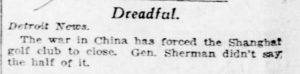
Warlords battle, skirmish and fight around Shanghai in 1924 – things must have got serious…the golf club’s had to close!!
Posted: December 12th, 2016 | No Comments »
I have blogged about the prolific Frank G Carpenter before (here), journalist and compiler of the lovely Carpenter’s World Travels series of books between the 1890s and his death in 1924. Here is Carpenter’s probable last dispatch back to the American newspapers from Shanghai which he predicts will soon rival New York. Interestingly he does suggest digging a deep hole downwards from New Orleans to get to Shanghai!!
Shortly after sending this report Carpenter travelled from Shanghai to Nanking, where he died aged 69.

Posted: December 11th, 2016 | No Comments »
Saw somewhere that John Milton, the poet, author of Paradise Lost and other works, polemicist was born this week in 1608.
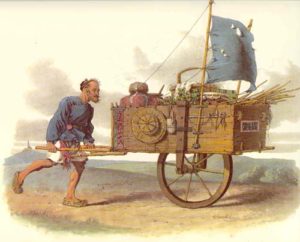
Blind John Milton (1608-74) was born into the height of the Protestant Reformation in England though clearly heard of China writing, “Chinese drive, with sails and wind, their cany waggons light” in Paradise Lost (1667) indicating that the West knew of the sail driven wheelbarrows of China that William Alexander was to paint over a century later in the 1790s (as in the example below) when he saw them while accompanying Lord McCartney s Mission to China. Milton also noted the spice trade as well as the greatness of Beijing in Paradise Lost:
 City of old or modern fame, the seat
 Of mightiest empire, from the destined walls
 Of Cambalu, seat of Cathaian Can
Milton later refers to Pequin without apparently realising that both Pequin and Cambalu are alternative names for Beijing. It seems Milton was excited by China as a vast market for English manufacturing, but criticised what he saw as the country’s absolutist government which, in his mind, paralleled the absolutism of Catholicism and the Divine Right of Kings.