Posted: November 26th, 2016 | No Comments »
That’s Shanghai tells me that there is to be a new tram running the length of Yan’an Road (the old Avenue Edward VII, or the Avenue Eddy) – the former border between the International Settlement and Frenchtown. Great, but nothing new – a tram always ran along the Avenue Eddy.
J.G. Ballard recalled the Avenue Eddy tram in his novel Empire of the Sun as Jim rides through town on his bicycle as the Japanese encirclement of the foreign concessions tightens:
‘Pedaling fiercely, Jim followed a heavily laden tram that clanked along the Avenue Edward VII. Morose Chinese clung to its sides, and a cop-headed youth in a black mandarin suit spat at Jim, then leaped down and ran into the crowd, nervous that even this small act would set off a train of retribution.’
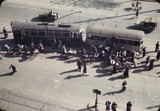
As well as along Avenue Edward VII Route 8 from the Garden Bridge along the Bund and crossing Nanking Road then crossed the Avenue Eddy whereupon any passengers continuing on their journey were required to buy a new ticket for travel in the French Concession. On the image below you can clearly see the tramlines on the Avenue Eddy…

and here’s the tram stop on the Bund, just before the tram turned up the Avenue Eddy…
Posted: November 25th, 2016 | No Comments »
Remember….think about what you’re buying – protest outside a department store in Manhattan, 1938…..

Posted: November 24th, 2016 | No Comments »
Yesterday I posted on the repatriation from civilian internment in Manila of the former Shanghai-based correspondent Bernard Covit. It was remiss of me not to mention the other gentleman repatriated on the Gripsholm with Covit and featured in the newspaper story, Charles Forrest Cress. I humbly apologise for the omission.Â
Charles Forrest Cress was executive manager, Far Eastern Area, Export Division, of Chrysler (see this post on Chrysler’s ads in 1930s/1940s China) and based, I believe in China and Manila. He was in China for a long time I believe, since his early 20s. The Ohio State University Monthly, in a 1920 edition, has note remarking on Mr Cress ‘returning’ to China.
After returning to the United States in 1944 Mr Cress was active on behalf of Free China. He certainly introduced guest speakers from the Chinese government (KMT), visiting Michigan from Chungking on tours to rally continued support from America for China.
I believe Charles Forrest Cress lived in Los Altos, California and died in 1996 at 104!

Posted: November 23rd, 2016 | No Comments »
Referring back to a post some weeks ago detailing an inside report on life in Japanese occupied Shanghai that appeared in Liberty magazine in January 1944 (click here). The author was Bernard (sometimes Bernhard, or just Bert) Covit (1907-1978), Brooklyn-born and a former newspaperman with the New York Post who had witnessed the bombing at the Great World Amusement Palace in Shanghai on Bloody Saturday August 14th 1937. He moved on to the AP Bureau in Manila and ended up in several Japanese-run Civilian Internment Camps in the Philippines. Eventually he made it onto the Gripsholm evacuation ship back to America, arriving to meet the media as you can see below.
Covit went on to remain involved in Asian affairs – editing several books on the South Seas and Tahiti. After the war I think he also worked in radio with WPIX, New York, and the Mutual Broadcasting System.
(PS: his name is spelled with two t’s in the article below but I believe he spelt it with just one)

Posted: November 22nd, 2016 | No Comments »
I was looking through some George Chinnery prints the other day – Chinnery of course being by far the best western painter to have recorded Macao, Hong Kong and the Canton Factories in the early to mid-1800s, prior to photography. I won’t go on as I’m sure Chinnery needs no introduction to regular readers of this blog. However, I read that prior to leaving England (after a spell in Dublin) for India and eventually Macao and the Far East, Chinnery’s London studio was at 20 Lower Brook Street. That address is now simply 20 Brook Street in Mayfair, just of New bond Street. Here is it today, though I suspect the top floor is a more recent addition and probably wasn’t there when Chinnery was there around 1802. It was a handy location anyway being close to the Royal Academy on Piccadilly where Chinnery, like his peer Turner, was submitting portraits for exhibition.
20 Brook Street (obviously the white building) was completed around 1737, making it early Georgian and not untypical of what was being constructed across the Mayfair district. The building is safely listed with English Heritage, who support my theory about the top floor claiming that work was done to alter the property in the 18th, 19th and 20th centuries. The shop frontage on the ground floor only dates from the late 1960s. Since its construction the property had an artistic flavour – No.20 was the residence of the painter Sir William Beechey between 1787-88.

Posted: November 21st, 2016 | No Comments »
I’m making a bit of a specialty in collecting foreigners of one sort of another born in China who went on to become (or at least try to become) Hollywood stars (if any publisher thinks there’s a book in that feel free to call!!). Here’s the latest addition – Serge Temoff…
Temoff was a Russian but had been born in the heavily Russified Chinese city of Harbin in 1901. His father was a fur trader who moved the family between Moscow and Harbin. Temoff was a trained ballet dancer and worked with the Moscow Opera in 1916 and had become a soloist with the Maryinsky. During the 1917 Bolshevik Revolution he served with General Kolchak’s White army (his two brothers died in the conflict), eventually having to flee across Siberia to China and from there to America where he joined Anna Pavlova’s touring company. The Devil Dancer was his first straight acting role in 1927 where he appeared along with Gilda Grey, Clive Brook and Anna May Wong. He had joined the Goldwyn Studios as a dance instructor but Sam Goldwyn himself was said to have spotted him and ordered he be cast in films in acting roles. Goldwyn liked Temoff’s large eyes and believed he saw twenty years of suffering in his face.

Posted: November 20th, 2016 | 3 Comments »
The other day I had cause to look out a copy of China: After Five Years of War which was published in 1942 by the Ministry of Information of the Republic of China (the Chinese government in Chungking at the time). It’s an interesting tome, stressing how China was responding to the attack from Japan, its role as an allied power in the overall struggle of World War Two and how the home front was being maintained and surviving. There’s a lot of interesting photographs too (I’ve been adding some of them to my instagram feed at oldshanghaipaul). There is also a later edition of the book, about 1946 I think, published in the UK by Victor Gollancz that has additional pictures.
 This copy is from the London Library and is especially interesting as it was donated to the library in St. James’s by George K.C. Yeh who was, at the time, the London Director of the Chinese Ministry of Information. As you can see they had offices at No.9 Bentinck Street in Marylebone (see below for that house today). George Kung-chao Yeh was born in Canton into a family with a tradition of scholarly activity, he came to the United States in 1919 and attended Amherst College. After graduation in 1924, he earned a masters’ degree two years later at Cambridge University in Indo-European linguistics. He then returned to China as a professor of English at universities in Peking and in Shanghai. During World War Two, he joined the Government and worked as the Information Ministry’s representative in Singapore and in London before transferring to the Foreign Ministry in 1946. He later went to Taiwan with Chiang Kai-shek as Foreign Minister from 1949 to 1958 – the longest tenure of any Nationalist Foreign Minister – Yeh signed the 1952 peace treaty with Japan and the 1954 defense pact with the United States. He died in 1981.


No.9 Bentinck Street today
Posted: November 19th, 2016 | No Comments »
I’ve blogged about Harry Hervey, the Asian travelogue writer, novelist of French Indo-China, adapter of Somerset Maugham’s Rain and the treatment writer of Shanghai Express. Hervey was good friends with the artist Christopher Murphy (Jr.), though I’m not quite sure about whether they travelled to China and Asia together or not. Certainly they were friends and contemporaries (Hervey born 1900; Murphy 1902) and spent time in Savannah, Georgia (Hervey lived in the old De Soto Hotel in Savannah while his mother was the housekeeper).
Murphy provided the illustrations that accompany Hervey’s 1925 travelogue of the Far East Where Strange Gods Call: Pages Out of the East. Although I’m not sure Murphy made the trip. They’re good illustrations anyway…

Hong Kong

Canton

Macao
Hong Kong

Canton