Posted: February 5th, 2015 | 1 Comment »
I have written about the small Roma (gypsy) community in 1930s Shanghai previously (if you’d like a copy of that paper it’s on Academia.edu or just email me via this blog) and so it’s good to come across another reference to them. This time from the journalist and writer Ilin Natalia Losifovna (1914-1944), a White Russian from Harbin (born in Russia but left as a small child) who moved to Shanghai in the 1930s and wrote for various Russian emigre journals (sometimes under the pen name “Miss Peng”). She was apparently close to the great singer and sometime Shanghai nightclub owner Alexander Vertinsky and, like him, returned to the USSR around 1943. In her autobiography Roads and Destiny she describes a gypsy dance troupe in 1930s Shanghai:
Men in sequined vests, women in multicolored skirts and shawls, their necklaces jangling… The famous Shurik is dancing; he is dark-skinned, aged nine. Beautiful Masha is dancing too, she is about fifteen. Both of them are snatching one-dollar and five dollar banknotes the customers give them.
Of course, as was often the case, this could be regular White Russians done up like gypsies to capitalise on the popularity of gypsy entertainers in the city, but it’s still interesting.

Posted: February 4th, 2015 | No Comments »
Movies and TV shows about old Shanghai invariably thrown in images of richshaws and their pullers. They’re iconic of Chinese cities – and of course its literature – think Lao She’s Rickshaw Boy. Less commonly shown on screen but commonly referred to in memoirs are the old pedicabs of Shanghai. Pedicabs were definitely a step up from pulling a rickshaw and introduced to the Settlement in 1926, when they are first mentioned as being licensed in a Shanghai Municipal Council annual report. Pedicab numbers soared in the later 1930s as petrol restrictions due to the Japanese invasion made petrol taxis unaffordable.
Incidentally unlicensed pedicabs made somewhat of a comeback to Shanghai in 2010 as more and more people jostled for taxis (click here), but the new authorities of the city were less impressed….

Posted: February 3rd, 2015 | No Comments »
It’s been a while since I had a Chinese parasol on this blog (if you’re interested just put ‘parasol’ in the search box and you’ll find a load) so here’s a poster for the amazing Fontaine from the Folie-Bergere in Paris who had tight rope walked across Niagara Falls – here though using a Chinese parasol for a little extra balance….

Posted: February 2nd, 2015 | No Comments »
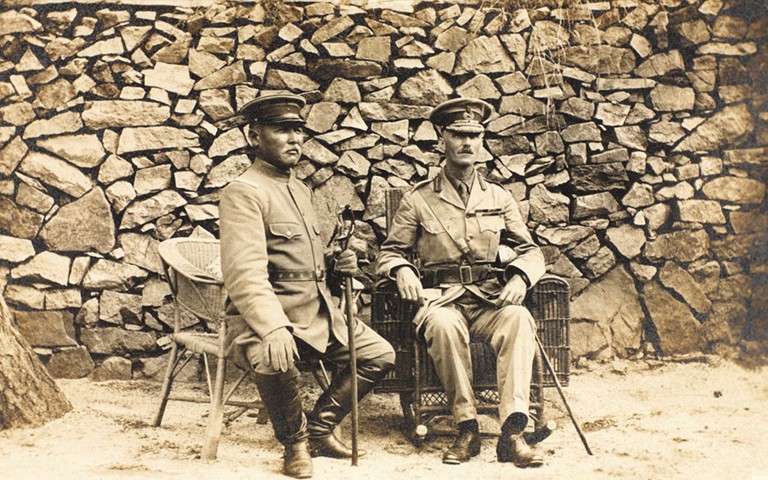
I hadn’t realised until recently reading Jonathan Fenby’s The Siege of Tsingtao that any British troops died at the battle. Japanese casualties numbered 236 killed and 1,282 wounded while he German defenders lost 199 dead and 504 wounded
But, there in a very minor supporting role, was a British detachment – The British deployed the 2d battalion of South Wales Borderers, later reinforced by 2 infantry companies of the 36th Sikhs Regiment including:
- General Barnardiston
- 9 staff officers
- 910 non-commissioned officers and men of the 2nd Battalion South Wales Borderers
- 450 non-commissioned officers and men of the 36th Sikhs Regiment
It seems the British lost 12 killed and 53 wounded (though it’s not entirely clear which is the correct number, another source states that the British lost 74 Army and 9 Navy casualties with 13 Army and 3 Navy dead while yet another says the British suffered 65 casualties with 12 dead and 53 wounded ). That autumn was the wettest on record and the British turned up in summer kit rather unprepared for the terrible weather. Indeed it seems most of the British dead were either drowned or swept away in rain water – the water levels apparently rose a full two meters in under an hour. It is also suggested, though I’m not sure entirely proven, that the German artillery at Tsingtao sought out the British detachment thinking that prioritising killing them would mean they wouldn’t meet them later on the front in Europe. The Times correspondent, who wrote a rather thrilling account of the Siege in the December 17th 1914 edition of the paper gives few details of how the soldiers died, except that one succumbed to disease.
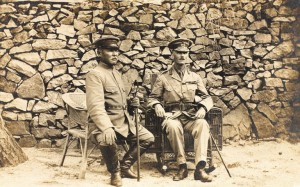
General Kamio Mitsuomi (left) and General Barnardiston (right), in Tsingtao, September 1914
Posted: February 1st, 2015 | No Comments »
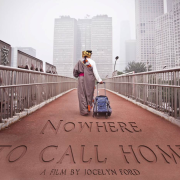
NOWHERE TO CALL HOMEÂ provides a rare glimpse into the world of a Tibetan farmer, torn between her traditional way of life and her desire for her son to have a better future in the city.
Shot in the slums of Beijing and a remote village near the epicenter of Tibetan self-immolations, this gripping story of a woman determined to beat the odds puts a human face on the political strife that fractures China and Tibet.
Along the way it challenges common western stereotypes about Tibetans, and reveals a dark side of village life, where, as the saying goes, ‘women aren’t worth a penny.’
SYNOPSIS: Widowed at 28, Tibetan farmer Zanta defies her tyrannical father-in-law and refuses to marry his only surviving son, who is in prison for armed robbery. When Zanta’s in-laws won’t let her seven-year-old go to school, she flees to Beijing to become a street vendor. Destitute, and embattled by ethnic discrimination she inveigles a foreign customer into helping pay her boy’s school fees. When the three travel back to Zanta’s village for the New Year holiday, Zanta’s father-in-law takes her son hostage.  The unwitting American journalist faces a tough decision: does she intervene in the violent family dispute, or watch in silence as Zanta and Yang Qing face abuses typically borne by Tibetan widows and their children.
University of Manchester:
Tues. Feb. 3, 17:00
Wed. Feb. 4 Panel Discussion
http://events.manchester.ac.uk/…/nowhere-to-call-home-tibet…
University of Birmingham:
Thurs. Feb. 5, 18:00, Mockingbird Theater
http://mockingbirdtheatre.com/contact-us/
University of Leeds:
Mon. Feb. 9 (To be confirmed)
Newcastle University:
Tues. Feb. 10, 18:00-21:00 Newcastle University Culture Lab Space 4/5
http://www.ncl.ac.uk/culturelab/
Oxford:
Thurs. Feb. 12
Frontline Club (London):
Mon. Feb. 16, 19:00
http://www.frontlineclub.com/screening-nowhere-to-call-hom…/
Chatham House (London):
Wed. Feb. 18, 18:00-19:15 (Talk on challenging taboos in China with film clips, followed by panel discussion)
http://www.chathamhouse.org/events…
London School of Economics:
Thurs. Feb. 19, 17:30
University of Edinburgh:
Mon. Feb. 23, 18:30
Posted: January 31st, 2015 | No Comments »
Reading Harry Hervey’s 1925 travelogue of his journeys through the Far East, Where Strange Gods Call, I thought his description of an exclusive Chinese casino in Macao quite interesting….
‘After nightfall, when a tiara of lights crowned the bay, Chang led the way to a very exclusive establishment where glazed-paper lanterns heavily ideographed, proclaimed its purpose. The interior presented a scene soaked in thick aqueous blue smoke and enriched by the pungent odour of opium. Around a large table on the lower floor were crowds of middle-class Chinese, swimming in the weird smoke-light like the inhabitants of some undersea cavern. Above, hovering over the encircling rail of a gallery, was a multitude of faces floating in the gloom like misshapen moons. there, said Chang, indicating the faces, were the high-class patrons. Accordingly, we joined them, escorted thither by an attendant. S most elegantly assembly crowded this upper-floor, all men, and dressed in silks and brocades, some standing by the rail, lowering their bets to the table below by means of a basket, and other lounging upon divans, drinking tea or inhaling poppy smoke. The air staggered with the combined richness of opium-fumes and pomaded humanity.’
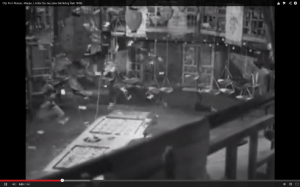
The casino scene in the French film Macao: L’enfer de du Jeu captures it pretty well
Posted: January 30th, 2015 | No Comments »
Reading Linda Simon’s excellent The Greatest Shows on Earth – A History of the Circus made me think of traditional western ringed circuses and Shanghai. Amazing to think that in 1933, just after the First Shanghai War, Hagenbeck’s Circus came to Shanghai from Japan on a world tour. In the first half of the twentieth century Hagenbeck’s Circus, based in Peru, Indiana, rivalled Ringling Brothers and Barnum & Bailey for fame. And in 1933 it pitched up at the site of the Majestic Hotel on Bubbling Well Road, which had been pulled down and demolished just a year or two before. As Shanghai found itself in an economic depression after the 1932 Shanghai War, added to by the post 1929 depressions in America and Europe, nothing had been built on the site. It was a boggy flooded swamp after war and heavy rain but Hagenbeck’s drained it and pitched their tents.
Hagenbeck’s played to a mixed Chinese and foreign audience and despite the depression tickets sold well. The main draw was apparently an Indian elephant that wore a crown. the Shun Pao newspaper got political and likened the elephant passively following its trainers orders to the Chinese people. Lu Xun went and wrote a review of the show for the Shun Pao too. The circus eventually moved on but it had been the highlight of 1933 for thousands of Shanghai residents.

Posted: January 29th, 2015 | 2 Comments »
Pakhoi (now Beihai) was considered one of the remoter treaty ports to be posted to. Pakhoi was in Kwangsi (Guangxi) on the north shore of the Gulf of Tonkin, which placed it as an important port for trade west of Hong Kong and up into Yunnan, as well as its proximity to the French Indo-Chinese empire. Britain, America, Germany, Austria-Hungary, France, Italy, Portugal, and Belgium all had consulates there, built hospitals, schools and churches alongside the local branch of the Imperial Maritime Customs offices. In 1920 Benson, who was British and a suffragette but had spent time in America before moving on to teach in Hong Kong, met James (Shaemus) O’Gorman Anderson, an Anglo-Irish officer in the Customs Service. She followed him to his postings – first to Nanning, and then to Pakhoi. She was a prolific writer – their honeymoon driving across America was depicted in The Little World (1925) along with a number of novels and travelogues. Her novel The Far-Away Bride, was published in the United States first in 1930, and as (the rather obscure sounding) Tobit Transplanted in Britain in 1931. It won the Femina Vie Heureuse Prize for English writers in 1932. Sadly life in the east took its toll on Benson and she died in 1933 in Hongay (now Ha Long), in Vietnam. She is best known in England now for her friendship with Vera Brittain (she of Testament of Youth) and Winifred Holtby and Virgina Woolf (who also knew her) penned an obituary. I mention this as it shows that though people between the wars did travel far away – and Pakhoi was very remote at the time – they were able to maintain correspondences and careers despite the distances and rather basic communications systems.
Stella was actually quote pleased to be going to Pakhoi as she had previously been forced, for just a few weeks, to live in Hoi-how (now Haikou) on Hainan Island, a place she described a “scabby” and had suffered sickness. Stella was still very sick when she and Shaemus arrived at Pakhoi and she was carried ashore by the Russian harbour master. Stella liked their house, not least for its quiet and cool veranda (as shown below). There were only a handful of Europeans – some English and Germans as well as the Russian harbour master (and a few missionaries best avoided) and no access to fresh milk to help her convalesce. The missionaries were a big problem as they were divided and apparently fighting over a small matter of religious doctrine! The weather was extremely humid and hot and not conducive to a full recovery or much in the way of energy. She left Pakhoi to visit Vietnam with her husband (where she died) – leaving Pakhoi, her last view of China, she described its a “sugarily picturesque”.

This picture labelled, “Stella with Penko on the verandah at Pakhoi, 1933, shortly before her death

Beihai today