Posted: September 7th, 2012 | No Comments »
Remiss of me not to have mentioned earlier the Cambridge University Press reissue of Herbert A. Giles’s China and the Manchus – Giles of course a massive scholar of all things China and half of the old Wade-Giles team! Still incredibly readable (I reckon) for a book originally published in 1912 (i.e. one year after the Manchu’s exit stage left). As ever details below…link to an excerpt here.

Originally published during the early part of the twentieth century, the Cambridge Manuals of Science and Literature were designed to provide concise introductions to a broad range of topics. They were written by experts for the general reader and combined a comprehensive approach to knowledge with an emphasis on accessibility. China and the Manchus by Herbert A. Giles was first published in 1912. The volume presents a historical account of the Manchu people and the Qing Dynasty.
Posted: September 6th, 2012 | 3 Comments »
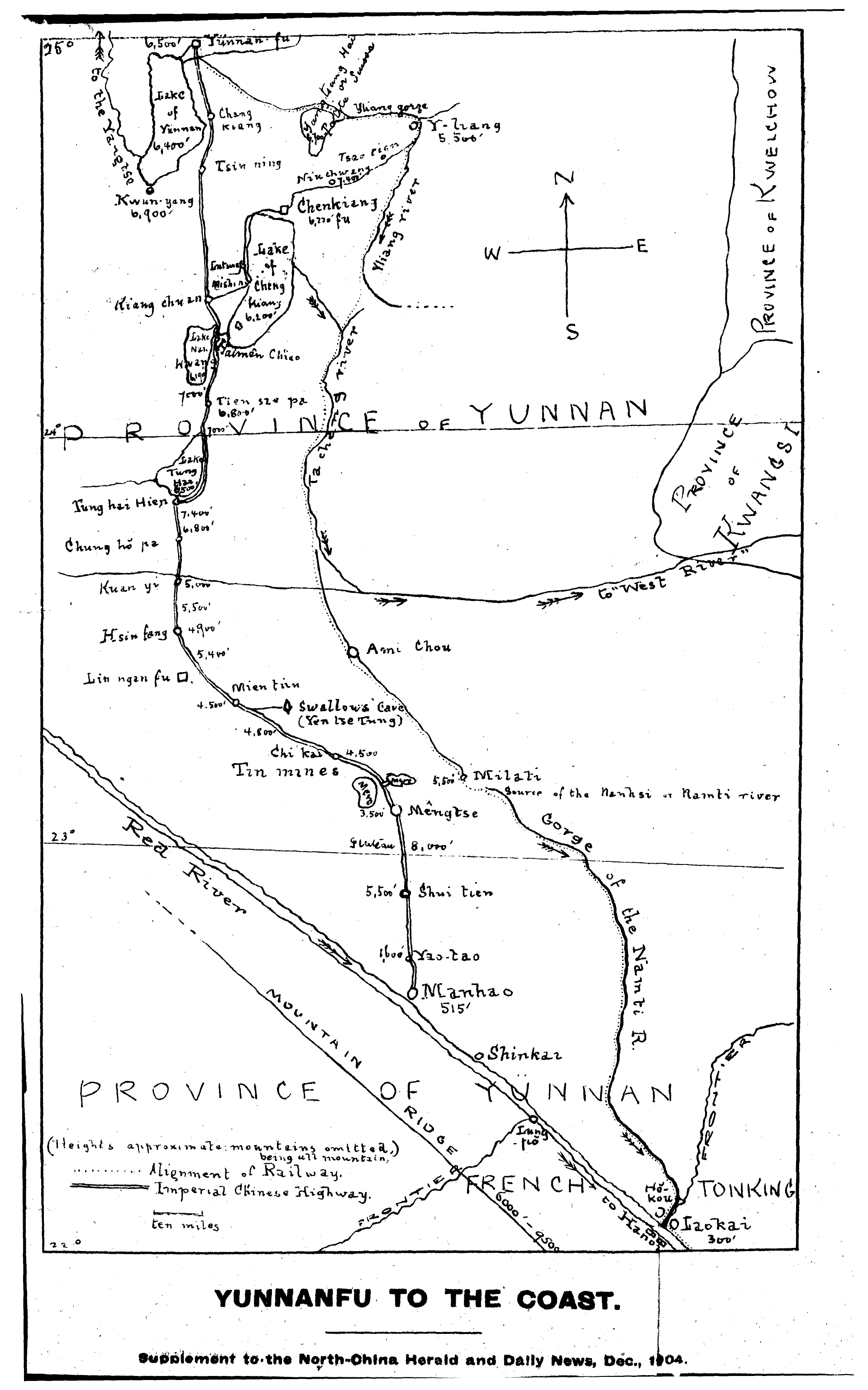
Here’s a map – rather roughly hand drawn – entitled Yunnanfu (now Kunming) across to the coast. It was published in Shanghai in the North China Herald on December 9th 1904. There’s a lot to notice obviously – the boundaries of Yunnan province with French Indochina as well as the borders with the provinces of Kweichow (Guizhou) and Kwangsi (Guangxi). Kunming Lake is included in the top left and the route to the Yangtze. You can look up the others. Yunnan at this time was a tin mining centre so commodities were important over a century ago!!
Posted: September 5th, 2012 | No Comments »
The Jesuits, Matteo Ricci and all that are an industry really – books on them/him just keep coming – and why not indeed. Recently I noted Mary Laven’s Mission to China and now we have the paperback edition (from OUP but thankfully affordable) of R. Po Chia-Hsia’s A Jesuit in the Forbidden City. As ever details below….

A 16th century Italian Jesuit, Matteo Ricci was the founder of the Catholic Mission in China and one of the most famous missionaries of all time. A pioneer in bringing Christianity to China, Ricci spent twenty eight years in the country, in which time he crossed the cultural divides between China and the West by immersing himself in the language and culture of his hosts. Even 400 years later, he is still one of the best known westerners in China, celebrated for introducing western scientific and religious ideas to China and for explaining Chinese culture to Europe.
The first critical biography of Ricci to use all relevant sources, both Chinese and Western, A Jesuit in the Forbidden City tells the story of a remarkable life that bridged Counter-Reformation Catholic Europe and China under the Ming dynasty. Hsia follows the life of Ricci from his childhood in Macerata, through his education in Rome, to his sojourn in Portuguese India, before the start of his long journey of self-discovery and cultural encounter in the Ming realm. Along the way, we glimpse the workings of the Portuguese maritime empire in Asia, the mission of the Society of Jesus, and life in the European enclave of Macau on the Chinese coast, as well as invaluable sketches of Ricci’s fellow Jesuits and portraits of the Chinese mandarins who formed networks indispensible for Ricci’s success.
Examining a range of new sources, Hsia offers important new insights into Ricci’s long period of trial and frustration in Guangdong province, where he first appeared in the persona of a foreign Buddhist monk, before the crucial move to Nanchang in 1595 that led to his sustained intellectual conversation with a leading Confucian scholar and subsequent synthesis of Christianity and Confucianism in propagating the Gospels in China. With his expertise in cartography, mathematics, and astronomy, Ricci quickly won recognition, especially after he had settled in Nanjing in 1598, the southern capital of the Ming dynasty. As his reputation and friendships grew, Ricci launched into a sharp polemic against Buddhism, while his career found its crowning achievement in the imperial capital of Beijing, leaving behind a life, work, and legacy that is still very much alive today.
Posted: September 5th, 2012 | No Comments »
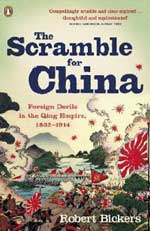
THE SCRAMBLE FOR CHINA
a talk by Professor Robert Bickers
preceded by book launch
Date: Thursday, 13th September
Time: 7.00-8.30 pm
Venue:Â To be confirmed
Entry: Members of The Meridian Society and SACU free
Non-members £5 donation
Registration: Â themeridiansociety@gmail.com
Robert Bickers obtained his PhD at SOAS, University of London. He is Professor of History at Bristol University. His publications include Empire Made Me: An Englishman Adrift in Shanghai; Britain in China: Community and Colonialism, 1900-49; Picturing China, 1870-1950: Photographs from Bristol Collections; The Boxers, China and the World ed. with R.G Tiedermann)
His latest book, The Scramble for China: Foreign Devils in the Qing Empire, 1832-1914, covers the period of upheaval in China’s modern history, when European powers invaded and controlled Chinese territory, pioneered by merchants, traders, missionaries, East India Company officials, military adventurers and finally gunboat naval officers and seamen. This was the quest to open up China to foreign trade, prising open a free market against the restraints and restrictions of the Qing Dynasty Manchu rulers. The tool was opium imports in exchange for tea, silk and other Chinese luxuries and the method was war, starting with the first Opium War of 1839-1842.
This talk will be preceded by book launch at Arthur Probsthain Bookshop
Time:Â 6.00 – 6.30 pm.
Venue:Â 41 Great Russell Street, London WC1B
Posted: September 4th, 2012 | 1 Comment »
In case you didn’t know audio books are back in fashion – largely thanks to the people at Audible.com who’ve been making a wide range of stuff available as never before. Recently they’ve added nine books (yes, nine!) by a great favourite of mine (and if you’re a regular reader of this blog you too probably) Peter Fleming. So probably no need to explain him here – new audio book recordings include (as well as non-China related books worth a listen such as Brazilian Adventure and Operation Sea Lion):

Fleming in Tartary looking, well frankly, very cool…
One’s Company – Catching all the fascination and humour of travel in out-of-the-way places, One’s Company is Peter Fleming’s account of his journey through Russia and Manchuria to China when he was Special Correspondent to The Times in the 1930s. Fleming spent seven months with the “object of investigating the Communist situation in South China” at a time when, as far as he knew, “no previous journey had been made to the anti-communist front by a foreigner”, and on its publication in 1934, One’s Company won widespread critical acclaim. Packed with classic incidents – brake-failure on the Trans-Siberian Express, the Eton Boating Song singing lesson in Manchuria – One’s Company was among the forerunners of a whole new approach to travel writing.
To Peking – Peter Fleming, brother of James Bond author Ian Fleming, was one of the greatest adventurers and travel writers of the 20th century and author of several classic and best-selling books. This book presents an exciting adventure that could never be made today, and it will appeal to all interested in the region.
When in 1934 at the age of 27 Peter Fleming set out for the Far East, his ultimate goal was to return from China to India overland – a journey he later described in the classic News from Tartary. On his outward journey, Fleming travelled through regions which remain some of the most remote and least-visited in Asia and which, soon after his journey, became closed entirely to Westerners. From Moscow, through the Caucasus to the Caspian, on to Samarkand and Tashkent, skirting the edge of Outer Mongolia to Vladivostok and winding his way down to Peking, Fleming tells of people encountered, places explored, and of ways of life that have since been lost through revolution, war, and the passage of time. Along the way, he kept a diary that he never intended to publish and that lay forgotten ‘in the box-room’ of his mind for 15 years. To Peking is an unassuming classic of travel literature. Subtle yet sparkling with intelligence and humour, simple yet beautifully told, it illuminates a world that travellers – armchair or otherwise – can only dream of today.
Bayonets to Lhasa – The British invasion of Tibet in 1904 is one of the strangest events in British imperial history. Conceived by Lord Curzon as a strategic move in the Great Game – that colossal struggle between imperial Britain and Tsarist Russia for influence in Central Asia – the incursion was in fact ill-conceived and inspired by only the weakest of motivations. Led by the soldier, explorer and mystic, Francis Younghusband, the mission – doomed from the very beginning – became caught in political cross-fire and the distant and destructive machinations of China and Britain and ended in ignominy and disappointment for this idealistic adventurer. Peter Fleming’s gripping portrayal of this curious episode and its charismatic protagonists brilliantly illuminates what is now seen as a key moment in the Great Game, the repercussions of which continue to be felt throughout the region.
The Siege at Peking – In June 1900 the foreign legations at Peking were attacked by troops of the Boxer rebellion and Imperial Chinese troops. The ensuing siege lasted 55 days and shook the world. In this work, Peter Fleming traces its history and impact.
Posted: September 3rd, 2012 | 3 Comments »
I believe this is the old Commissioner’s House in Foochow (Fuzhou) taken some time towards the end of the nineteenth century or early years of the twentieth. That is to say the Commissioner of the Chinese, but foreign-run, Maritime Customs Service. I don’t know for sure as I do not know Fuzhou at all but I assume this building is long gone.

Posted: September 2nd, 2012 | No Comments »
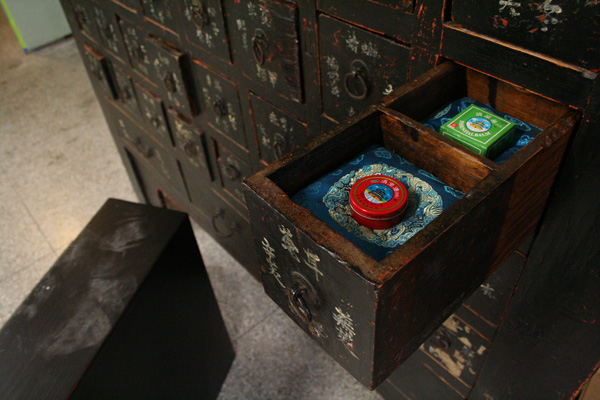
Back in 2010 I blogged about (then) Shanghai-based artist Christina Shmigel’s wonderful Cabinet of Chinese Curiosities project. I particularly liked it as it combined both an examination of China now and ideas around Chinese history, interpretation and Chinoiserie – all things that get a bit of an airing on China Rhyming. Now the catalogue for that exhibition (which includes some great photos of the cabinet itself and its contents) is available online to look at for free here (or to buy here). I always loved Christina’s idea for a cabinet of curiosities after having seen drawings of Herr Wunsch’s Cabinetto Cinese at the City Museum of Oriental Arts in Trieste. Wunsch’s Cabinetto tapped into a love of chinoiserie in the late nineteenth century Austro-Hungarian Empire (just check out Castle Miramar nearby for Chinois overload!). The Cabinetto was a converted shop full of Chinese curiosities and entry was gained for a few pennies. It was apparently massively popular with local Tiestinos.
Posted: September 1st, 2012 | 1 Comment »
Events in Burma in the last couple of years have been brilliant – and now there’s literary festivals and I’m plugging the Irrawaddy Literary Festival as one of the best events you could probably get along to in 2013. The first ever literary festival in Burma, and it will include some of the best local authors (writing in English) as well as a rich mixture of writers and artists from elsewhere. Here’s their web site with a tentative list of authors and all at the Inya Lake Hotel in Rangoon (below). If you’re planning a trip to Burma next year this might make a nice compliment to your visit.