Posted: June 15th, 2012 | 5 Comments »
Can’t say whether or not this book – A Lady Cyclist’s Guide to Kashgar – is any good (though it did get picked as a Summer Read by The Missoulian newspaper, as did Midnight in Peking):

It is 1923 and Evangeline English, keen lady cyclist, arrives with her sister Lizzie at the ancient Silk Route city of Kashgar to help establish a Christian mission. Lizzie is in thrall to their forceful and unyielding leader Millicent, but Eva’s motivations for leaving her bourgeois life back at home are less clear-cut. As they attempt to navigate their new home and are met with resistance and calamity, Eva commences work on her book, A Lady Cyclist’s Guide to Kashgar…In present-day London another story is beginning. Frieda, a young woman adrift in her own life, opens her front door one night to find a man sleeping on the landing. In the morning he is gone, leaving on the wall an exquisite drawing of a long-tailed bird and a line of Arabic script. Tayeb, who has fled to England from Yemen, has arrived on Frieda’s doorstep just as she learns that she is the next-of-kin to a dead woman she has never heard of: a woman whose abandoned flat contains many surprises – among them an ill-tempered owl. The two wanderers begin an unlikely friendship as their worlds collide, and they embark on a journey that is as great, and as unexpected, as Eva’s. A stunning debut peopled by unforgettable characters, A Lady Cyclist’s Guide to Kashgar is an extraordinary story of inheritance and the search for belonging in a fractured and globalised world.m
Posted: June 15th, 2012 | No Comments »
Talking of hotel luggage labels yesterday, I recently got asked by a media organisation to come up with some historic hotels in China…but then they didn’t use it, so you lot get it…and a more deserving group you are too…
1) The Jinjiang Hotel – Shanghai
The Jinjiang Hotel, once the gorgeous Cathay Apartments in the old French Concession. Most famously though where President Nixon and his team stayed in 1972 when they arrived to break the Cold War ice and sign the “Shanghai Communiquéâ€. The Chinese even built a special hall for the signing next door to the hotel. The Jinjiang’s management claim Nixon said the hotel was the best he ever stayed in…but then we know Tricky Dicky had a flexible relationship with the truth!

2) The Pujiang Hotel – Shanghai
The former Astor House Hotel had a lot of famous guests over the decades and now likes to claim Zhou En-lai, Mao’s right-hand-man and the Premier of the PRC, as a long stay guest. Though it’s contentious, as Zhou was not a normal guest seeing the sites but rather hiding out in the Astor in 1927 as outside he was being hunted down as a Communist agitator. The urbane Zhou and his wife posed as tourists, dressed in western clothes and conversed only in English or French so that nobody would realise he was, at the time, the most wanted man in Shanghai with a price on his head.

3) The Peking Hotel – Beijing
It’s hard to believe but before June 1989 CNN was little known outside the USA. Then the tanks rolled into Tiananmen Square to crush the student protestors and CNN was right there with cameras rolling. Veteran journalists John Holliman and Bernard Shaw were in the thick of it. CNN’s Beijing correspondent at the time Mike Chinoy maintains that CNN’s coverage of the massacre, while the tram were based in the Peking Hotel, ” put CNN on the map”. The balconies of the Beijing Hotel were where most of the footage of the Square was shot from including AP’s Jeff Widener and his iconic picture of a lone man with two shopping bags who stopped a tank. Tiananmen was just the latest event witnessed by guests at the former Grand Hôtel de Pékin built as the capital’s grandest lodging house in 1917.

4) The Astor House Hotel – Tianjin
Not many know that the regal Astor on the banks of the Hai River in the heart of the former British Concession of Tientsin was the favourite hotel of a young American mining engineer by the name of Herbert Hoover who later became the 31st President of the United States. In reality the Hoover’s only stayed in the Astor for a few weeks in 1899 but that hasn’t stopped the hotel opening a “Hoover Suite†and intimating he was President when he stayed there – not quite, Hoover wouldn’t be the Commander-in-Chief for another 30 years. Still, he did pick up a little Chinese and reportedly used it in the White House when he wanted a private conversation with his wife.

5) The Cathay Hotel – Shanghai
Sir Victor Sassoon’s impressive Bund-side hotel was home to many famous visitors. But here’s an unlikely pairing to demonstrate the hotel’s range! Just a year after the hotel opened in 1930 Noel Coward arrived from Singapore with a terrible bout of the flu. Confined to bed, Coward busied himself writing what would become his most famous play, Private Lives. By way of contrast, during the Cultural Revolution, or as it’s now officially known “the ten years of madnessâ€, the Cathay became the base for Madame Mao and the notorious Gang of Four. Proletarian revolutionaries they may have been but they knew a stylish hotel when they saw one!

6) The White Swan Hotel – Guangzhou
The White Swan stands majestically upon Shamian Island, the spit of land where foreigners were first allowed to settle and trade in Canton, now Guangzhou. It was one of China’s first five star hotels and is also home to one of the greatest urban legends of modern China – the Queen’s mobile throne! When Queen Elizabeth II visited in 1986 she was the first British monarch to set foot on Chinese soil and she stayed at the White Swan. However, a legend was born that every Chinese person believed at the time – the tale that the Queen brought her own toilet to China and that it accompanied her everywhere to allow her to avoid using a Chinese loo. True or false? Buckingham Palace will not confirm or deny, but it doesn’t matter as everyone believes in the legend of the Queen’s mobile throne.

7) The Yamato Hotel Mukden – Shenyang
Yamato were a Japanese-built hotel chain in northern China known for their modernist architecture and sumptuousness. No wonder then that the Yamato Mukden, now the Liaoning Hotel Shenyang, was a favourite of Mao Tse-Tung and Den Xiaoping when on business up north. It’s a palace of a hotel so perhaps fit for supreme leaders enjoying the Mandate of Heaven…and close to the railway station where Mao’s personal and private train carriage could wait for him. Incidentally, the Yamato Hotel in Dalian (now the Dalian Hotel) was the favourite out-of-office meeting place for the former mayor, the now slightly more well-known Bo Xilai!!

8) The Peninsula – Hong Kong
The grand old lady of Kowloon, overlooking the harbour and facing The Peak opposite and, once, right next to the railway station where the trains arrived from Canton (in case you’re wondering why Hong Kong’s grandest hotel is Kowloon-side). Depending on your style choose your Peninsula hero – W. Somerset Maugham staying here in the “finest hotel east of Suez†drinking gin Martinis; James Bond in The Man With the Golden Gun using the hotel’s fleet of Rolls Royce’s or; Bruce Wayne (aka Batman) arriving on the hotel’s rooftop helipad in The Dark Knight.

9) The Lucky Holiday Hotel – Chongqing
Technically called the Nanshan Lijing Guest House, but better known as the Lucky Holiday Hotel. Secluded villas with views of the sprawling metropolis of Chongqing below. Scenic for sure…but lucky? Perhaps not, as this previously rather obscure hotel was where British businessman Neil Heywood died, allegedly murdered, in November 2011 kicking off China’s most notorious and mysterious political scandal for decades. Don’t expect any plaques or a confessional tell-tale sessions from the management – they’re denying everything and anything!

Posted: June 14th, 2012 | No Comments »
Hugues Martin has some lovely old luggage labels from Chinese hotels on his Shanghailander blog – worth checking out….
I’ll add this one for the old Imperial Hotel in the Peking Legation Quarter…

Posted: June 14th, 2012 | No Comments »
RAS WEEKENDER
Saturday 16th June 2012 at 4.00pm
The Tavern, Radisson Blu Plaza Xingguo Hotel 78 Xing Guo Road, Shanghai
TIM LUARD
ON
THE ONE-LEGGED ADMIRAL’S ESCAPE FROM HONG KONG

In one of the most remarkable adventures of the Second World War, Admiral Chan Chak and more than sixty British companions broke out through the Japanese lines within hours of Hong Kong’s surrender on Christmas Day 1941.  As the rest of the colony buckled down to long years of occupation, they sped by torpedo boat through the night to Mirs Bay and marched for four days across occupied China to freedom. The one-legged admiral (the only person ever to have served as China’s official representative in the British colony) left behind his wooden leg when he had to swim for his life in a barrage of gunfire and after hiding in a cave was later carried over the hills and rivers of Guangdong in a sedan chair.
The motley escape party also included the future head of Hong Kong’s post-war civil administration (David MacDougall), bickering staff and intelligence officers carrying sensitive military information, old-school naval commanders and a raucous array of sailors.  The survivors from the Royal Navy party reached home five months later after travelling overland right across the Chinese interior (the first time the Royal Navy had been seen there since the Opium War).  The escape was hailed as an unprecedented example of Sino-British cooperation and the admiral was knighted.
Tim Luard will give an illustrated talk on the escape, focusing on who the different members of the party were and how they came to be among the lucky few who got away. Â He will also be signing copies of his recently published book, Escape from Hong Kong: Admiral Chan Chak’s Christmas Day Dash, 1941.

Tim Luard graduated in Chinese at Edinburgh University in 1973 and spent the next seven years in Hong Kong, working as a freelance journalist.  Highlights of his 23-year career at the BBC included covering the 1989 events in Tiananmen Square during a two-year stint as Beijing Correspondent for the World Service and making a 6-part radio series on the history of Hong Kong to mark the handover. Tim and his wife Alison — whose father Colin McEwan was a member of Admiral Chan’s party — retraced the escapers’ 80-mile route to Huizhou on foot in 2009 and put together an exhibition on the escape which is showing till the end of 2012 at the Hong Kong Coastal Defense Museum.
Entrance: RMB 30.00 (RAS members) and RMB 80.00 (non-members). Those unable to make the donation but wishing to attend may contact us for exemption, prior to the RAS Weekender event. Membership applications and membership renewals will be available at this event.
RSVP: “Reply” to this email or to RAS Bookings at: bookings@royalasiaticsociety.org.cn
N.B. RAS members will have booking priority until Tuesday June 12th.
Posted: June 14th, 2012 | No Comments »
I have not had a chance to go through this yet but Earnshaw Books are invariably reliable so I’ll post details in the hope I can catch up at some point with Tales about China and the Chinese but many of you may be interested to get your hands on it asap…

Before there was Rudyard Kipling, there was Peter Parley, delighting his “young friends†with his fantastic fables of faraway lands and whimsical sense of humor. Published right after the first Opium War, this book reveals the chasm between the Marco Polo-inspired view of a mythically serene China and the harsh realities of the colonial era. A delightful mix of fact and fancy, Tales about China and the Chinese encapsulates the ethos of an era when the West saw China as a remote, and unspoiled empire – ripe for the picking.
Peter Parley was a pen name coined by the highly popular and influential American author Samuel Griswold Goodrich and was often used by imitators. The author of this book, whose real identity remains unknown, was one such imposter. Andrew Chubb is the editor of Earnshaw Books’ Classic series.
Posted: June 13th, 2012 | No Comments »
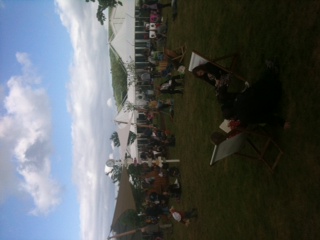
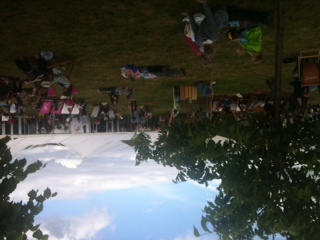
Spent three rainy days get soaked but educated at the Hay Festival. Lovely spot on the England/Wales border and, of course, a book town. I’d recommend The Pear Tree guesthouse to anyone visiting – lovely rooms, comfy beds, a good fry up in the morning and central location.
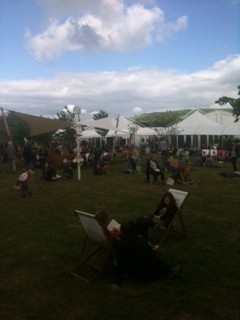 This was the only day I saw (and not the whole day) anyone could sit out on the deckchairs….
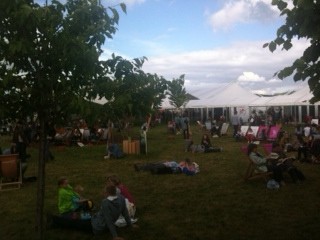 and, to be fair, when the sun came out it was charming up on the Welsh border…
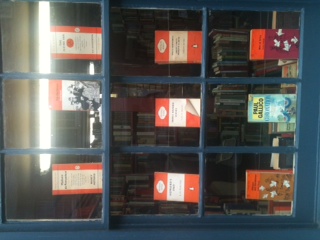
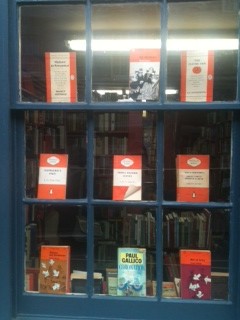 Hay is of course a book town and so to see window displays of original Penguin covers is a bit better than your usual British High Street.
Posted: June 13th, 2012 | No Comments »
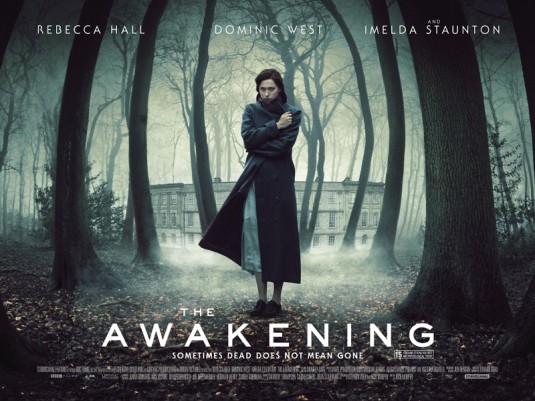
Maybe it’s just coincidence but I’m reading a lot of stuff at the moment that has seance’s in it – in the last few months I’ve read Chris Womersley’s Bereft which has a just-after-WW1 seance in Marylebone while DJ Taylor’s new novel Secondhand Daylight has a 1930s Soho seance (complete in this case with an exotic Indian man rather than a Chinese). Seance’s keep popping up in films too – the Ouija board remains a popular staple. And Chinese are, and were genuinely, often hired to appear at seances in London to add a touch of exoticism to the proceedings. This is nicely shown in the movie The Awakening with Dominic West and Rebecca Hall – where we are again in just post-WW1 England. Rebecca Hall’s character goes round unmasking the charlatans that run seances and, at the start of the film, does so successfully at a seance where a poor pigtailed Chinese man is part of the whole ambiance designed to lure in the mug punters. I can’t find a picture of the seance scene but the whole film is worth watching anyway. And of course Chinese elements to seances in fiction are nothing new – remember the great seance in Graham Greene’s The Ministry of Fear? Very chinois!
Posted: June 12th, 2012 | No Comments »
Nice to see that the Royal Asiatic Society in China, so active in Shanghai and latterly in Suzhou too is now able to start help organising great events up in Beijing in conjunction with the Beijing Bookworm…
Bookworm Beijing
Wednesday, June 13 7:30pmÂ
Escape from Hong Kong – a booktalk with Tim Luard
20/30rmbÂ
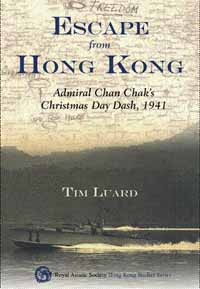
Author Tim Luard, former Beijing correspondent for the BBC World Service, discusses the amazing true life adventure tale of the dramatic escape of more than 60 Chinese, British and Danish intelligence, naval and marine personnel on December 25th, 1941, the day of Hong Kong’s surrender to the Japanese. Led by Admiral Chan Chak – the Chinese government’s chief agent in Hong Kong  – this group escaped the invading Japanese army, traveling on five small motor torpedo boats and walking for four days through enemy lines to Huizhou, before flying to Chongqing or going over land to Burma. This gripping account of the escape sheds new light on the role played by the Chinese in the defense of Hong Kong, on the diplomacy behind the escape, and on the guerillas who carried the Admiral in a sedan chair as they led his party over the rivers and mountains of enemy-occupied China.
Tim’s book Escape from Hong Kong will be available at the Bookworm (or here in hardback, or here in Kindle)
This event is brought to you by the Royal Asiatic Society.