Posted: May 20th, 2012 | 1 Comment »
Last year I noted in a post a few references to old Shanghai in popular culture – Elizabeth Wilson’s War Damage (Serpent’s Tail, 2009) was one examples, a great novel that takes the reader to post-war Hampstead where the Bohemian set are getting started again after six years of fighting the Nazis. One suspect immediately shoots up the “most likely to be guilty of something†list when it is mentioned that he had spent many years before the war in Shanghai, in antiques or something. Clearly someone who needs further investigation. A cracking read.
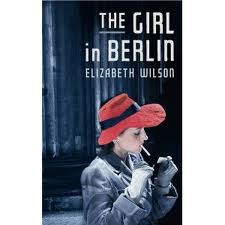
Now Elizabeth Wilson is back with a new novel and it’s even better – The Girl in Berlin – as well as being a really atmospheric spy thriller set in 1951 amid the scandals of the Burgess and Maclean scandals. And Shanghai gets another mention to cement it’s well deserved reputation!! One rather louche female character from the upper classes – Reggie – is described as, “…one of those women who somehow acquired lots of husbands. There was a mystery about her first, pre-war one, met in Shanghai.” Oh those dodgy chaps you meet in old Shanghai!
Posted: May 19th, 2012 | No Comments »
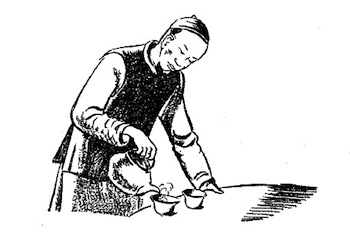
A quick plug for the excellent and utterly absorbing new online edition of the China Heritage Quarterly which focuses on tea, teahouses and all things to do with the lovely brew.
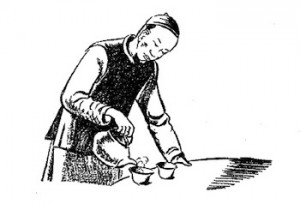
Pouring tea, by Kurt Wiese (Source: Grace Yaukey (pseud. Cornelia Spencer), Made in China, London: George G. Harrap and Co, 1947, p.47.)
Posted: May 19th, 2012 | No Comments »
For those who might be interested – here’s a quick post to a couple of links:
1) I did a “5 of the Best” for the Wall Street Journal this weekend and chose White Mischief so there’s a couple of old-Shanghai references
2) Here’s a link to a session I did with Jianying Zha (China Pop, Tide Players) at the Adelaide Writers’ Week in March courtesy of the ABC Big Ideas channel – it’s a contemporary China thing but anyway..more details below:
This episode of Big Ideas is one of the better insights into the political and social complexities of China. The discussion features writer and media critic, Jianying Zha, sinologist and novelist Linda Jaivin and economist and writer Paul French.
They argue and debate way beyond the ‘Australian idea of China’ – the economic powerhouse and the country that’s keeping the Australian economy afloat, to a much more complex picture of democracy, trust in the civilian population, corruption, dispensing justice at a local level and the future of the Party structure.
Particularly good are the exchanges between Jianying Zha and Paul French. They agree to disagree on various aspects of Party leadership, the meltdown of the old structures, innate corruption and individual greed.
Jianying Zha has written two books in English; China Pop and How Soap Operas, Tabloids and Bestsellers are transforming a Culture and most recently the Tide Players, a collection of interviews with intellectuals and entrepreneurs who have prospered during the years of huge economic growth.
Linda Jaivin is a sinologist and novelist. Best known of her works is her erotic novel Eat Me. Her non fiction works include Confessions of an S &M Virgin and her China memoir, The Monkey and the Dragon. She is currently a Visiting Fellow at the ANU College of Asia and the Pacific.
Paul French is an economist and writer and a long term resident of Shanghai. His most recent work is the true crime story Midnight in Peking. His earlier works include Carl Crow: A Tough Old China Hand and Through the Looking Glass: China’s Foreign Journalists from the Opium Wars to Mao.
This China panel formed part of Adelaide Writers’ Week.
Posted: May 19th, 2012 | 2 Comments »
Right now it’s hard to find anyone I know who hasn’t in the last six months taken a trip to Burma. It’s all the rage – economic analysts, political think tankers, investment bankers, NGO-types and, of course, the hack pack looking for new stories (and inevitably of course seeking them in the same places!!). I’m stuck working and promoting books so can’t join the exodus and I suppose by the time I get round to it I’ll be able to visit a Rangoon Starbucks and get a Papa John’s pizza in Mandalay!!
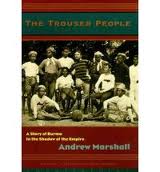
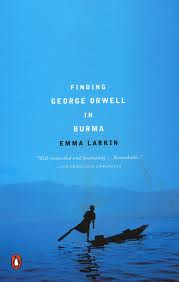
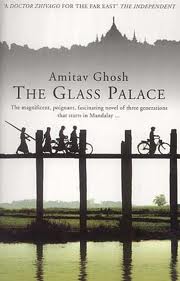
Still, we can read. And I’m going to assume that everyone reading this blog has already read, and re-read, Orwell’s Burmese Days and the associated Burma essays. If you haven’t please desist from visiting this blog – it’s not really the place for you! I’d also recommend two opther great Burma books that evoke the old times (this is an old times blog afterall) – Emma Larkin’s Finding George Orwell in Burma which is fascinating and Andrew Marshall’s Trouser People: A Story of Burma in the Shadow of Empire. I’ve added details of these two below. I’d also note Amitav Ghosh’s The Glass Palace – but you should all also know that too! It would naturally be remiss of me to not plug my own small contribution to Burma studies in the form of the Carl Crow war diaries, The Long Road Back to China, I edited a couple of years ago that describe, in Crow’s own words, Rangoon, Burma and the perilous Burma Road in 1940 (I’ve blogged a lot about that before – just use the search box to find references and details).
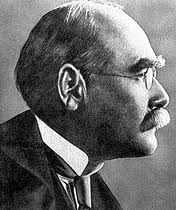
And so I came across something that may interest us all thinking about Burma and another great writer associated with the country Kipling. Here then is a link to an address by George Webb to the royal Society of Asian Affairs given in 1983 on the subject, Kipling’s Burma: A Literary and Historical Review.
 The Trouser People – Two journeys, one hundred years apart–that of the eccentric British explorer George Scott, who introduced the game of soccer to Burmese natives, and that of the author, charting the same dangerous terrain in a country vastly changed by colonialism, war, and politics. Andrew Marshall has written an unforgettable adventure story, the wry account of two journeys into the untraveled heart of Burma. Part travelogue, part history, part reportage, The Trouser People recounts the story of George Scott, the eccentric British explorer, photographer, adventurer, and later Colonial Administrator of Burma, who introduced the Empire’s best game (soccer!) to Burmese natives and to the forbidden Wa state of headhunters, who were similarly enthusiastic about it. The second, contrasting journey is Marshall’s own, taking the same dangerous path one hundred years later in a country now devastated by colonial incompetence, war, and totalitarianism. Wonderfully observed, mordantly funny, and skillfully recounted, this is journalistic travel writing at its best.
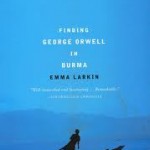 Finding George Orwell in Burma – In one of the most brilliant and intrepid memoirs in recent memory, Emma Larkin tells of the year she spent travelling through Burma, using as a compass the life and work of George Orwell, whom many of Burma’s underground teahouse intellectuals call simply “the prophet”. In stirring, insightful prose, she provides a powerful reckoning with one of the world’s least free countries. Finding George Orwell in Burma is a brave and revelatory reconnaissance of modern Burma, one of the world’s grimmest and most shuttered dictatorships, where the term “Orwellian” aptly describes the life endured by the country’s people. This book has come to be regarded as a classic of reportage and travel and a crucial book for anyone interested in Burma and George Orwell.
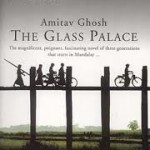 The Glass Palace – Rajkumar is only a boy, helping out on a market stall in the dusty square outside the royal palace in Mandalay, when the British force the Burmese King, Queen and court into exile. He is rescued by a far seeing Chinese merchant and with him builds up a great logging business in upper Burma. But haunted by his vision of the Royal Family and one of their attendants, he journeys to the obscure town in India where they have been exiled, and his family and friends become inextricably linked with theirs. Through the lives of the wider family and connections, an extraordinary story of this century is told: in Malaya, amid the vast rubber plantations, in India, among the growing nationalist feeling, in America where ideas of democracy and terrorist action, as well as business acumen, could be learnt. By the time World War II arrives, Rajkumar – who had made and lost several fortunes – has spread his family and influence from the great estate at Morningside where his son will be involved in the British collapse in Singapore, and one of his relations in the remarkable rebellion of the Indian troops against their British officers. Another of the great characters, the formidable Indian widow, Uma, becomes a spearhead of the Indian nationalist movement and provides a final refuge for the battered remnants of the family as they flee from Burma before the Japanese advance in a horrifying trek across appalling terrain. And it his granddaughter who survives that experience who brings the readers back to contemporary Burma, and completes the circle of the family started so long ago in Mandalay.
Posted: May 18th, 2012 | No Comments »
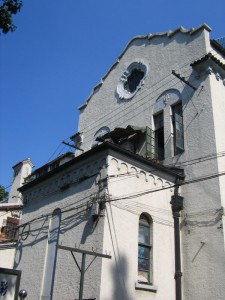
An interesting article on Spanish Revival architecture in Shanghai (or what’s left anyway) on Hugues Martin’s Shanghailander blog…
Posted: May 18th, 2012 | No Comments »
RAS WEEKENDER
Saturday 19th May 2012 at 4.00pm
No.8 Xintiandi North Part Lane 181 Taicang Road Shanghai
  Address in Chinese: 太仓路181弄,新天地广场北里8å·,T8é¤åŽ…
PROFESSOR DANIEL A. BELL
On
Political Legitimacy in China: A Confucian Perspective
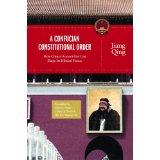
The Chinese government has managed to achieve a high degree of political legitimacy without democracy in the sense of free and fair competitive elections for the country’s leaders. The main explanation is that the government has recently revived and drawn upon three sources of non-democratic legitimacy: performance legitimacy, political meritocracy, and nationalism. In a critical spirit, Prof. Bell will suggest that those sources of legitimacy may not be sustainable and justified from a moral point of view. He will then argue that a modified version of Jiang Qing’s theory of political legitimacy may help to remedy some of the defects of “actually-existing” legitimacy in China. He will conclude by asking if this model of legitimacy is relevant and desirable outside of China.
Daniel A. Bell was born in Montreal, Canada. He obtained his B.A. at McGill University and his graduate degrees at Oxford University. He is Zhiyuan Chair Professor of the Arts and Humanities at Jiaotong University (Shanghai) and Professor of Ethics and Political Philosophy and Director of the Center for International and Comparative Political Philosophy at Tsinghua University (Beijing). He is the author of China’s New Confucianism (Princeton University Press, rev. ed. 2010), Beyond Liberal Democracy (Princeton University Press, 2006), East Meets West (Princeton University Press, 2000), and Communitarianism and Its Critics (Oxford University Press, 1993). He is the co-author of The Spirit of Cities (Princeton University Press, 2011). He has edited and co-edited eight books, and he is the series editor of the new Princeton-China translation series. He co-edited and wrote the introduction for the first book in the series Ancient Chinese Thought, Modern Chinese Power (Princeton University Press, 2011) as well as the second book, A Confucian Constitutional Order (Princeton University Press, forthcoming in 2012). He is a frequent contributor to the New York Times, the Globe and Mail, and to Chinese language publications (His Chinese name: è´æ·¡å®). His writings have been translated into twenty-two languages.
Entrance: RMB 80.00 (RAS members) and RMB 130.00 (non-members). Those unable to make the donation but wishing to attend may contact us for exemption, prior to the RAS Weekender event. Membership applications and membership renewals will be available at this event.
RSVP: “Reply” to this email or to RAS Bookings at: bookings@royalasiaticsociety.org.cn
N.B. RAS members will have booking priority until 15 May 2012.
Posted: May 17th, 2012 | No Comments »
Another day another Sitwell…this time Sacheverell and published in Wheels 1916…
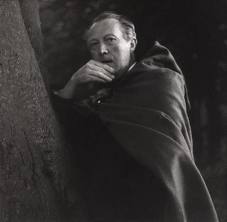
Li Tai Pe Drinks and Drowns
THE spray splashes on the petals of the anemone
Creasing the water to a mesh of magic circles moving outwards:
The petals shake like the notes
Of a woman singing.—
Then Li Tai Pe lifts back his cup
And the red scimitar goes back to its sheath.
The magical rings move further away
Till they shake the ivory towers of the water-lilies.
Now, as a finger shuts the notes of a flute,
The petals fold together.
Then Li Tai Pe with reeling mind
Sees the moon as an ivory mask
Hung from the belt of Fate the Histrion.—
With such a mask, the princesses will deem him of the
dragon-blood.
He jumps to catch it.
The moon-stained water runs into his mouth.
With open arms he sinks
And through the jade-cold water seeks his diadem.
Posted: May 17th, 2012 | No Comments »
A Chinois-style poem from Edith Sitwell first published in Chapbook, July 1920.

A few notes:
Bohea – a tea growing area in Fujian
Sir Joshua Jebb – who was a British army engineer in Canada and then designed some of Britain’s most famous prisons – not sure why he pops up here but he did have a lot of daughters as indicated
Joppa – the city now more commonly known as Jaffa in Israel
En famille – Edith Sitwell
In the early springtime after their tea,
Through the young fields of the
springing Bohea,
Jemima, Jocasta, Dina and Deb
Walked with their father
Sir Joshua Jebb –
An admiral red, whose only notion,
(A butterfly poised on a pigtailed ocean)
Is of the peruked sea whose swell
Breaks on the flowerless rocks of Hell.
Under the thin trees,
Deb and Dinah,
Jemima, Jocasta, walked, and finer
Their black hair seemed (flat-sleek to see)
Than the young leaves of the
springing Bohea;
Their cheeks were like
nutmeg-flowers when swells
The rain into foolish silver bells.
They said, “If the door you would
only slam,
Or if, Papa, you would once say “Damn” –
Instead of merely roaring “Avast”
Or boldly invoking the nautical Blast –
We should now stand
in the street of Hell
Watching siesta shutters that fell
With a noise like amber softly sliding;
Our moon-like glances through
these gliding
Would see at her table preened and set
Myrrhina sitting at her toilette
With eyelids closed as soft
as the breeze
That flows from gold flowers
on the incense-trees.
The Admiral said,
“You could never call –
I assure you it would not do at all!
She gets down from table
without saying “Please”,
Forgets her prayers and to cross her Ts,
In short, her scandalous reputation
Has shocked the whole of the
Hellish nation;
And every turbaned Chinoiserie,
With whom we should sip
our black Bohea,
Would stretch out her simian
fingers thin
To scratch you, my dears, like a
mandoline;
For Hell is just as properly proper
As Greenwich, or as, Bath, or Joppa!”