Posted: May 16th, 2012 | No Comments »
I said, rashly, back in January that this would be the year of Chinois-inspired poetry on China Rhyming. I got off to a good start with Vachel Lindsay (here and here) and Ezra Pound (here). And now some more from various Sitwells.
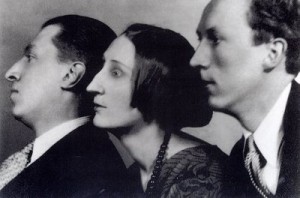 Osbert, Edith and Sacheverell
The Sitwell’s all had a relationship with China in one way or another and for Edith and Sacheverell both wrote Chinois inspired poems – reproduced here today and tomorrow. And to start a short excerpt from John Pearson’s biography of the Sitwell’s followed by an untitled poem from Edith…
When Osbert Sitwell went to China in January, 1934, it was with the conviction that little of what he would see could last and because he wished to experience ‘the wonderful beauty of the system of life it incorporated before it should perish.’ For three months he and his companion David Horner rented a small house in the middle of Peking’s Tartar City. It amused Osbert to spend each morning writing about the charms of the chinoiserie Pavilion in his latest book, a social history of Brighton, while the winds brought the yellow sand from the Gobi Desert onto his work table. Through his friend Harold Acton, dandy aesthete turned Chinese man-of-letters, Sitwell and Horner had an entrée to a vanished Peking that Sitwell would bring vividly to life in Escape with Me!: An Oriental Sketch-Book (1939), hailed by Hugh Walpole as one of the half-dozen best travel books in English of the previous half-century.
When May came, and the peonies were over, it was time to leave. One of the last visits Osbert made before departing was to the ancient college of the imperial eunuchs. He spent some time talking to the oldest of them, a wrinkled, hairless man with a piping voice and an inquisitive manner: ‘Tell me, young man, the old castrato said, ‘do you have no group of people like us where you come from?’ Osbert thought a while then answered gravely, ‘Yes, indeed we have. We call it Bloomsbury.’
See John Pearson, Façades: Edith, Osbert and Sacheverell Sitwell (1978)
Untitled – Edith Sitwell
The King of China’s daughter She never would love me,
Though I hung my cap and bells upon
Her nutmeg tree.
For oranges and lemons
The stars in bright blue air (I stole them long ago, my dear)
Were dangling there.
The moon, she gave me silver pence;
The sun did give me gold:
And both together softly blew
And made my porridge cold.
But the King of China’s daughter
Pretended not to see,
When I hung my cap and bells upon
Her nutmeg tree.
Posted: May 15th, 2012 | No Comments »
The second of the University of Westminster’s China in Britain conferences is being held at the Uni on 31/5/12 – details as below with some interesting screenings:
China in Britain #2. Film
May 31st 2012 – Time: 09:45 AM – 16:45PM
Room 451, 309 Regent Street, London W1B 2UW
Programme: RSVP – Entrance is free but strictly limited so it is essential to book your place by emailing
anne@translatingchina.info
9:45AM Coffee/welcome Anne Witchard and Diana Yeh, Research Fellow
10:00AM Screening of Soursweet (1988)
11:50AM coffee
12:15PM Presentations of their work by filmmakers Rosa Fong and Lab Ky Mo
Lab Ky Mo is an award winning screenwriter and director of innumerable short films, commercials, teen soaps, Hollyoaks and The Cut, and the controversial feature film Nine Dead Gay Guys (2002), reviewed by the Sunday Express as “the most outrageous and original British film of the yearâ€. My Dad the Communist (2009) and recent projects, The Bruce Lee Bus and My Triad Summer Holiday, are stories of British-Chinese boyhood in the 1980s.
Rosa Fong is Senior Lecturer in Film and Television at Edge Hill University. She is an industry professional with more than 15 years’ experience working on feature films and documentaries, and, as a director/producer, in independent film and television. Rosa has worked in Hong Kong as a commercials director and in the UK directing music videos for MTV and Partizan. Her short films have won awards from the BFI and Arts Council of England. More recently she was Associate Producer on the award-winning Cut Sleeve Boys (2006), dubbed the first British-Chinese gay feature film. She is currently writing several feature film scripts for the UK market.
1:30PM – 2:30PM lunch
2:30PM Director Mike Newell will talk about Soursweet followed by a roundtable with Lab, Rosa,
and actress Lucy Sheen
Lucy Sheen has over thirty years of experience working in film, television, theatre and radio. She was born in Hong Kong, orphaned and then adopted by an English family. One of the first British-Chinese actresses to be accepted into a UK drama school, she graduated with a BA in Theatre Arts in 1984. Her first role was the female lead in the ground-breaking British film Ping Pong (dir. Po Chi’h Leong), the first feature film to explore the complex issues of the British-Chinese community. Though not in competition Ping Pong received critical acclaim at the Venice Film festival. Lucy is now in production with her independent documentary looking into the issues of trans-racial adoption and what it felt like growing up in the late sixties/early seventies as a British-Chinese.
Mike Newell has been directing and producing films for screen and television, both in the UK and Hollywood, since 1977. After the release of Harry Potter and the Goblet of Fire in 2005, he was confirmed third most commercially successful British director in recent years by the UK Film Council. He won the BAFTA Award for Best Direction in 1994 for Four Weddings and a Funeral, and the BAFTA Britannia Award for Artistic Excellence in Directing in 2005. His film adaptation of Great Expectations will be released later this year.
3:30PM tea
3:45PM Jeffrey Richards, Professor of Cultural History at Lancaster University, will present his paper ‘Dr Fu-Manchu and the Yellow Peril’
Jeffrey Richards is a leading cultural critic and nationally renowned expert on theatre and cinema history. He is the author of seminal books too numerous to list here – among the most recent are Films and British National Identity (1997), Imperialism and Music (2001), Sir Henry Irving: A Victorian Actor and His World (2005), Hollywood’s Ancient Worlds (2008), John Ruskin and the Victorian Theatre (with Kate Newey, 2010), and Cinema and Radio in Britain and America 1920-60 (Manchester University Press, 2010). He is currently the recipient of a large AHRC grant for a project on Victorian pantomime and popular entertainments.
http://www.translatingchina.info
Posted: May 15th, 2012 | 2 Comments »
Midnight in Peking rather nicely got selected as one of the Editors’ Picks on Amazon.co.uk for May…

Midnight in Peking was also the USA Today’s Weekend book pick last weekend.
Posted: May 14th, 2012 | 1 Comment »
This project has been progressing for some time down on Hawaii – now there’s a teaser available…click here
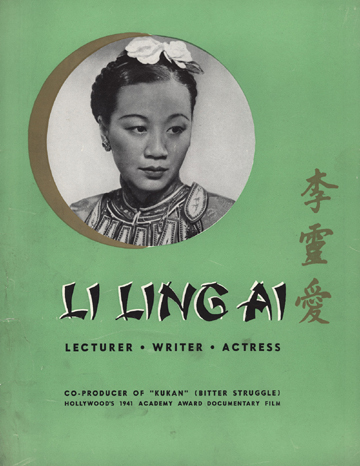
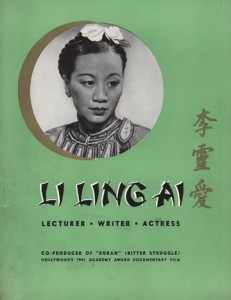
DriÂven by a lifeÂlong lack of ChiÂnese AmerÂiÂcan heroÂines to emuÂlate, filmÂmaker Robin Lung goes on a quest to disÂcover the real life equivÂaÂlent of a ficÂtional ChiÂnese AmerÂiÂcan female detecÂtive. As she folÂlows clues she runs across a fasÂciÂnatÂing memÂoir writÂten by a ChiÂnese woman from Hawaii named Li Ling-Ai and unearths a 1941 Oscar-winning docÂuÂmenÂtary that Li worked on called KUKAN – an epic color film about war-torn China that has been “lost†for over half a cenÂtury. Lung’s hunt for a heroÂine takes on a new dimenÂsion as she tries to track down the story behind KUKAN and prove that Li’s role in the film went beyond the TechÂniÂcal AdviÂsor credit she was given. She quickly disÂcovÂers two other peoÂple who have their own reaÂsons for digÂging into KUKAN’s amazÂing past: Ed Carter, the docÂuÂmenÂtary curaÂtor at the AcadÂemy Archives who’s seekÂing the missÂing corÂnerÂstone of his colÂlecÂtion; and Michelle Scott, the grandÂdaughÂter of KUKAN camÂeraÂman Rey Scott, a young artist who longs to know more about her dead grandÂfaÂther and the mysÂteÂriÂous phoÂtographs he left behind.
Posted: May 11th, 2012 | No Comments »
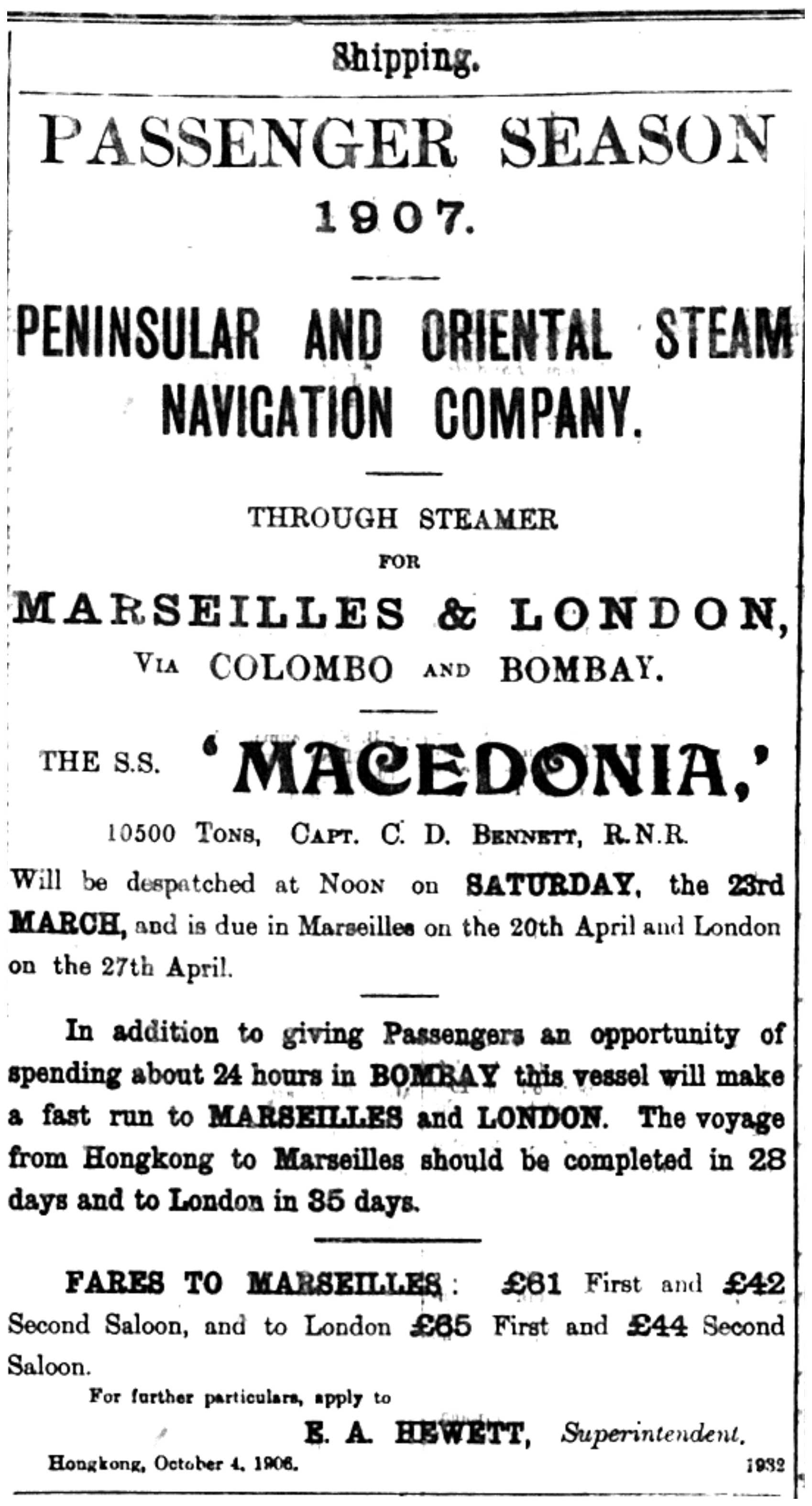
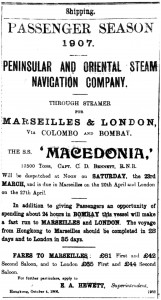
Here’s P&O’s 1907 passenger season from Hong Kong through to Marseilles and London via Colombo and Bombay aboard the SS Macedonia – a fair old trip but I nice way to spend a month…
Posted: May 11th, 2012 | No Comments »
Applications for the 2013 M Literary Residency Programme are now open – the residentcy supported by M on the Bund and Capital M, those two great restaurants in Shanghai and Beijing. The Programme funds three-month residencies in India and China for writers of fiction, nonfiction, poetry or dramatic prose. (The residency in India is at Sangam House, which can also be applied to separately www.sangamhouse.org).
Application forms and Residency Guidelines, plus all relevant information can also be found on their website ~ http://www.m-restaurantgroup.com/mbund/Ms_residency.html or facebook page ~ https://www.facebook.com/m.literaryresidency
Applications close on July 1, 2012.
The M Literary Residency Programme was established to disseminate a broader knowledge of contemporary life and writing in India and China today and to foster deeper intellectual, cultural and artistic links across individuals and communities.
Posted: May 10th, 2012 | No Comments »
James Palmer on Tangshan at the RAS in Shanghai and, below, in Suzhou….
RAS WEEKENDER
Saturday 12 May 2012 at 4.00pm
Tavern, Radisson Plaza Xingguo Hotel 78 Xing Guo Road, Shanghai
兴国宾馆上海市兴国路78å·
JAMES PALMER
on
Unnatural Disasters: The Tangshan Earthquake and the End of Maoism
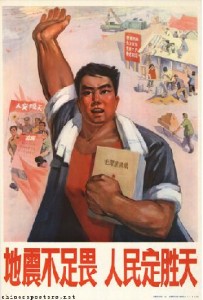
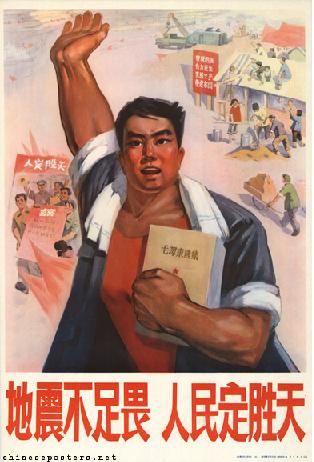
On July 28, 1976, the city of Tangshan was obliterated by the worst natural disaster in modern Chinese history, killing at least 250,000 people. In Beijing, the dying Mao, whose long illness had politically paralyzed the country, was wheeled into a shelter as buildings shook around him. But the quake was only one in a long series of calamities for China in the 1960s and 1970s. Politics and nature interacted to rock the foundations of the country, expose the gulf between the Chinese people and their leaders, and eventually end 30 years of Maoism.
This talk will discuss the events around the disaster and how the power struggle of the 1970s still echoes in Chinese politics today.
James Palmer is the author of Heaven Cracks, Earth Shakes: the Tangshan Earthquake and the Death of Mao’s China. His previous book, shortlisted for the John Llewellyn Rhys prize, was The Bloody White Baron. In 2003, he won the Spectator’s Shiva Naipaul prize for travel writing. He lives and works in Beijing.
Entrance: RMB 30.00 (RAS members) and RMB 80.00 (non-members). Those unable to make the donation but wishing to attend may contact us for exemption, prior to the RAS Weekender event. Membership applications and membership renewals will be available at this event.
RSVP: “Reply” to this email or to RAS Bookings at: bookings@royalasiaticsociety.org.cn
N.B. RAS members will have booking priority until 10 May 2012.
Sunday, March 13, 2012, 2pm
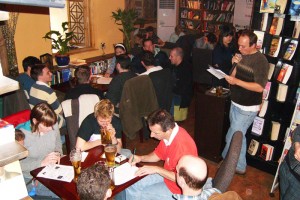
After a fine lunch at the Bookworm join the Royal Asiatic Society in Suzhou to discover how the Tangshan Earthquake of 1976 accelerated momentous change in modern Chinese politics and society. James Palmer, author of “Heaven Cracks, Earth Shakes: the Tangshan Earthquake and the Death of Mao’s China”, explains the impact the tragedy had on Chinese society and politics then and now.
When an earthquake of historic magnitude leveled the industrial city of Tangshan in the summer of 1976, killing more than a half-million people, China was already gripped by widespread social unrest. As Mao lay on his deathbed, the public mourned the death of popular premier Zhou Enlai.
Anger toward the powerful Communist Party officials in the Gang of Four, which had tried to suppress grieving for Zhou, was already potent; when the government failed to respond swiftly to the Tangshan disaster, popular resistance to the Cultural Revolution reached a boiling point.
“In Heaven Cracks, Earth Shakes”, acclaimed historian James Palmer tells the startling story of the most tumultuous year in modern Chinese history, when Mao perished, a city crumbled, and a new China was born.
Palmer’s previous book, shortlisted for the John Llewellyn Rhys prize, was “The Bloody White Baron”. In 2003, he won the Spectator’s Shiva Naipaul prize for travel writing. He lives and works in Beijing.
At the Suzhou Bookworm. Tell your taxi driver the intersection of Wu Que Qiao and Shi Quan Jie. Or, take the subway to the Lindun Lu stop in downtown Suzhou and take a 10 minute ride by pedicab or five-minute taxi ride to the Bookworm. It’s a fifteen minute walk due south from the Lindun Lu subway station: Gongyuan Lu (across from the old Sofitel Hotel – now Marco Polo), cross Shi Zi Jie to Wu Que Qiao. The Bookworm will be on your left at the intersection of Wu Que Qiao and Shi Quan Jie.
50 rmb for members; 90 rmb for non-members. Includes one glass of wine or beer. For more information or membership applications, contact Bill Dodson at bdodson88@gmail.com.
Posted: May 9th, 2012 | No Comments »
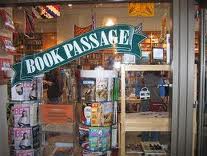
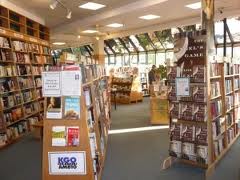
I wind up the first phase of my US tour this week (I’ll be back in June!!) in San Fancisco. I’ll be at Book Passage in the San Francisco suburb of Corte Madera this week…More details here
 Osbert, Edith and Sacheverell