Posted: April 9th, 2012 | No Comments »
I pass through KL a couple of times a year. The city has given itself over to the car almost entirely now and so any advance in public transport is not only welcome to those of us who find cars dreary and boring but also essential if the city is not to descend into gridlocked chaos and choking asthma filled skies. Malaysia’s MRT Corp is building some public transport – light rail and there are developments in KL’s Chinatown. Preservationists were worried that expanding the light rail around Jalan Tun Tan Cheng Lock might damage, or see the destruction of, some old buildings – specifically some old shophouses in Jalan Sultan above a planned tunnel. However, MRT Corp has insisted that it can build the tunnel and preserve the shophouses.
I hope this is the case as KL should learn from Singapore. Singapore nearly lost all its old shophouses but managed just before knocking them all down that they were of value. KL Chinatown without shophouses would be a slightly odd thing.
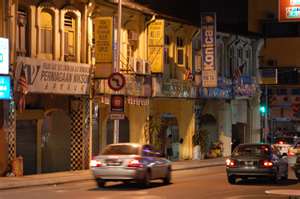
Jalan Sultan shophouses
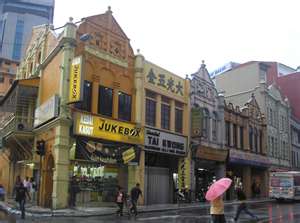 Jalan Tun Tan Cheng Lock shophouses
Posted: April 7th, 2012 | No Comments »
Katya Knyazeva is one of the smartest and most diligent people around in the Shanghai heritage “movement” (such as it is). She is very good particularly on the old town and its ongoing destruction which, given that that now includes some of the oldest Chinese style structures in Shanghai, is particularly shocking. For years we’ve heard officials blithely disregard the destruction of western style structures as unimportant – “colonial”, “imperialist” and therefore embarrassing for them and so to be swept away, but these arguments were always straw men to cover for their vandalism-for-profit and philistinism. The destruction of ancient Chinese culture in Nantao is obviously harder to explain away and so largely they just let places rot away until they fall down. Here, in Time Out Shanghai, Katya takes a tour round some of the most vulnerable buildings in old town and the long running dispute over the preservation of the Nie’s Garden compound in Yangpu (Yangtszepoo). Fascinating but tragic…
Posted: April 6th, 2012 | No Comments »
It’s been a while since I read Emily “Mickey” Hahn’s story of sin and salvation in the brothels of the wartime Orient (mostly in Shanghai) Miss Jill (originally published 1947). Jill doesn’t stand a chance – a drunk Aussie mum, taken in and lured to Shanghai by a dodgy Japanese count, sold into the bordello of Madame Antoinette on the Tibet Road (Xizang Road now but not a stone’s throw from the old “Line” of bordellos on Kiangse Road/Jiangxi Road). She then meets a good looking American journalist. It’s not a great book (in fact to be fair Mickey Hahn never wrote a great book – but most were fair enough) and it doesn’t have the touch of a Somerset Maugham or a Graham Greene, either of whom would have plumbed the depths of the characters psyches more ably than Hahn and would have rendered a better Shanghai too. Though from a technical point Hahn knew her Shanghai and renders it well here. There are those Shanghailanders and China Hands who worship the ground Hahn walked on – I’m not one of them; I like her of course, probably would have fancied her something rotten had I been knocking around in Shanghai at the time but, apart from her excellent New Yorker pieces, her output was fair-to-middling at best to be honest.
Still, here’s a cover of an edition of Miss Jill I picked up recently – a mass market paperback from America’s Avon put out in 1950. “A Beautiful Girl’s Story of SAlvation and Sin in the Orient” and, on the back, Miss Hahn herself, “Of all the cities of the world, it (Shanghai) is the town for me.” Indeed so….


Posted: April 6th, 2012 | 2 Comments »
OK, so this is one of my semi-regular really rather anal posts and as we were talking telly yesterday (Underbelly Razor and its Chinese nods) here’s some more. I really liked The Hour, the BBC drama (made by the production company Kudos – and more about them soon on this blog) set in amongst the BBC news department and a fair amount of intrigue in the 1950s (Suez Crisis time). I just sat back and let it wash over me as I tend to do with these things (even Downton Abbey, which got a bit ridiculous in series 2 you have to admit – all those tingling toes!!). Still, I couldn’t help noticing that some people pointed out various problems with Abi Morgan’s script, notably (as this is the China Rhyming blog) the use of the phrase “going for a Chinese”. A number of people, apparently including some language historians (according to the Daily Telegraph here), believe this phrase to date from some time post-1956. Maybe…but I’m not so sure.

Just today I kicked back and decided to take a few hours out to indulge one of my great pleasures – reading Eric Ambler spy novels from the 1930s – and settled in with a cup of tea, a biscuit and Ambler’s brilliant Cause for Alarm (hey, if Pico Iyer can read and re-read Graham Greene over and over, as he says he does in his well worth reading The Man Within My Head, then I can read and re-read Ambler). Ambler wrote Cause for Alarm in 1937, it was published in 1938 and redefined the spy novel in Britain. It also, early on, happens to contain a scene where the hero of the book, Nicky Marlow, takes his girlfriend Claire to a Chinese restaurant run by Cantonese in London, and they eat with chopsticks – an engineer and a secretary. Now, they don’t actually say “going for a Chinese” but it doesn’t seem to me particularly inconceivable that they would have. And, if they didn’t say “going for a Chinese” what did they say that wasn’t’t an impossibly long and convoluted way of saying “going for a Chinese”? Any ideas welcome.
 First US edition cover
Posted: April 5th, 2012 | No Comments »
Underbelly, the Australian true crime TV franchise that is pretty damn good reaches a peak for me with Underbelly Razor, the story of the late 1920s, early 1930s razor gang wars in Sydney between the gangs of the two madams Kate Leigh and Tilly Devine. A cracking series – better than Boardwalk Empire for my money. Quite a few good references to Chinoiserie or things Chinese including a whore being introduced to her first chop suey (and liking it) as well as several opium den scenes with Chinese serving up the dope to washed up WW1 vets turned killers for hire in Sydney. One character, John “Snowy” Cutmore (a Melbourne standover man exiled to Sydney) particularly likes the dens and also smoke opium (with a pucker pipe) at home. Eventually, towards the end of the series, we see the Chinese involvement in the Sydney dope business in more detail. Not sure how you can see the show outside Australia (though it has popped up on pirated DVD in Shanghai I note).

Posted: April 5th, 2012 | No Comments »
Below I reprint the blurb for an event that may or may not be very interesting this weekend – I’m slightly worried as whoever wrote the blurb about how “Shanghai’s uniqueness as a home and haven to thousands of Jews over many centuries” is clearly a bit of an idiot – “centuries”!!!! anyway….
Goodbye Shanghai: Historic Shanghai book talk with author Sam Moshinsky
Sam Moshinsky shares his story of growing up in the Shanghai of foreign settlements, the Japanese occupation and the return to Chinese sovereignty.
Saturday, April 7, 4pm
M on the Bund, Shanghai
RMB 75, includes a drink
Reservations essential/预约方å¼: reservations@m-onthebund.com, 6350 9988
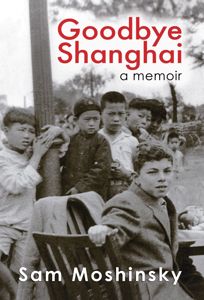 I don’t know this book at all…so here’s what Amazon says – and the book’s here too
During the first seventeen years of his life, spent in Shanghai, Sam experienced wars, changing regimes, different currencies and a variety of schools that reflected the evolving political landscape. In a world obsessed with conflicting nationalism, his family survived as stateless residents, neither subject to, nor the responsibility of, any country. They were instead, sustained by their Russian Jewish culture and community. Through Sam s memories of early life and his love of history, we learn of Shanghai s uniqueness as a home and haven to thousands of Jews over many centuries.
Born in Shanghai, Sam Moshinsky migrated to Melbourne, Australia, in November 1951, at the age of seventeen. He studied at The University of Melbourne where he obtained a Bachelor of Commerce degree, which led to a successful career as a chartered accountant. Later he became a financial executive, a professional director and an adviser on numerous corporate boards. Sam has also chaired the board of many Jewish organisations including the United Israel Appeal, Temple Beth Israel, the Jewish Museum of Australia and The Australian Jewish News. In June 2000, Sam was awarded a Medal of the Order of Australia in recognition of his contributions to Jewish organisations and the general community.
Posted: April 4th, 2012 | No Comments »
An interesting new book – Visualizing Beauty: Gender and Ideology in Modern East Asia (shame that Hong Kong Uni Press now feels the need to that concentrates on the first half of the twentieth century, edited by Aida Yuen Wong:
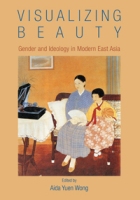
What does it mean to be a modern woman in Asia? How do institutionalized gender divisions affect creativity? Whose interests does the pursuit of beauty serve? Is being beautiful empowering, and in what context? How do physical expressions of femininity alter women’s status in society?
Visualizing Beauty examines the intersections between feminine ideals and changing socio-political circumstances in China, Japan, and Korea during the first half of the twentieth century. Eight essays present a broad range of visual products that informed concepts of beauty and womanhood, including fashion, interior design magazines, newspaper illustrations, and paintings of and by women. Studying “Traditional Woman” and “New Woman” as historical categories, this anthology contemplates the complex relations between feminine subjectivity and the promotion of modernity, commerce, and colonialism.
Aida Yuen Wong is Associate Professor of Fine Arts and Chair of the East Asian Studies Program at Brandeis University.
“These insightful essays investigate perceptions of women in East Asia during the first half of the twentieth century through different visual cultures, and will be essential reading for those interested in how women figured at a time of emerging nationalism and modernities.” — Tina Yee-wan Pang, Curator, University Museum and Art Gallery, University of Hong Kong
Posted: April 3rd, 2012 | No Comments »
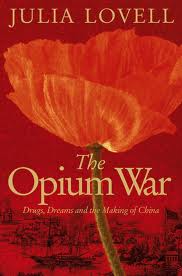
As the long list for the Orwell Prize has been announced there is a chance to plug Julia Lovell’s great book The Opium War: Drugs, Dreams and the Making of China. Of course there’s some stiff competition, not least from China Rhyming favourites such as the late Christopher Hitchens for Arguably and Misha Glenny’s Dark Market: Cyberthieves, Cybercops and You. But still this is a China matters blog and so we must stick with our kind and wish Julia the best of luck.