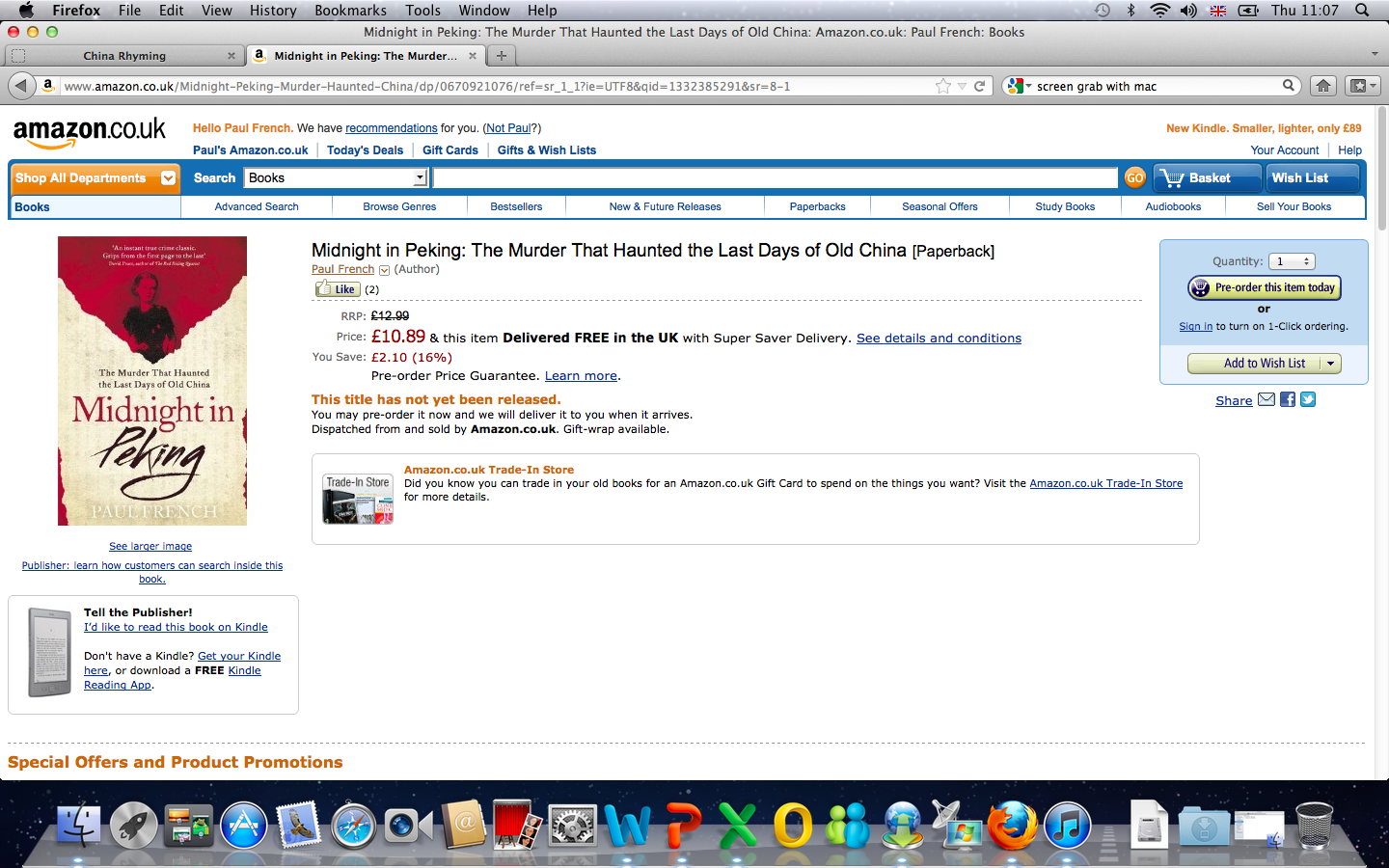
Pre-Order Midnight in Peking in the UK for a Discount Before May 31st
Posted: April 3rd, 2012 | 2 Comments »You can pre-order Midnight in Peking in the UK via Amazon for a discount – the book is officially available from the 31st May…
All things old China - books, anecdotes, stories, podcasts, factoids & ramblings from the author Paul French
You can pre-order Midnight in Peking in the UK via Amazon for a discount – the book is officially available from the 31st May…
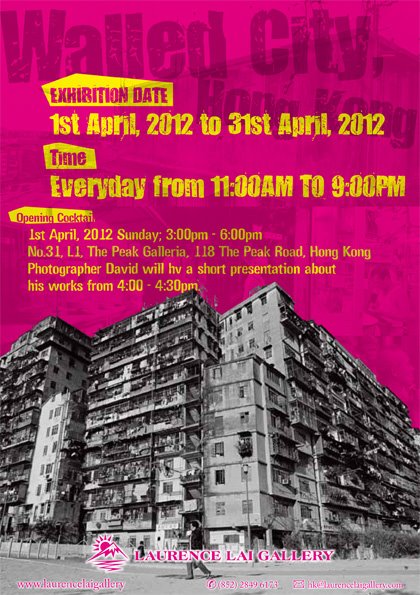
Herewith a plug for sometime Shanghailander photographer, now embedded in Macao, David Hartung and an exhibition of his photographs of the old Kowloon Walled City (which never fails to fascinate me). The exhibition at the Peak Galleria in Hong Kong features a selection of Hartung’s black and white photographstaken in Hong Kong’s Walled City in 1989/90 prior to the once notorious community’s demolition. be on exhibit. They’ll be on show at the Peak Galleria from Sunday, April 1 through to the end of the month.
I think the International Peoples’ Assembly was one of those myriad organisations for peace in the late 1930s – here’s their Feb/March newsletter for 1938 which highlighted the dire situation in China and called for a boycott of Japanese goods in Britain – quite right too! They had a boycott parade down Oxford Street to support China and oppose Japanese aggression – I hope it worked and loads of people turned out. Apparently no lesser personages than Chiang Kai-shek and Madame Sun Yat-sen had appealed to the IPC to launch the boycott in Britain. Good work all!


Thinking back to my What We Lost Lists for Shanghai’s architecture one major area where there is a need for preservation is industrial architecture. Beijing tarted up an old factory complex for the 798 art district and Shanghai has 1933, the old Municipal abattoir – 798 has certainly been more of a hit than the invariably deserted 1933 I have to say. However, in general industrial architecture is rarely recognised as being important or worth using despite being eminently suitable for other purposes from shopping malls to nightclubs to niche luxury apartments.
I thought of this when wandering around the old St James Power Station in Singapore on a quick visit recently. the former power station, a modernist building, is now a complex of nightclubs and bars that really only comes alive at night and is sort of as racy as Singapore gets. It’s on the Keppel and is now overshadowed by the horror that is Sentosa nearby. They’ve got a web site explaining all that fun stuff here. The power station was built in 1927, it was Singapore’s first coal fired power plant supplying electricity to nearby shipyards, industry and residences. The station was shut in 1962 but fortunately not bulldozed. There’s a full history and more details of the building’s history here.
The problem for Shanghai is that most of the good industrial architecture that’s left is not in areas considered suitable for nightlife and redevelopment. It’s mostly down in Hongkou, or even further away in Yangpu. Many Shanghainese don’t travel to those areas and foreigners seem to consider pretty much anything in Shanghai north of the Suzhou Creek terra incognita! Still, the St James Power Station in Singapore does show what is possible with a little thought and creativity.


I recently had a great day at Carrick Hill (just outside Adelaide) with the great biographer Selina Hastings and the director and urge anyone in South Australia to visit if at all possible – Richard Heathcote, the director there, was a wonderful guide and it’s true (as he notes on his blog) we did become a bit over-absorbed in the great Stanley Spencer’s and Jakob Epstein’s to take in all the Chinoiserie too!!
Here’s Carrick Hill’s website – a gorgeous English style country house and gardens just a short taxi ride from downtown Adelaide
And here’s a blog post from Richard on the Chinoiserie in his collection that Selina and I rather missed due to our fascination and delight in discovering so much 1930s British art hanging on these walls in South Australia!
 Chinese jardiniere that is part of the Carrick Hill collection
As many of you will know China is the featured country at the London Book Fair this April – bad news as of course Beijing has sought to control the presentation of China at the event and LBF appear to have just let them (see this Guardian article for instance on how only state-approved writers will be appearing). So a stand has to be taken, however minor. Asian Arguments is a series of shorter books on China and Asia that I series edit with Zed Books – we’re having a gathering during LBF to celebrate diverse opinions and viewpoints on China that are without Beijing’s official view. And you’re invited – it’s at Probsthain’s, the great Asian specialist bookseller opposite the British Museum and there’ll be a drink or two and hopefully a good gathering of academics, writers, policy analysts and business people with a variety of view and contact points with China. So, for homogeneity Beijing style go to Earl’s Court for LBF, or come and join us for a drink (no long speeches guaranteed too). Details below and rsvp contact.

Tuesday 17th April
7pm – 9pm
Probsthains Book Shop
41 Great Russell Street
London WC1B 3PE
Chinese Publishing is the special focus of London Book Fair 2012.
Zed Books would like to invite you to a reception to celebrate the full range of Chinese voices and viewpoints whether they be from arts, academic or business backgrounds.
To supplement the London Book Fair which is an official occasion for promoting Chinese literature and long-lasting business partnerships with China, come to this informal event, which will encourage broad discussion. You will meet others who are also well-informed about China and its recent development.
You will also have the opportunity to browse and discuss Zed’s new Asian Arguments series, which is sponsoring the event.
We hope to see you there.
For more information, please contact Ruvani de Silva, Publicity Manager at Zed Books at ruvani.de_silva@zedbooks.net
Every time I visit Australia (happen to be spending a week in Melbourne at the moment) I find China books that I’d hadn’t been aware of. Peter Thompson’s Shanghai Fury: Australian Heroes of Revolutionary China is one such – probably deemed hard to promote outside Australia the title was always going to make me sit up and pay attention. I stumbled across it in a bookshop here and snapped it up straight away.
Among many attributes the book is a nice production, striking cover and a great set of photo plates inside
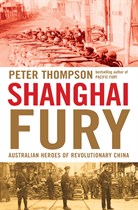
Shanghai is a city defined by war. The city and its armed struggles were central to the relationship between China and Australia from the fall of the Manchus in 1912 to the Communist victory in 1949. Yet with the notable exception of George ‘Chinese’ Morrison, the Australian contribution has been largely neglected and no single volume covers the experiences of the many remarkable Australians caught up in the drama.
Set against a backdrop of imperial splendour and abject squalor, Shanghai Fury examines one of the seminal periods of the 20th Century in a compellingly readable narrative that mixes personal memoir with combat action to complete a powerful trilogy on Australians at war.
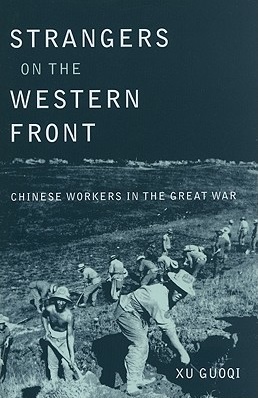
I’ve heard about a whole bunch of books about the Chinese Labour Corps (the “Coolie Corps”), both the British and French corps, being released imminently. I suspect it’s a combination of this being a generally fascinating but overlooked subject as well as the centenary of the Great War approaching. The story of those Chinese hired and brought over to help ship armaments, clear the battlefields etc etc is compelling. Xu Guoqi’s book Strangers on the Western Front appears to have its flaws – not looking at the lives of these men is a serious omission as is not considering what became of them when they returned to China (many became the backbone of the warlord armies) or stayed on (forming part of the nascent Chinatowns of London and Paris). There appear to be a lot of unsubstantiated comments about the corps, its overseers and the war – I’ll get into all sorts of trouble but it has to be said that a lack of rigorous fact checking, rather sweeping generalisations and a tenancy to never criticize anything Chinese but find blame elsewhere is, all too often, the hallmarks of Chinese historians schooled in a highly politicised environment that sees getting the “line” correct more important than accuracy frequently. Still, any nuggets on the Corps are most welcome all the same.
There’s a more thorough review here on The China Beat