Posted: February 16th, 2012 | No Comments »
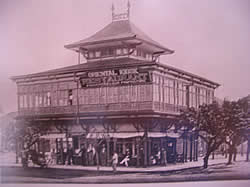
Few cities have been as important to fostering trade between China and Europe than Laurenco Marques, now better known as Maputo in Mozambique. The Portuguese developed it as a crossroads between the Orient and Europe. Laurenco Marques was himself a sixteenth century Portuguese trader who have the port his name. Ships stopped en route and then of course during the Second World War the evacuation ships from China often passed through Laurenco Marques. So perhaps not so surprising that an “Oriental Kiosk” and restaurant would be a prominent waterfront business catering to those already homesick travellers or Chinese sailors. Don’t know much else about it and obviously I think it is long gone in Maputo – but interesting all the same.
Posted: February 15th, 2012 | 1 Comment »
Doug Clarke is a lawyering type of chap, ex of this parish up in Shanghai for many years and now resident down in the former Crown Colony to the south and barristering away. He’s also found time to write a history of the foreign and mixed court system in Shanghai and China in the treaty port era. It’s forthcoming from Earnshaw Books and entitled Gunboat Justice. I’ve seen snatches and Doug has dug up some great stories and some serious analysis of the system – we await with baited breath. In the meantime, as a taster, he’s just published an essay raising some of the historical issues around the Supreme Court in Hong Kong and the treaty port courts on the website of the Hong Kong Lawyer – I realise many of you will not be regular readers of Hong Kong Lawyer, so here‘s the link!
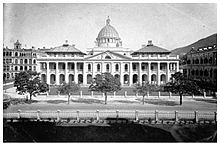
Hong Kong’s “old Supreme Court Building” facing Statue Square circa 1915
Posted: February 15th, 2012 | No Comments »
RAS LECTURE
Tuesday 21st February 2012 at 7:00 p.m.
Tavern, Radisson Plaza Xingguo Hotel 78 Xing Guo Road, Shanghai
PETER COOKSON SMITH
The Urban Design of Concession: Tradition and Transformation in the Chinese Treaty Port
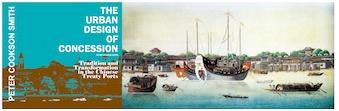
The Treaty Ports were established as beachheads of foreign influence around the coast of China during the mid-nineteenth century, a period of massive Western expansionism and trading ambition. These port cities, based on enforced treaties between China and Western powers, became the centres of foreign settlement and trade in China, opening up parts of the country to Western cultural influence just as much as they expanded investment and economic horizons. In a more elusive way, the nature of these new ‘gateways’ both into and out of China, transformed not only attitudes to modernization, but almost inadvertently fuelled changing political attitudes. Foreign concession and settlement areas, which generally formed separate but planned extensions to established city structures, offered an alternative urbanism outside hidebound tradition and state control.
The Treaty Ports can be considered from a number of perspectives – initially as differentiated societies with dual administrative structures; as socio-cultural phenomena; as new political power structures; as robust centres of international trade and commercial growth; and as new regimes of city building and institutional development. In all, the treaty port period reflected a frequently unstable but inevitable transition from the old to the new China.
The talk will focus on these aspects and some of the contextual changes in the main Treaty Ports of Shanghai, Guangzhou, Fuzhou, Ningbo, Xiamen, Dalian, Harbin, Nanjing, Tientsin, Qingdou, Hankow and Shantou over the past 150 years and will be accompanied by sketch illustrations showing the imprints on the modernizing cities of older places and spaces from these early times, which have left a residue of physical traces in terms of plan forms, streets and building groups.
Dr Peter Cookson Smith is an architect, planner and urban designer. He has been resident in Hong Kong since 1977 when he founded Urbis Limited one of the first specialist planning, urban design and landscape consultancies in South-east Asia.
Over the past 35 years, he has directed a large number of studies in Hong Kong, and throughout China and other parts of Asia including new town planning, urban regeneration, central area and waterfront studies.
He writes regularly on the subject of urban design and is the author of ‘The Urban Design of Impermanence’ on Hong Kong, ‘The Urban Design of Concession’ on the Treaty Port Cities in China, and the forthcoming ‘The Urban Design of Intervention’ on Asian Cities. He was a Professor in the Department of Architecture, University of Hong Kong 2000-2004, and is a member of the HKU Advisory Council for the Department of Planning and Urban Design. He is also a Visiting Scholar at the Centre for Asian Studies, HKU. He is currently the President of the Hong Kong Institute of Planners, and Vice-President of the Hong Kong Institute of Urban Design.
Entrance: RMB 30.00 (RAS members) and RMB 80.00 (non-members) those unable to make the donation but wishing to attend may contact us for exemption, prior to the RAS Lecture. Membership applications and membership renewals will be available at this event.
RSVP: to RAS Bookings at: bookings@royalasiaticsociety.org.cn
Posted: February 14th, 2012 | No Comments »
Today, just a picture postcard from Peking’s Tartar City (Cite Tartare). This card was posted in 1907 so the picture is probably turn of the century or late nineteenth century I suppose. There’s a good lot of detail there to zoom in on.

Posted: February 13th, 2012 | 1 Comment »
I hear there’s a new documentary Assignment: China—”The Week That Changed The World” from director and former CNN Beijing correspondent Mike Chinoy. I don’t know where you can see it – apparently it’s quite funny in parts, not a trait I ever associated with Tricky Dicky but still. Here’s a link to an Asia Society discussion on the film.
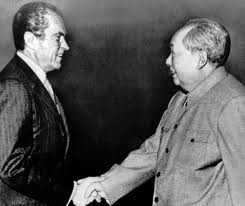 Tricky Dicky meets Murderin’ Mao
Posted: February 13th, 2012 | No Comments »
RAS BOOK CLUB
Monday 20th of February, 2012 at 6.30pm
The PuLi Hotel and Spa
1 ChangDe Road, JingAn District, Shanghai
璞麗酒店ä¸å›½ä¸Šæµ·å¸‚é™å®‰åŒºå¸¸å¾·è·¯1å·
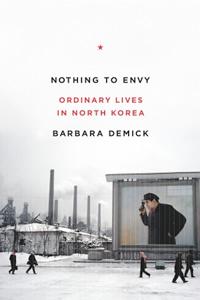
The RAS Book Club will meet to discuss NOTHING TO ENVY: Ordinary Lives in North Korea, the author, Barbara Demick will participate in the conversation giving the members the opportunity to discuss the writing, motivations, literary experience and evolution of this book. Entrance: RMB 70.00 (RAS members) and RMB 100.00 (non-members) including a drink (tea, coffee, soft drink, glass of wine). Those unable to make the donation but wishing to attend may contact us for exemption, prior to this RAS Book Club event. Membership applications and membership renewals will be available at these events.
RSVP: bookclub@royalasiaticsociety.org.cn
N.B RESERVATIONS ESSENTIAL AS SPACE IS LIMITED AT THIS EVENT
NOTHING TO ENVY: ORDINARY LIVES IN NORTH KOREA
In NOTHING TO ENVY, Demick follows the lives of six people: a couple of teenaged lovers courting in secret, an idealistic woman doctor, a homeless boy, a model factory worker who loves Kim Il Sung more than her own family and her rebellious daughter. Demick spent six years painstakingly reconstructing life in a city off-limits to outsiders through interviews with defectors, smuggled photographs and videos. The book spans the chaotic years that saw the death of Kim Il-sung, the unchallenged rise to power of his son Kim Jong-il, the devastating effects of a famine that killed an estimated twenty percent of the population, and an increase in illegal defections.
While many books focus on the North Korean nuclear threat, NOTHING TO ENVY is one of the few that dwells on what everyday life is like for ordinary citizens. With remarkable detail, Demick brings to life what it means to be living under the most repressive totalitarian regime in the world today. She gives a portrait as vivid as walking oneself through the darkened streets of North Korea.
Winner of the 2010 BBC Samuel Johnson prize
Barbara Demick has been interviewing North Koreans about their lives since 2001, when she moved to Seoul for the Los Angeles Times. Her reporting on North Korea won the Overseas Press Club award for human rights reporting, the Asia Society’s Osborne Eliott award and the American Academy of Diplomacy’s Arthur Ross Award.    Before joining the Los Angeles Times, she was with the Philadelphia Inquirer as a foreign correspondent in the Middle East and Eastern Europe. She lived in Sarajevo during the war in Bosnia and wrote a book about daily life, Logavina Street: Life and Death in Sarajevo Neighborhood. , Logavina Street: Life and Death in Sarajevo. Her Sarajevo reporting won the George Polk Award, the Robert F. Kennedy Award and was a finalist for the Pulitzer. Demick grew up in Ridgewood, N.J. She is currently the Los Angeles Times’ bureau chief in Beijing.
Posted: February 12th, 2012 | No Comments »
On my website (www.midnightinpeking.com) there’s a walking tour of all the locations from Midnight in Peking – click here – but then I was mucking about on Google Earth – of course the Second Ring Road wasn’t there in 1937 and where the railway runs between the Fox Tower and Armour Factory Alley wasn’t there either and was a silted up part of the Grand Canal complex. Sadly also the Tartar Wall, though you can see part of the last remaining bit of it here, runs out a bit further on as, of course, Mao had it all knocked down.

Posted: February 11th, 2012 | No Comments »
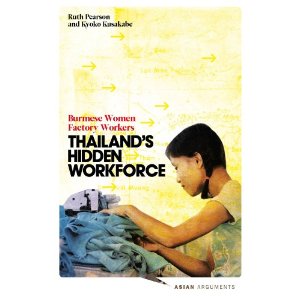
Just a quick note that the third book in my series for Zed Books, Asian Arguments, is now available for pre-order, Thailand’s Hidden Workforce. The book will be available in June. It’s a great subject that has been little reported to date – millions of Burmese women migrate into Thailand each year to form the basis of the Thai agricultural and manufacturing workforce. Un-documented and unregulated, this army of migrant workers constitutes the ultimate “disposable” labour force, enduring grueling working conditions and much aggression from the Thai police and immigration authorities. This insightful book ventures into a part of the global economy rarely witnessed by Western observers. Based on unique empirical research, it provides the reader with a gendered account of the role of women migrant workers in Thailand’s factories and interrogates the ways in which they strategize about their families and their futures.
Ruth Pearson is Professor for Development Studies at the University of Leeds. Kyoko Kusakabe is an Associate Professor of Gender and Development Studies, and Associate Dean of the School of Environment, Resources, Development (SERD), at the Asian Institute of Technology, Thailand.