Posted: September 22nd, 2011 | No Comments »
For anyone who might be interested
Here’s me talking about Midnight in Peking and China in general on Afternoons with Richard Stubbs on 774 ABC Melbourne radio.
And again on ABC, but this time talking to the very interesting and veteran Aussie broadcaster Philip Adams about Midnight in Peking
A video interview on Midnight, non-fiction writing and research with the Sydney Writers Centre
An OK review from The Australian
A nice online review from Abbey’s Bookstore in Sydney
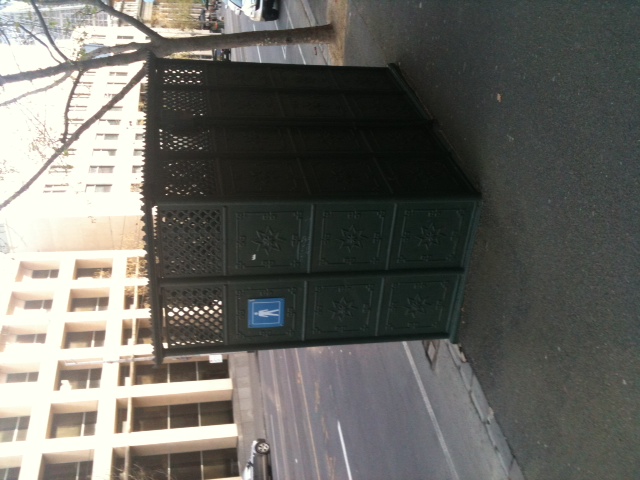
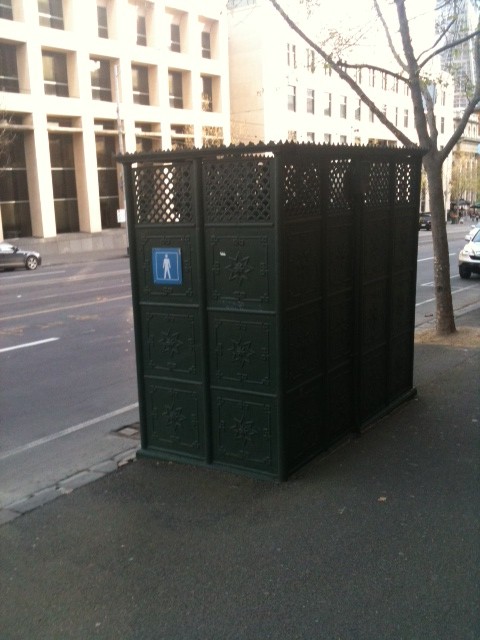
And, finally, as we’re talking Australia, may I say how nice it was to see that Melbourne has pissoirs. I remember going to Paris is the 1980s and encountering pissoirs and thinking them marvellously French in design, function and execution. That Melbourne has them is unexpected! They are simple though and do prevent all that peeing up alleys and shop doorways!!
Posted: September 21st, 2011 | No Comments »
Midnight in Peking takes to the august stage of the RGS in Hong Kong where I’ll be talking a little more about the places and locations of 1937 Peking that feature in the book. Rather worringly we’re in the Social Services building!! I’ve always managed to stay out of the clutches of social services…until now it seems!!

Last days of Old China
Lecture by: Paul French
Location: Auditorium 1/F, Duke of Windsor Social Services Building, 15 Hennessy Road, Wanchai
2011-09-22
RGSÂ HKÂ members HK$100 non members HK$150.
Soft drinks and book signing from 6.30 pm lecture starts 7.30 pm
Chinese historian and author Paul French to speaks on “The Last Days of Old Peking”, focusing on the last days of old Peking in the 1930s, with its pompous Foreign Legations, unstable Chinese government and large criminal underclass.
In 1937, Japanese troops had already moved into Manchuria and were poised to move on Peking. The people of the city nervously waited, enjoying the last days of their indulgent Peking lifestyles. Ever on edge and with tension peaking, the upright residents of the Foreign Legations were brought into collision with the other side of Peking’s foreign community, residing in the city’s infamous ‘Badlands’. Through years of research for his latest book, Midnight in Peking, Paul French discovered that those two worlds of Peking were not as separate or as different as people might have liked to think.
Paul French tells of a city full of intrigue, a city where the authorities were more interested in saving face than solving crimes, a city on the brink of invasion, and in doing so he vividly portrays the last days of old Peking. He also examines the relationships between Chinese and foreigners, the risque nightlife and illegal activities during the 1930s and the early years of the Japanese occupation of Peking.
Peking at that time had a population of some one and a half million, of which only three thousand were foreigners. They were a disparate group, ranging from consuls to destitute White Russians. In between were journalists, a few businessmen, some old China hands, with no shortage of foreign criminals, dope fiends and prostitutes. For the most part, Peking’s foreigners clustered in and around the small enclave known as the Legation Quarter, where the great powers of Europe, America and Japan had their embassies, guarded by imposing gates and armed sentries in a haven of Western architecture, commerce and entertainment.
While calm appeared to prevail on the surface though, both the Chinese and foreign inhabitants of Peking had been living with chaos and uncertainty for a long time. Ever since the downfall of the Qing dynasty in 1911, China had been ruled by the Kuomintang, under the leadership of Chiang Kai-shek, but the government competed for power with the warlords and their private armies, who controlled swathes of territory. Thus, city was at the mercy of marauding warlords, providing a chaotic backdrop for Paul French’s fascinating portrait of the last days of old Peking.
Posted: September 19th, 2011 | No Comments »
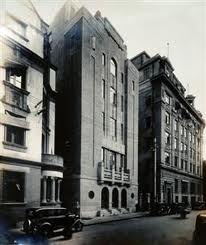
The Shanghai RAS have organised a trip out to Suzhou that features some interesting folk out there such as Shelley Bryant and the brilliantly erudite Paul Hansen s0 I’m giving it a plug (and an excuse for a picture of the old RAS building in Shanghai – now the rather unexciting Rockbund museum thingy):
RAS WEEKENDER
Sunday 25th September, 2011
MEET POINT: TBA
MEET TIME: 0900hrs
SUZHOU SOJOURN
With
BILL DODSON, AS THE HOST AND RAS SUZHOU CHAPTER, PRESIDENT
SHELLY BRYANT walking us through I.M. Pei’s Suzhou
PAUL HANSEN’S readings of ‘The Lyric Poetry of Xin Qiji’
In a unique venue of a typical Suzhou style canal side house, BEN POTTER of the SUZHOU BOOKWORM, will welcome us, choose and prepare us a special RAS Members lunch and drink & snack menu.
A SON OF SUZHOU; I.M. PEI’S SUZHOU with Shelly Bryant
World-famous architect I. M. Pei comes from the illustrious Bei family, making him one of Suzhou’s most famous sons. The rich heritage of the city, especially its gardening culture, has had a profound influence on Pei’s philosophy and his work. The New Suzhou Museum, Pei’s crowning work, was designed in such a way as to mark a career that has come full circle. It is a homecoming, an act of homage to the forces that went into the making of the man who created so many outstanding works of architecture around the world.
The walk covers the main sites of importance in I. M. Pei’s relationship with the city of Suzhou, including the New Suzhou Museum, the Bei Ancestral Hall, and the Lion Grove Garden. Â The tour will focus on the part Suzhou played in the shaping of Pei and his work.
Shelly Bryant divides her year between Suzhou/Shanghai and Singapore, working as a teacher, freelance writer, researcher, and student of Chinese language and culture. She is the author of a travel guide to the city of Suzhou entitled Suzhou Basics, and two volumes of poetry, Cyborg Chimera and Under the Ash.  Her current projects include writing an updated guide to the city of Shanghai for Urbanatomy and translating the novel 《北妹》 Northern Girls for Penguin Books.
THE LYRIC POETRY OF XIN QIJI by Paul Hansen
With some 700 lyrics surviving Xin Qiji (1141-1207) remains the most prolific composer in the lyric form of the Song period. He lived during the first half of the Southern Song Dynasty, when the Northern (third of China), was ruled by the Tartar Jin Dynasty. A man of considerable military prowess, throughout his official career Xin advocated the re-conquest of the North by the Southern Song, and submitted a number of proposals to the throne and high officials in which he outlined strategies for it. Indeed, Xin’s outspoken recommendations on this crucial matter caused him to spend more than twenty years in enforced rural retirement. It was during these times he composed many of his most renowned works.
Today the disappointed poet-official is known almost exclusively for his patriotic poetry encouraging military action on the part of the Songs, and many modern Chinese people can recite examples of them. It is these great patriotic lyrics on which his enduring reputation is largely based.
PAUL HANSEN will read translations of some of these patriotic lyrics and also offer examples from his lyrics, the subject matters of which are not quite so well known: from his pastoral poetry depicting rural landscape and the simple, but satisfying lives of the local people and as well from his romantic lyrics, usually written in a woman’s persona. Though satisfying as love songs, his romantic lyrics are widely considered to be allegories that reflect the nations and his own dilemmas.
Paul is a poet, landscape painter and translator of Classical Chinese poetry. He has exhibited widely, most recently in 2010 with my former Fish Town colleagues of the 1970’s at the Museum of Northwest Art in La Connor, Washington: ‘A School of Fish’. He studied at the University of Washington, first coming to Asia in 1962 and the PRC in 1983. Presently he teaches in a private middle school in Suzhou. Published works include: Rimes of a Riverrat, Ramblings of an Unfrocked Mandarin (poetry) and Before Ten-Thousand Peaks, Lin Hejing, Recluse Poet of Orphan Mountain and Slanting light along the riverbank, a stretch of trees: Selected Lyrics of Xin Qiji (translations).
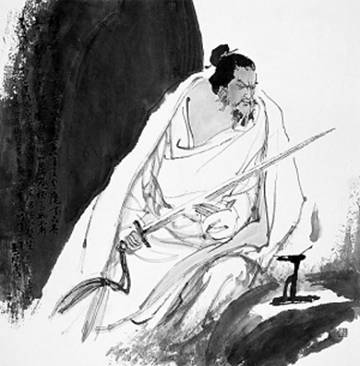
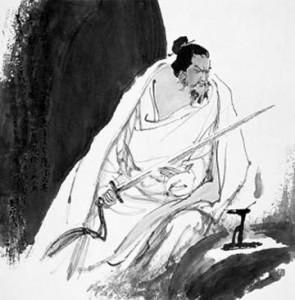 Xin Qiji by Ma Zhensheng – “Drunk, teasing the lampwick/I gaze at my sword’
BEN POTTER the Chef and Manager of Suzhou Bookworm started his career in the highly acclaimed and award winning Country Hotel ‘Thornton Hall’… washing dishes.
Three weeks later during the scorching summer of ’96, with a large wedding reception underway, the pastry chef cut his thumb with a bread knife, accidentally. The Head Chef looked around and settled on BEN to help send out the 250 swan shaped pavalovas to the guests.
From that day on Ben Potter has always worked with or around food, he loves everything about his chosen profession. He has worked in many acclaimed establishments in London and Paris. Loving China he has realized a more permanent arrangement at the Suzhou Bookworm, where he: ‘ loves having someone; a couple, a group of friends coming to my place and really enjoying themselves, eating good food, drinking well and leaving my establishment full and satisfied and a little bit ‘happy’ both physically and intellectually. The Bookworm doesn’t have anything incredibly new or cutting edge on the menu, what we do have however is good, fresh and clean food, and if you have that, all you have to do is watch your thumbs and let the word spread.
ENTRANCE: RMB 350.00 (RAS members) and RMB 500.00 (non-members) including; return train tickets, private bus in Suzhou, guided walk of I.M. Pei’s Suzhou, lunch at Suzhou Bookworm, some time to meander the canals with a return to Suzhou Bookworm and a poetry reading of Xin Qiji’s Lyric Poetry.
ENTRANCE FOR SUZHOU RESIDENTS: RMB 250.00 (RAS Members) RMB 350.00 (non members)
A limited attendance event (30), Members have priority for booking until 16th of September.
Those unable to make the donation but wishing to attend may contact us for exemption, prior to the RAS Weekender. Membership applications and membership renewals will be available at these events.
RSVP: to RAS Bookings at: bookings@royalasiaticsociety.org.cn with scan of passport copy with reservation (in order to advance purchase train ticket for individuals from the group) RSVP: By latest 2011.09.16
FULL PROGRAMME FOR SUZHOU SOJOURN
RSVP: By latest 2011.09.16 (including passport copy for train ticket purchase) Â
MEET POINT: At Station – details of Meet Point to be advised once place has been confirmed and passport copy submitted.
MEET TIME: 0900hrs DEPARTURE TIME: TBA
TRAIN NO. AND DEPARTURE TIME: TBA
PICK UP AT SUZHOU RAILWAY STATION BY PRIVATE BUS: TBA
DROP OFF: For Walk of I.M. PEI’S SUZHOU with Shelly Bryant.
LUNCHTIME: 1330HRS AT SUZHOU BOOKWORM with Ben Potter and Bill Dodson RAS in China, Suzhou Chapter, President. The Suzhou Bookworm is housed in a typical Suzhou style canal side house, adding to the charm…
FREE TIME: 1500HRS – 1700HRS
FREE TIME OPTIONS: A bus will be available to take members of the group to PingJiang Street; one of the oldest surviving streets of ‘old Suzhou’, in Paul French’s words; a lovely warren of old traditional Suzhou canal side houses with lots of cafes and individual craft shops AND no traffic. Running along side one of the original canals of Suzhou, Ping Jiang Jie retains its old character with stone walk ways, stone bridges (some dating back as far as Song Dynasty) with willow trees draping the banks of the canal.
PAUL HANSEN’S reading and explaining the Lyric Poetry of Xin Qiji @ 1730hrs                        – at THE SUZHOU BOOKWORM
ADDITIONAL DRINK AND SNACK MENU AVAILABLE ON REQUEST
DEPART SUZHOU BOOKWORM FOR SUZHOU TRAIN STATION: 1930HRS
TRAIN BACK TO SHANGHAI: APPROXIMATELY 2000hrs
Menu: TBA
Requirements: Minimum 16 persons, Maximum 30 persons