Sherlock and China 2 – Holmes in Tibet
Posted: December 30th, 2009 | 2 Comments »Previously I noted that it wasn’t really surprising that the Chinese liked Holmes – all that scientific deduction and dismissal of emotional reasoning. But what did Holmes think of China? It appears he was most interested. One of the things the new Guy Ritchie movie gets right from the original Conan Doyle stories is that Holmes has mastered martial arts which is noted in several Holmes stories. He also regularly evinces a taste for the mystical and of course there’s the opiates. And then there’s the question of what dedicated Sherlockians term the ‘great hiatus’.
 The legions of Holmes aficionados refer to the period from 1891 to 1894 – the time between the detective’s tumble over the Reichenbach Falls to his presumed death (in The Adventure of the Final Problem – 1893) and his reappearance in The Adventure of the Empty House (1903 – and filmed later as The Woman in Green) – as “the Great Hiatus.†Reintroducing Holmes, Conan Doyle explains that Holmes defeated his arch-enemy Moriarty at the Reichenbach Falls and then disappeared to prevent his nemesis’s confederates from killing him. He had apparently been wandered for two years mostly to Tibet where he spent time in Lhasa with the “head lama†locked in study. England’s greatest detective could think of nowhere else to go to increase his knowledge than Tibet.
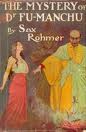 This is rather interesting as Conan Doyle’s use of Tibet and the East as a place where Holmes journeys to seek knowledge and learn was at odds with most literature of the time. Remember the early years of the twentieth century where the heyday of the ‘Yellow Peril’ novel. Concerns about Chinese immigration to western cities, the recent Boxer rebellion in Peking, scares over opium addicts, all fodder for the Shilling Shocker authors. The Australian writer Guy Boothby had his Russian serial villain Dr Nikola make his first appearance in 1896 infiltrating a lost Tibetan monastery in order to steal its secrets while M.P. Shiel’s highly racist The Yellow Danger had appeared in 1898. The Yellow Peril was to be a fairly long-lived genre. Sax Rohmer (1883-1959), who’s real name was Arthur Stansfield Ward, introduced the sinister but suave Dr. Fu Manchu in 1913’s The Mystery of Dr Fu Manchu, which appeared in America as The Insidious Dr Fu Manchu (try getting the word ‘insidious’ in an American book title now!) and described London’s Chinatown as a place of evil and debauchery.
Yet Conan Doyle went somewhat the other way (though had delved into the opium dens of Limehouse in The Man With the Twisted Lip – 1891) and had Holmes travel East to learn in what was in a way a small show of opposition to the general Yellow Peril tide perhaps.
PS: among the hundreds of Holmes pastiches knocked out since Conan Doyle’s death a couple deal with Holmes’s supposed time in the East. Among the great mass of post-Conan Doyle “Sherlockian†books is the rather fun Oriental Casebook of Sherlock Holmes by Ted Riccardi which has Holmes travelling to and solving crimes in Tibet, India, Nepal and various other parts Oriental.
Additionally, I’ve also heard about (but never seen, so if anyone knows where I can get a copy please let me know?) of a Taiwanese writer from before the Second World War called Yu Sheng, who apparently wrote a story or novel called something like Wrestling with Wisdom where, apparently Sherlock Holmes is invited to Formosa to solve a case and maanges to do so while also learning to speak Chinese.
There are several books detailing Holmes’ missing years in Tibet. The very best is by Tibetan author Jamyang Norbu, The Mandala of Sherlock Holmes, The Mandala of Sherlock Holmes.http://www.amazon.com/Mandala-Sherlock-Holmes-Jamyang-Norbu/dp/1582343284
Quite right, i had forgotten Norbu’s book – thanks for reminding me.