Postcards by Ivon Donnelly (and a review)
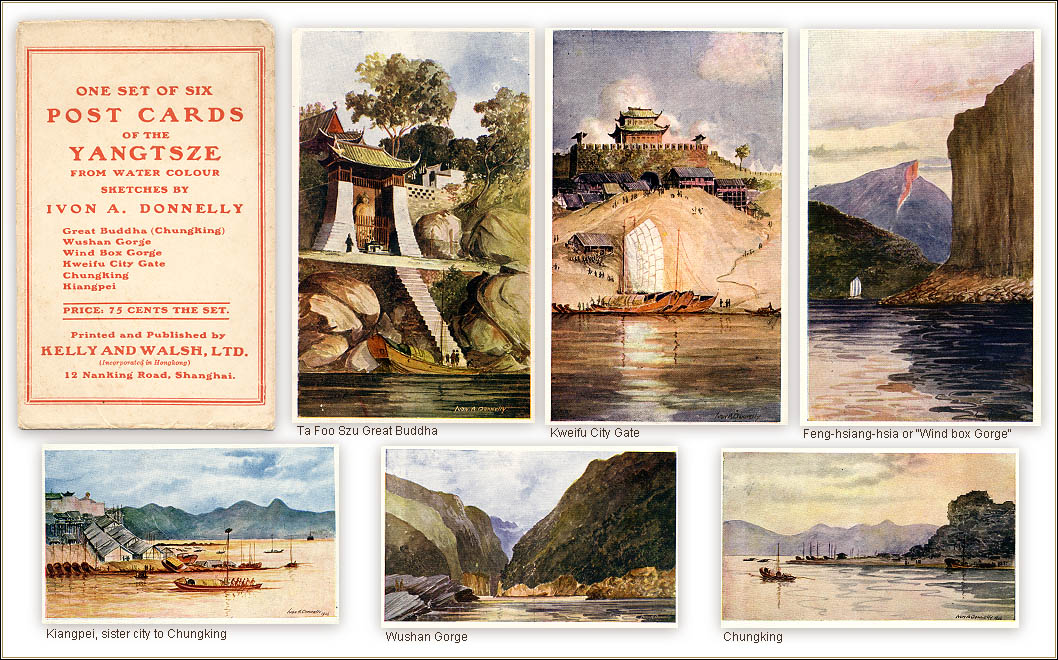
Posted: April 29th, 2010 | 3 Comments »I’ve mentioned the great artist of junks Ivon Donnelly before on this blog (here, here and here) as well as the recent reprint of his great Chinese Junks and Other Native Craft. Interesting to note that his publishers, the esteemed Kelly and Walsh of Shanghai, also issued some of the colour images from Chinese Junks as a series of postcards (a bargain at cents75 for the set!). And rather nice they were too. A review of the book by the way below:
Ivon A. Donnelly, Chinese Junks, 1924
Ivon Donnelly spent most of his life from the early 1900s to the late 1930s on the rivers and seas of China between Tianjin and Hong Kong. He was employed as a shipping agent on the Yangtze for most of the time but spent the best part of his days recording and sketching the old junks he saw. We should be grateful he did as there is no better record of the variety and types of Chinese ships who’s time was coming to an end. Steam engines and diesel effectively ended the days of the China junk though armadas of them would occasionally be seen clustered together around Hong Kong when a typhoon approached as late as the 1970s.
Now we can see them again in all their variety in the new reprint of Donnelly’s 1924 classic Chinese Junks and Other Native Craft from the Shanghai-based reprint publisher Earnshaw Books. In his introduction to the reprint Gareth Powell, a self-declared “Junk nut†lays to rest the myths that junks were somehow inferior sailing vessels – junks were easily handled by one sailor; their rigging was complex and they could point into the wind and they were superbly built and indeed have lasted better than any European ships of the Napoleonic era.
Donnelly’s book is full of his lavish illustrations – watercolours and sketches – that allow you to better appreciate the difference between a Yentai Trader and Tsungming Cotton Junk. You’ll probably never need to do this but you can appreciate that junks came in a wide variety of sizes – his painting of a Foochow Pole Junk or a Chinchow Trader reminds us that they had high sterns, elaborate three masted riggings and could be up to 180 feet in length.
The junks are gone now – replaced by engined craft and the family-run barges that still crowd the inland waterways and canals of China. Junks were working boats and often appeared dirty and dishevelled to the amateur eye but as Donnelly reminds us in his beautiful little book – ‘Chinese Junks appear sorry looking craft – nevertheless the beauty is there.’
Great site. A lot of useful information here. I’m sending it to some friends!
There is also a post card set of 6 junk sketches . The original watercolours for these ( which are also the colour plates in his book Chinese Junks and Other Native Craft ) were in a back office in Swire’s London office for many years . A former Swire employee , now retired in New Zealand , who had seen my blog recalled this and contacted me and the folks at Swire graciously agreed to return them into the family in return for a donation to a seamans charity they support .
Left my blog address off
http://iadonnelly.blogspot.com/