Gulangyu Charming?
Posted: February 2nd, 2012 | 5 Comments »OK, so it’s been over 6 years I just realised since I last got time to visit Gulangyu Island in Xiamen (Amoy). Then I saw this article on Gulangyu on CNNGo Shanghai, the island that was home to the majority of the foreign population when Amoy was a treaty port. The article (and CNNGo does not run anything but gushing articles for some reason) claims it’s still charming though when I was last on the island, though still blessedly car free, the treaty port era western houses were mostly in a very bad state of repair and basically crumbling away. Since then I’ve heard differing reports about restoration or destruction so any serious information welcome. This article suffers a couple of problems in that the author appears to be a first time visitor so therefore has no idea whether Gulangyu is more or less charming, more or less preserved and protected than it was a decade ago and, sadly, the pictures accompanying the story give no indication as to the state of repair of the island’s housing stock. The fact that the article claims the government is to charge an entry fee worries me – we all saw the ‘tartification’ that happened to Shanghai’s water towns and countless other locations once that happens. Any recent and informed information and opinion on Gulangyu much appreciated.
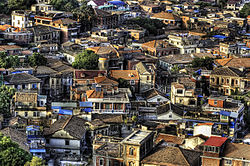
I was on Gulangyu last Easter and was quite impressed by many of the buildings. There does seem to have been a concerted effort to restore and renew a large number of them, though there were still a lot that needed some love and attention.
Charming? Hmm, not when you have to battle your way through hordes of tourists and hawkers selling the ubiquitous nasty plastic tat. Once you get away from the main pier and to the quieter parts of the island though then some parts are quite attractive.
Some recent shots (2010?) from Gulangyu on Gwulo here:
http://gwulo.com/image/tid/1023
and you can also find some pictures on this picasa album (along with Xiamen in general):
https://picasaweb.google.com/Oriental.Sweetlips.HK/XiamenGulangyu
Paul, I have lots of Gulangyu photos from a family trip last year. It’s worth a visit, especially if you miss Taiwanese night markets. Some of the housing was beautiful. The streets are very charming. Fun to walk around- especially since it’s pedestrian (other than a few tourist golf carts). The view from day to night is worth staying for.
ps. I tried out my new word “muppet” in London. Thanks.
If you practise you can start to use the term ‘muppety’ as well as well as the simple ‘muppet’, which is very London – as in, “you’re a right muppety little c**t” – people will believe you to have been born and bred in South London.
Bloody hell. Were you hoping it would be like Xintiandi or something? You sound like one of the (surprisingly numerous, and daft) people who come away from the Old Quarter of Hanoi and the Shanghai French Concession with a dismissive shrug because they’re nothing like Paris. It’s a bit decrepit I guess, but how else would you have it, if you don’t like ‘tartification’? Have you been anywhere else in China that’s managed to spruce up an historic area without making a neon-coloured balls-up of it?
I went last year, the third time I visited, and I’ve been really impressed every time. I was pleased to discover that it hasn’t been painstakingly over-restored (yet) a la Sinan Mansions, although there’s definitely been a creeping bourgie-fication since I first went in 2006, with a number of residences turned into ’boutique’ hotels and what have you. Not that this is necessarily a bad thing if done tastefully, though, as many of them seem to have been.
The crowds can be a bit much, but as long as you stay away from the crap beach, the sites that charge for entry, and the tourist trap area near the main ferry landing during the day, it’s not too bad.
Staying overnight is essential. After the yellow and red baseball cap brigades leave en masse around 5pm, you practically have the place to yourself. It’s at this point you really start to appreciate the faded colonial charm of the place, and how fantastic it is to have it all crammed into a compact whole, rather than have it scattered around in bits and pieces, like Singapore, Hong Kong and Shanghai.
I would rank it alongside the Tianjin foreign concession, Pingyao, and Nanxun as the only contiguous urban areas I’ve visited in China which have come close to striking a good balance between Disneyfication and decrepitude, however imperfectly. For me, Qingdao has too much of a dowdy, everyday-is-like-sunday English seaside town feel to it, Harbin’s ‘Russian’ area consists of a single, touristy street, and the various water towns around Shanghai are as tarty as pre-Expo Tongren Lu.