The Sanctification of the Mango – Alfreda Murck – M on the Bund – July 19
Posted: July 16th, 2012 | No Comments »A few years ago Alfreda Murck published her paper on Mao’s famous sainted mangoes (she did it to help raise money for the Wenchuan earthquake if I remember right) and it’s a fascinating story. She’s telling it again in Shanghai this Thursday…
A LITERARY LUNCH AND ILLUSTRATED LECTURE BY ALFREDA MURCK
EAT. TALK. THINK.
RMB 188, includes three course lunch, coffee or tea
Reservations required: +8621 6350 9988, or click here.
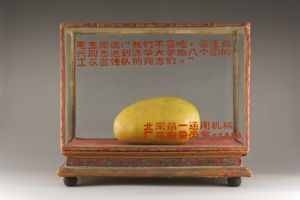
In August 1968, a Pakistani foreign minister arrived in Beijing with a crate of mangoes as a gift for Chairman Mao Zedong. Mao was not inclined to eat them. He sent them instead to workers who, ten days before, had put down warring factions of Red Guards at Tsinghua University. The workers were continuing to occupy the campus as “Mao Zedong Worker’s Propaganda Teams.” Greeted with awe, the mangoes quickly became religious relics that were celebrated as talismans of Mao’s love for the workers.
The summer of 1968 thus marked a turning point in China’s Great Proletariat Cultural Revolution (1966-1976). Student Red Guards, who had been the leaders, were by passed while workers were asked to take charge.
Freda Murck tells the story of the sanctification of the mango through artifacts found in the flea markets of Beijing, as well as photographs and magazines of the period.
About the Speaker: Freda Murck worked in the Asian Art Department at the Metropolitan Museum of Art, New York from 1978-1991. Since 1991, she has lived with her husband Christian Murck in Taipei and Beijing, publishing articles on Chinese art and a book on how eleventh century scholars combined poetry and painting to express dissent: Poetry and Painting in Song China: The Subtle Art of Dissent (Harvard 2000). She was one of the curators for the exhibition China: The Three Emperors, 1662-1795 (Royal Academy, London 2005). She collaborated with two Luo Ping specialists in curating the exhibition Eccentric Visions: The Worlds of Luo Ping (1733-1799). She currently serves as a consultant to the Beijing Palace Museum’s English web-page and as a researcher in the Palace Museum’s Painting and Calligraphy Research Center.
Leave a Reply