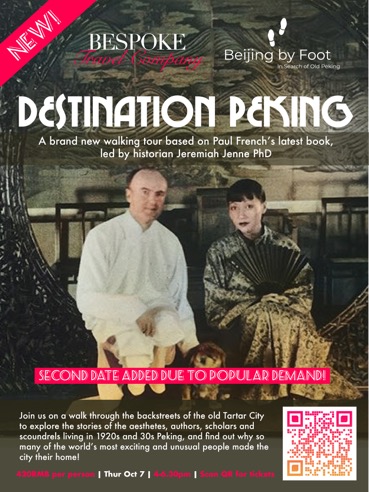
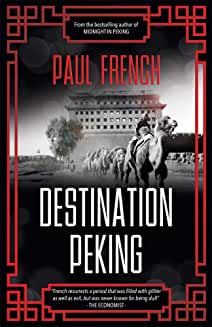
Bespoke Beijing, the people behind the Midnight in Peking walking tour, have got another tour going based on my collection of stories,Destination Peking. And it’s been led by the brilliant historian and doyen of Beijing walking tours, Jeremiah Jenne. Plenty of aesthetes, hutongs, bad guys, conmen, royalty, swish hotels and a 1930s cocktail thrown in. The first tour (October 5) sold out before I could post it, so they’ve added another on October 9….
And, of course, you can still buy the book even if you can’t make it to Beijing this October…
An interesting episode of the Barbarians at the Gate podcast with David Moser and Jeremiah Jenne talking to the academic and doc maker Marketus Presswood on jazz in Shanghai that notes the likes of Teddy Weatherford and Buck Clayton (who pop up in my books quite often)….
Networking the Russian Diaspora by Ho-Lan Helan Yang, Simo Mikkonen and Jonathan Winzenberg hopefully doesn’t just focus on classical and opera, but also on the cabarets and nightclubs. My copy is ordered anyway…
As a pioneering study of the Russian community, Networking the Russian Diaspora examines its musical activities and influence in Shanghai. While the focus of the book is on music, it also gives insight into the social dynamics between Russians and other Europeans on the one hand, and with the Chinese on the other. The volume, coauthored by Chinese music specialists, makes a significant contribution to studies of diaspora, cultural identity, and migration by casting light on a little-studied area of Sino-Russian cultural relations and Russian influence in modern China. The discoveries stretch the boundaries of music studies by addressing the relational aspects of Western music: how it has articulated national and cultural identities but also served to connect people of different origins and cultural backgrounds.
Just before Covid-19 hit, at the invitation of the Chinese mucisian Wu Fei, I put together a small privately published book entitled The Port of Last Resort and aiming to show through pictures and anecdotes the history of the Shanghai Jewish Ghetto and the European Jewish refugees who lived there from the late 1930s till Shanghai’s liberation in 1945 (and stayed somewhat longer in many cases).
The short book supports Hello Gold Mountain, an original composition by Wu Fei for chamber orchestra, performed by chatterbird ensemble, featuring Wu Fei on guzheng and Shanir Ezra Blumenkranz (Silk Road Ensemble) on oud — the traditional Chinese and Jewish plucked string instruments respectively. The work premiered at Vanderbilt University’s Ingram Hall in Nashville, TN. More details are here.
Then Covid-19 rather derailed plans. However, hopefully there will be more performances now, included one in Washington DC next year.
My thanks also to Bill Lascher for sharing the previously unpublished photographs of the ghetto taken by his relative the Jewish-American journalist Melville Jacoby (there is a book of all his China/HK/Macao photographs in the works at the moment). Do watch out for posts on future performances…
Wu Fei published a few pics of the small book which i’m reposting here….
See my post yesterday on Betty Joel, the interior designer and daughter of British diplomat James Stewart Lockhart of Hong Kong and Wehaiwei. Joel also offered a successful range of rugs, mnay designed by the French designer Ivan da Silva Bruhns and manufactured in Tientsin (Tianjin)… here then a picture of Betty and some of her rugs (all designed by da Silva Bruhns I believe)…
In January and February 1936 the artist Chiang Yee had his first solo exhibition in the UK – ‘Exhibition of Modern Chinese Pictures and Fans’, which included Chiang’s paintings and some Qing Dynasty fans. The exhibition was held at the Betty Joel Gallery, 25 Knightsbridge near Hyde park Corner.
It was a fitting venue for Chiang. Betty Joel was originally Mary Stewart Lockhart, the Hong Kong-born daughter of the British diiplomat in East Asia James Stewart Lockhart. A portion of her youth was spent in Weihai. She married a Royal Navy officer called Joel and so Betty Joel. In England she became a noted textiles and interior designer in part creating the art-deco interiors of the 1930s, with elements of Chinoiserie and having rugs made in Tianjin for sale in England (I’ll post some rugs another day).
Anyway, here is her shop, workshop and gallery at 25 Knightsbridge where Chiang exhibited.
An interesting story in Supchina – Chang Pao Cun was a coffee pioneer in China, one of the first people to bring the dark caffeinated beverage to locals. But his story, set against the unhinged origins of Shanghai coffee culture, is also full of tragedy. Click here
I’ve noticed that Adrian Bradshaw has been posting quite a lot on FB with his great photos of 1980s China. Worth reminding you that there is an accompanying book – The Door Opened: 1980s China – which is quite expensive but a almost unique gallery of images. Some sample pages/images here.