Sophie Fetthauer of Hamburg University has done an amazing piece of research that will benefit all us working on old Shanghai – the academics as well as those like me….this has everybody who was anybody included.
MUSIKER UND MUSIKERINNEN IM SHANGHAIER EXIL 1938–1949/ approx. 800 pages, ISBN 978-3-95675-033-5, 68.00 €
Topics covered include: the role of aid organizations in preparing the exile • popular music scene • trade union involvement • classical music scene and institutionalization • the Shanghai Municipal Orchestra • stage productions • Jewish cantors in synagogues and concerts • music educators and Chinese student circles • activities of composers • migration and rehabilitation after the end of the war
After a number of grueling cases Chief Inspector Chen is facing mounting pressure from his superiors, many of whom are concerned with where his loyalties lie. What’s more, he is excluded from an investigation into an incendiary poem posted on an online forum.
Wracked with self-doubt and facing an anxious wait to discover the fate of his career, Chen is left to reflect on the events that have led to where he is now – from his amateur investigations as a child during the Cultural Revolution, to his very first case on the Shanghai Police Force.
Has fighting for the Chinese people and the morals he believes in put him in conflict with the Party? Why is he being kept away from the new case? As well as his career, is his life now also at risk?
WHAT: “The Inside Story of ‘Becoming Inspector Chen'”, an RASBJ online conversation with author Qiu Xiaolong about his latest crime thriller, moderated by Rianka Mohan. WHEN: June 30, 2021 Wednesday 8:00 PM – 9:00 PM Beijing Standard Time
Award-winning writer Qiu Xiaolong says his latest book is his personal favorite because of its autobiographical and experimental elements. In this RASBJ conversation, Qiu reveals to us the story behind “Becoming Inspector Chenâ€, the latest in his series about Shanghai police inspector – and poet — Chen Cao. Despite setbacks at work, Inspector Chen pursues a mysterious new case involving a controversial poem posted on China’s most popular social media platform. His own past may hold tantalizing clues. The narrative about the inspector’s investigation has something evocative for nearly every kind of Sinologist — from the legacy of the Cultural Revolution to meticulously textured street life, from ancient poetry to the murder of a rich foodie after an extravagant but puzzling meal. The talk will be moderated by freelance writer Rianka Mohan.
HOW TO JOIN THE EVENT ON ZOOM: This event is free and exclusively for members and associates of RASBJ, and its RAS partners. If you know someone who wants to join the RASBJ, please ask them to sign up at least 48 hours before the event via our website at: https://rasbj.org/membership/
MORE ABOUT THE SPEAKER: Qiu Xiaolong won the 2001 Anthony Award for Best First Novel for Death of a Red Heroine, which kicked off his best-selling Inspector Chen series of detective novels set in China. He has since written ten additional novels in the series; his books have sold millions of copies, and have been translated into more than twenty languages. And all his Inspector Chen novels have been made into BBC radio dramatizations. He has also published collections of short stories, poetry, and poetry translations. Born in Shanghai, China, Qiu Xiaolong published poetry, translation and criticism in Chinese before he went to the United States as a Ford Foundation Fellow and obtained his PhD at Washington University in St. Louis. He currently lives in St. Louis with his wife and daughter.
MORE ABOUT THE MODERATOR: Rianka Mohan has moderated panels at the EU-China Literature Festival, the Neilson Hays Festival, and other literary events. She spent 15 years in New York working as an investment banker for J.P. Morgan and Credit Suisse. She is currently working on a screenplay.
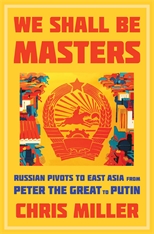
Since Peter the Great, Russian leaders have been lured by opportunity to the East. Under the tsars, Russians colonized Alaska, California, and Hawaii. The Trans-Siberian Railway linked Moscow to Vladivostok. And Stalin looked to Asia as a sphere of influence, hospitable to the spread of Soviet Communism. In Asia and the Pacific lay territory, markets, security, and glory.
But all these expansionist dreams amounted to little. In We Shall Be Masters, Chris Miller explores why, arguing that Russia’s ambitions have repeatedly outstripped its capacity. With the core of the nation concentrated thousands of miles away in the European borderlands, Russia’s would-be pioneers have always struggled to project power into Asia and to maintain public and elite interest in their far-flung pursuits. Even when the wider population professed faith in Asia’s promise, few Russians were willing to pay the steep price. Among leaders, too, dreams of empire have always been tempered by fears of cost. Most of Russia’s pivots to Asia have therefore been halfhearted and fleeting.
Today the Kremlin talks up the importance of “strategic partnership†with Xi Jinping’s China, and Vladimir Putin’s government is at pains to emphasize Russian activities across Eurasia. But while distance is covered with relative ease in the age of air travel and digital communication, the East remains far off in the ways that matter most. Miller finds that Russia’s Asian dreams are still restrained by the country’s firm rooting in Europe.
Eurasia Airlines was a Shanghai company with German investment and flying Junkers planes. Founded in 1925 it moved to Hong Kong during the Japanese invasion of China. It stayed in business until 1943. This ad shows their route network – from Shanghai to Beijing, Lanzhou, Ningxia, Baotou, Nanjing, Zhengzhou, Xian and Chengdu. Their offices were on Jinkee Road, just off the Bund and now Dianchi Lu. Their logo is below too.
This weekend’s South China Morning Post Weekend Magazine featured a story by me on a partial and fragmented history of espionage and spies across 150 years of the territory’s history. From poisoning scares to industrial espionage, rumour mongers in the Spanish-American War, Cold War politcs and of course the two world wars and their own spy scares. Click here.
Not quite China but i did review Emma Larkin’s excellent new novel, Comrade Aeon’s Field Guide to Bangkokfor the South China Morning Post (click here), which some China Rhyming readers might appreciate….