David Ludwig Bloch was a deaf Jewish artist from Bavaria who found refuge in Shanghai following his flight from Nazi Europe in 1940. There he joined a population of 20,000 other German and Austrian Jewish refugees, who found themselves living in relative safety in a place they had only imagined. A painter, illustrator, and lithographer, Bloch captured the daily life of Shanghai in the 1940s, a thriving metropolis of rich and poor, city natives, European exiles, and a vast population of Chinese refugees fleeing the Japanese invasion and chronic civil war. Through Bloch’s work, we meet the everyday people of Shanghai—the rickshaw drivers, small business owners, the homeless, and the street beggars—as well as an artist who made a new life for himself in China and then, finally, in the United States.
About the Series At the Center for Jewish History, there are tens of thousands of boxes in our partners’ archival collections. Boxes filled with photographs, journals, letters, and documents. We take these treasures Out of the Box in our new series. Join us!
Shepherd.com is a website dedicated to online book browsing. They recently asked me to talk about the best novels of old Shanghai….so here’s my choices – Malraux, Mao Dun, Zhang Ailing, Mu Shiying and Yokomitsu Riichi…click here
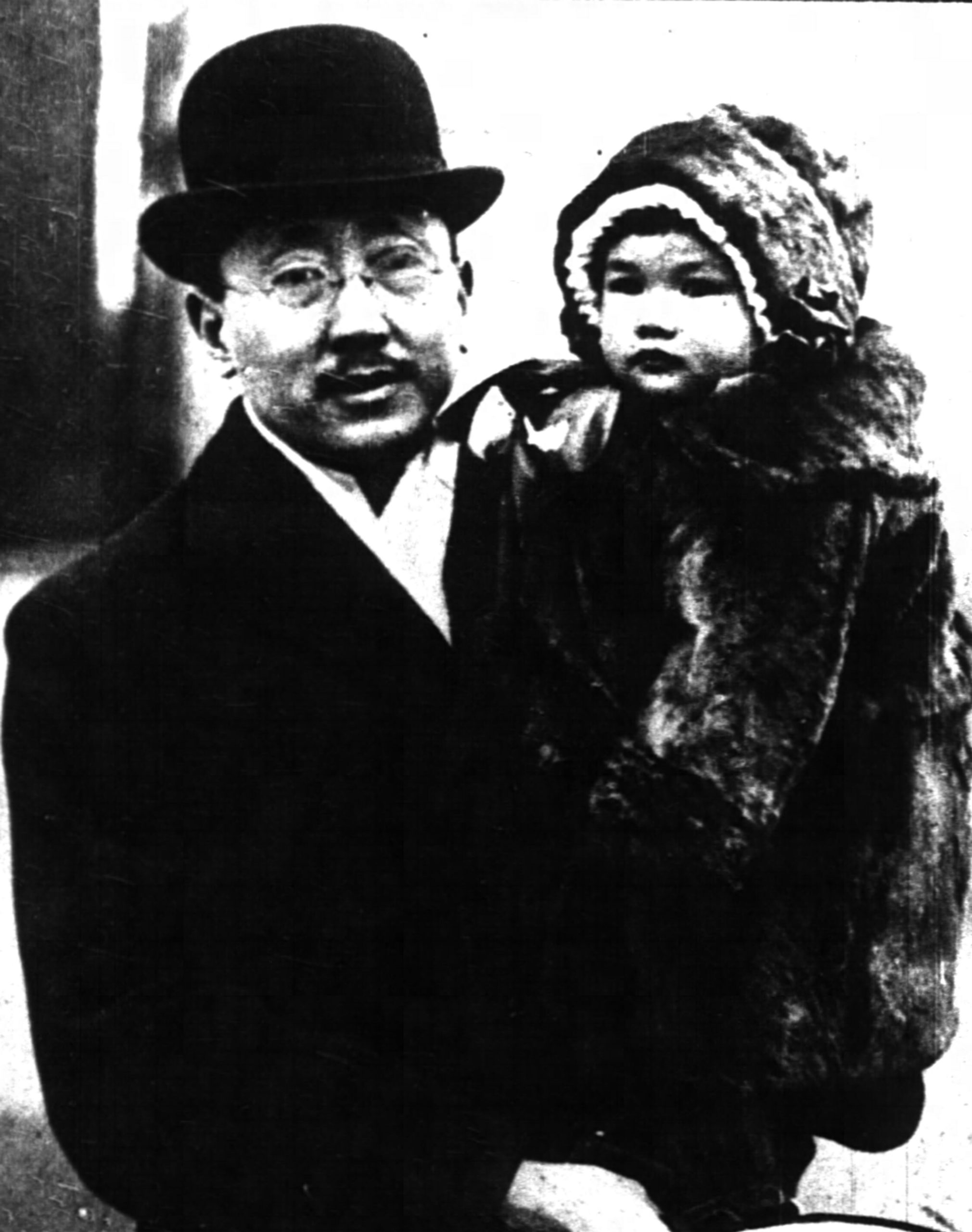
With Wellington Koo heading back to China after being Ambassador to the US and then the lead of China’s delegation at the Paris Peace Conference, Alfred Sze, who had also been in Paris and China’s Ambassador to Britain during World War One headed to New York, arriving here in February 1921 with his daughter (born 1919), Betty…
Delayed due to theb pandemic the third and final part of David Peace’s Tokyo Year Zero trilogy is now out – Tokyo Redux….And it’s brilliant….
Tokyo, July 1949, President Shimoyama, Head of the National Railways of Japan, goes missing just a day after serving notice of 30,000 job losses. In the midst of the US Occupation, against the backdrop of widespread social, political and economic reforms – as tensions and confusion reign – American Detective Harry Sweeney leads the missing person’s investigation for General MacArthur’s GHQ.
Fifteen years later and Tokyo is booming. As the city prepares for the 1964 Olympics and the global spotlight, Hideki Murota, a former policeman during the Occupation period, and now a private investigator, is given a case which forces him to go back to confront a time, a place and a crime he’s been hiding from for the past fifteen years.
Over twenty years later, in the autumn and winter of 1988, as the Emperor Showa is dying, Donald Reichenbach, an aging American, eking out a living teaching and translating, sits drinking by the Shinobazu Pond in Ueno, knowing the final reckoning of the greatest mystery of the Showa Era is down to him.
The old Shanghai Municipal Council building on the corner of Hankow Road & Kiangse Road (Hankou and Jiangxi Roads). It’s a five-story neoclassical building featuring a granite facade, Baroque styling, Ionic columns and arched windows. There’s a large closed courtyard with an entrance/exit on the southwest corner. The architect was the SMC’s then in-house architect Robert Charles Turner. Here is a picture of the building under construction in 1917 and then shortly after it was completed and opened in the early 1920s.
Winged Tiger Paints and Varnishes were probably the most aesthetically pleasing tins of paint and varnish imaginable! And what a slogan: ‘Save the Surface and You Save All’ – if Deng Xiaoping has said it they’d be carving in hillsides in the Chinese countryside! Manufacturing paint right by the side of the Suzhou Creek on North Soochow Road (i.e. the Hongkou side).
An article (originally for the LARB China Channel and click to read if you prefer) about the popularity of Sherlock Holmes in China from the 1930s to the 1990s to Benedict Cumberbatch is now available as an audio listen from SupChina’s China Stories podcasts….click here