Posted: November 10th, 2016 | No Comments »
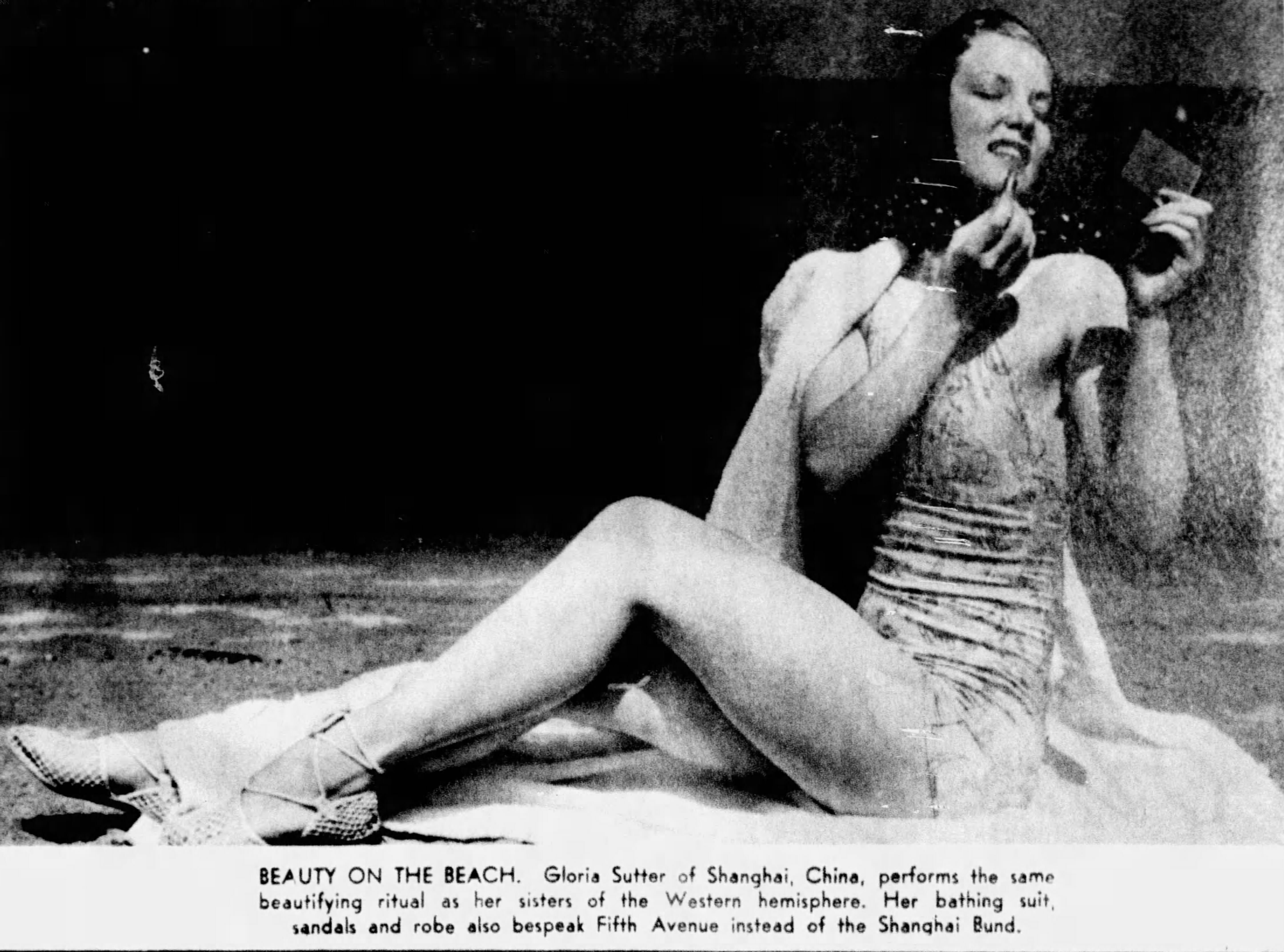
So this is Gloria Sutter of Shanghai in the summer of 1937, her picture taken shortly before the bomb attacks on the city that August 14th. I’m afraid I have not been able to track her down at all. I don’t know where she was from, how she got to Shanghai, what she was doing there or what happened to her later. There’s just this portrait of her in a bathing suit, applying lipstick and posing.
Posted: November 9th, 2016 | No Comments »
Just published and perhaps of interest to China Rhyming readers….John Stubbs and Robert Thomson’s Architectural Conservation in Asia: National Experiences and Practice…
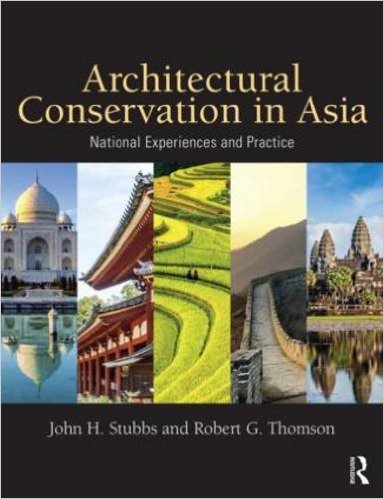
At a time when organized heritage protection in Asia is developing at a rapid pace, Architectural Conservation in Asia provides the first comprehensive overview of architectural conservation practice from Afghanistan to the Philippines. The country-by-country analysis adopted by the book draws out local insights, experiences, best practice and solutions for effective cultural heritage management that will inform study and practice both in Asia and beyond.
Whereas architectural conservation in much of the Western world has been extensively documented, this book brings together coverage of many regions where architectural conservation has been understudied. Following on from the highly influential companion volumes on global architectural conservation and architectural conservation in Europe and the Americas, with this book the authors extend their pioneering global examination to the dynamic and evolving field of architectural conservation in Asia.
Throughout the book, the authors and regional experts provide local case studies and profile topics that bring depth and insight to this ambitious study. As architectural conservation becomes increasingly global in practice, this book will be of considerable assistance to architectural conservation practitioners, site managers and students of architecture, planning, archaeology and heritage studies worldwide.
Â
Posted: November 8th, 2016 | No Comments »
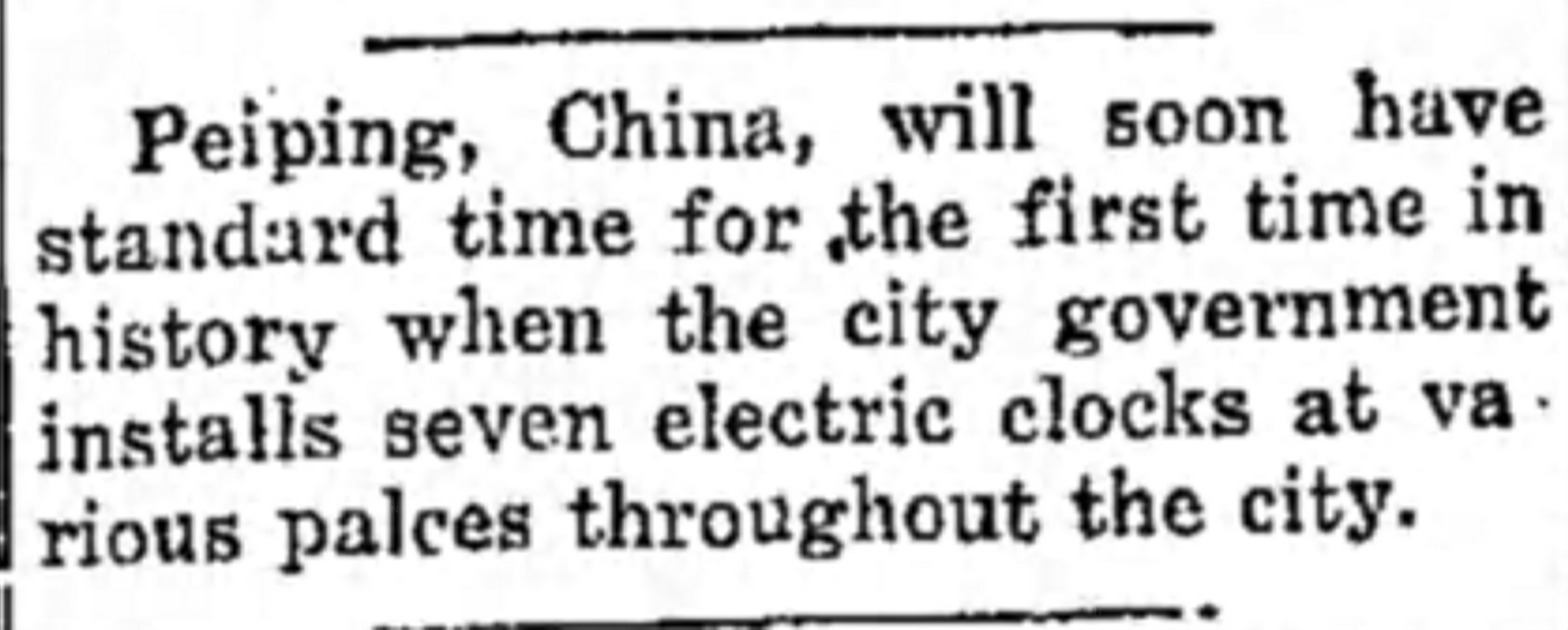
Until January 1937 Peking (Beijing, if you prefer) had no standard time. Of course there was a set time but very few clocks agreed and some people relied on gongs during the night, a cannon shot at noon and other forms of timekeeping. However, with the treaty ports having introduced standard time through electric clocks (and also Nanking, the capital) Beijing decided to get modern too. Additionally standard time would be a great help to train, bus, trolleybus and, just starting for Peking, flight timetables. And so seven electric clocks were installed in the city to allow people to set their own watches and clocks by these.
Nanjing had bought a KS Clock from Germany (I have seen this written but can find no trace of K.S. clocks) in 1929 which sent out a time signal at noon and 6pm each day for people to synchronize with. The National Astronomical Observatory had been opened in 1912 in Beijing and did answer telephone queries about the time – a sort of personalised Speaking Clock.
Maybe someone knows the following – what clocks did Peking use and where were the seven timepieces located?
Posted: November 7th, 2016 | No Comments »
A friend recently strolled down Armour Factory Alley in Beijing, now Kujiachang Hutong. It was of course where both the Werners (from my book Midnight in Peking) as well as Edgar and Helen Foster Snow lived….The latter courtyard house is gone; Werner’s remains (though intensely sub-divided). Anyway, at least it survives amazingly….


Posted: November 5th, 2016 | No Comments »
Another post somewhat related to my article in the current issue (No.8) of The Cleaver Quarterly on London’s Chinese restaurant scene in the 1930s and 1940s. Very interesting to me was M.P. Lee’s 1943 book, Chinese Cookery: A Hundred Practical Recipes. Useful ways to cook Chinese food during the Blitz and having to survive on the ration!
MP Lee enlisted the great British-based Chinese artist and poet Chiang Yee, famous for the Silent Traveller series of books, to provide the illustrations (or “decorations” as they rather charmingly called them). Of course you should order or buy the magazine to read the entire article and see all the illustrations, but here are a sample…


Posted: November 4th, 2016 | No Comments »
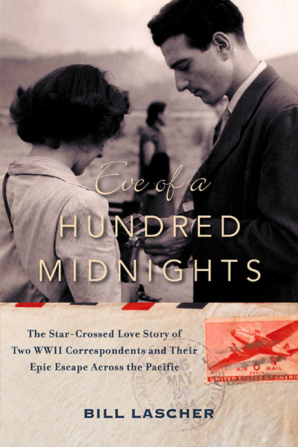
I’ve blogged before about Bill Lascher’s Eve of a Hundred Midnights, the biography of Mel and Annalee Jacoby, two of the finest correspondents to cover wartime China. Of course they had both long interested me from the time I wrote a history of the foreign press corps in China from the 1830s to 1950s, Through the Looking Glass. Recently I got to fire a few questions at Bill about the book and its subjects – while Mel is interesting to me I must admit that I’ve also been long fascinated by Annalee Jacoby (who co-authored the WW2 best seller Thunder Out of China with Theodore White) and feel (as i mentioned recently when talking about Helen Foster Snow, wife of Edgar and a great writer in her own right) she’s been seriously overlooked.
Anyway, here’s my Q&A with Bill Lascher in the Los Angeles Review of Books China Blog….
Posted: November 3rd, 2016 | 1 Comment »
The Mih-Ho-Loong Cocktail was made famous in 1930s Shanghai by the men of A Company of the Shanghai Volunteer Rifles, also known as a the Mih-Ho-Loong Rifles. The Company had been formed in 1870 when the Hook and Ladder Company (firemen) and the Mih-Ho-Loong Rifle Company were one and the same outfit. They split in 1879 though A Company Riflemen were invariably also volunteer firemen. They morphed into A Company of the Shanghai Volunteer Corps with a mostly British membership in the 1930s.
 A Mih-Ho-Loong helmet plate encompassing the crossed firemen’s ladder and rifle
And, Shanghai being Shanghai, they had their own preferred cocktail – the Mee-Ho-Loong:
Half fill a glass with broken ice and add:
1 dash orange bitters
a quarter gill sloe gin
eighth gill of French Vermouth
I’ve recreated it using my own home-made sloe gin:


Posted: November 2nd, 2016 | No Comments »
You can of course still stay in the Astor House Hotel in Tianjin – I wouldn’t stay anywhere else. They gave it a makeover a few years back which didn’t help thinks heritage wise (though was outstanding by Chinese standards that range from Bulldozer to Terrible). I stayed there quite a few times in the 1990s when it felt very ghost like and it wasn’t always obvious it would escape the demolition man. It is, of course, wonderfully situated close to the former Victoria Park and the river. I won’t go into the history of the hotel here – too long (1846) and easy enough to find in books or on the internet.
