Posted: November 1st, 2016 | No Comments »
On October 31 1916 recruitment of Chinese men for the British Chinese Labour Corps (CLC) began in Weihaiwei. The War Office in London had appointed a former railway engineer, Thomas J. Bourne, to the job of organising the recruitment centre. Bourne (1864-1947) had been Engineer-in-Chief on the Peking-Hankow Railway. He’d been in China nearly 30 years when asked by the government to organise the recruiting of the CLC. Bourne was based in Peking but made the three day journey to Weihaiwei to set up the recruiting station. He arrived and began work a century ago this week – October 31st. The recruitment camp they built in Weihaiwei is shown below.
Bourne’s assistant was Theodore Roberts, a chartered accountant. The day-to-day administration of the Labour Depot (where the recruited men were camped until shipped to Europe) was handled by G.S. Moss who worked in the British Consular Service. Moss had been stationed in a number of small treaty ports including Pakhoi. He went on to become British Consul in Weihaiwei and Canton (Guangzhou) after the war. Moss was considered a good linguist and got a CBE. Moss stayed involved through till 1919 and the demobilisation of the CLC.


Posted: October 31st, 2016 | No Comments »
I blogged a relocation ad from 1940 for Shanghai tailors Old Bond Street quite a while ago. And now my thanks to Bill Savadove in Shanghai who unearthed this ad of theirs from 1939.
There’s a few interesting things about this ad. Old Bond Street was run by Erwin Leschziner, a Jewish refugee tailor and dress designer, who came to Shanghai to escape the rise of the fascism. He employed some other Jewish tailors in the business – so his claim to branches in Berlin and Wien (Vienna) are more sort of where they came from than where they had stores (Jewish stores not being too popular in 1939 in either of those cities!!). He did have a store in Shanghai and they did do fittings in the Cathay Hotel though.
 Next, His Highness the Maharaja of Kapurthala (in the Punjab), better known perhaps as Jagatjit Singh (1872-1949). He became the Maharaja as a young boy, in 1877 (assuming full ruling powers in 1890) and ruled till the end of his life. He was a Francophile and constructed palaces and gardens in Kapurthala based on Versailles. Despite this he was a serious man, acting as the Indian representative at the League of Nations in the 1920s and becoming a hard core world traveller. He also did visit Shanghai – there’s pic here of him with the local Sikh community in the 1930s. One presumes the ‘ladies dresses’ were not for him but for his retinue (the Maharaja of Kapurthala travelled with a large female retinue apparently – back in the early 1900s he’d managed to annoy the Japanese by visiting Tokyo and “adding” two Japanese women to his travelling party).
In 1939 by the way the Maharaja was 67. He was also preparing for war and had publicly offered all his troops and resources to the service of the British Empire. He had assumed the rank of Colonel. He passed through Shanghai (and Singapore) on his way to visit the Golden Gate Exposition in San Francisco, travelling on the rather luxurious Lloyd-Triestino line the Conte Biancamano. He visited Shanghai with his second son, Prince Amarjit Singh, who was at the time the officer in charge of all Punjab armed forces.

Posted: October 29th, 2016 | No Comments »
This is the January 29th 1944 edition of Liberty magazine…including a report on life in Japanese-held Shanghai. It makes for good reading revealing the city at a time when things were about as bad as they could get. The correspondent is Bernard (or sometimes Bernhard) Covit (1907-1978), who’d been working as a correspondent for UP in Manila until captured by the Japanese and interned for 18 months. Before the war Covit, a Brooklynite I believe, worked for the New York Post among other papers and bureaus. He was in Shanghai on “Bloody Saturday”, August 14th 1937, when the city was bombed – he was close to the Great World Amusement Palc when two bombs fell on Thibet Road (Xizang Road) right outside the packed building.
I believe Covit went on to remain involved in Asian affairs – editing several books on the South Seas and Tahiti. After the war I think he also worked in radio with WPIX, New York, and the Mutual Broadcasting System. Anyway, here’s Covit in occupied Shanghai in 1944….


Posted: October 28th, 2016 | No Comments »
Fri 11 Nov, 2016 – Sat 12 Nov, 2016
The Inexplicable and the Unfathomable: China and Britain, 1600-1900
The Courtauld Institute of Art, Somerset House, Strand, London
More details, full programme and tickets here
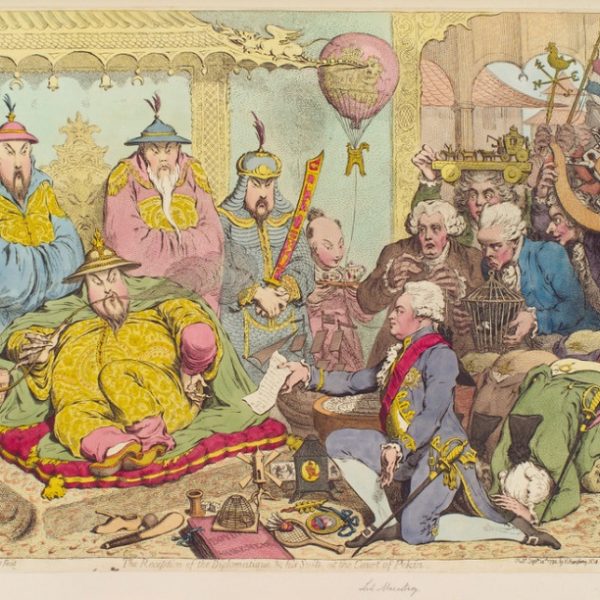
The ‘Chinese character seems at present inexplicable’, observed Lord Macartney during his celebrated embassy to China in the 1790s, while the Chinese themselves at this time often described ‘western ocean barbarians’ as ‘unfathomable’. The failure of Macartney’s embassy is well known, not least the Emperor Qianlong’s dismissive comment that ‘we possess all things. I set no value on objects strange or ingenious, and have no use for your country’s manufactures’.
A sense of bafflement might therefore overwhelm the present-day visitor to the Forbidden City, on encountering its glorious array of English clocks, many imported during Qianlong’s reign. The present conference will consider some of the endless misunderstandings and deliberate deceptions that characterised relations between Britain and China in the four centuries under review, in fields as varied as religion and art, and commerce and literature. It will also explore, however, the burgeoning range of contacts between the two countries, and the increased mutual understanding achieved by two cultures separated by ‘the confines of many seas’.
Posted: October 27th, 2016 | No Comments »
A header for the marvellous La Librairie Francaise of China. The publusher was the imprint of the great Henri Vetch who ran the French Bookstore inside the lobby of the Grand Hotel de Pekin (now “Block B” of the Beijing Hotel – aaahh, the romance of communism!!) from 1930 to (about) 1953 (I think). The Libraire had been started originally by Henri’s father, Francis. Henri Vetch (who eventually went to Hong Kong and died in the 1970s) also had a branch at 71 Rue de France in Tientsin (that’s the formerly French bit of Jiefang Road in Tianjin now).

Posted: October 26th, 2016 | No Comments »
Cincinnati’s Giddings Department Store ran a promotion in January 1937 on the delightful looking (but perhaps not so delightfully named) felt “coolie sailor” hat, the “China-China”. As the advertising says – “gay as a Peking party” it will “China Clipper you right into Spring”. And only $3.95.

Posted: October 25th, 2016 | No Comments »
Here’s something you don’t see that often anymore – a bunch of bandits paraded down the Nanking Road. But in October 1925 it was a daily occurrence apparently. they had to walk all the way out to Lungwha to get themselves hung – 180 of them! ‘The Chinese people seem to enjoy it” says the article – but then where were public executions not popular? Certainly not in London and Paris where crowds would gather only a few decades previously for such displays. Still, public execution was long lived in China – in 1937 over 50,000 people turned out to see drug dealers and addicts executed in Peking.

Posted: October 24th, 2016 | No Comments »
James Wong Howe is a fascinating character – born in Guangdong in 1899 he came to America as a small boy. Interested in cameras and the early movie business he got a job with Cecil B DeMille on the silents. In 1928 he returned to China to film some location shots for a movie – that movie never happened, but later Josef von Sternberg used some of the footage in Shanghai Express.
Anyway, Wong Howe was asked to contribute to the very thoughtful and now largely forgotten magazine Rob Wagner’s Script that mixed authors, actors, film folk and cultural critics together between 1929 and 1949 to produce a fascinating magazine. Wong Howe’s contribution, published in October 1945, was called Electric Shadows and it was an article dealing with Chinese cinema since the Japanese invasion and the opportunities for Chinese film in the immediate aftermath of WW2. He discusses how the traditions of lantern shows morphed into “electric shadow” shows. He throws in a few useful stats:
Pre-war China had 400 cinemas showing American films (85%), Chinese, Russian, British and French being the rest (15%).
He also talks of the possibilities of adaptations of Lu Xun and Lao She and the opporutnities for co-operation between Shanghai’s film studios and Hollywood now the Japanese have been defeated.
The whole essay is available in this collection, The Best of Rob Wagner’s Script (just $5 on Kindle)…which has a lot of other good writing on Hollywood.
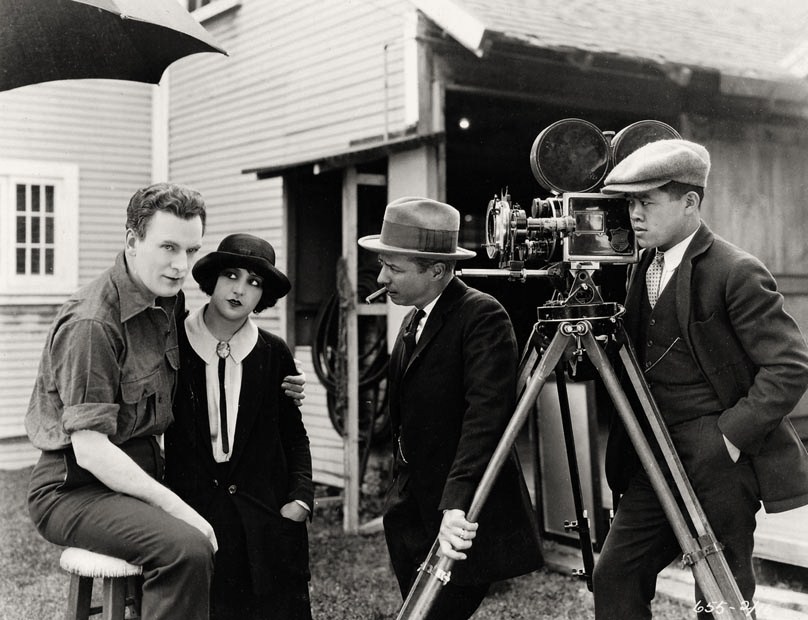
James Wong Howe on the set of The Alaskan, 1924