Posted: August 15th, 2012 | No Comments »
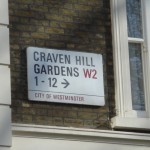 Quite a few people have asked me where DCI Dennis, one of the main characters in Midnight in Peking – a former Scotland Yard detective and then head of the British police force in Tientsin as well as one of the investigators into Pamela Werner’s murder – ended up when he returned to England after an exchange of nationals between Japan and the UK got him out of jail in Tientsin and back to London. Well, he ended up running the Dennis Hotel in that rather interesting area of central London, Bayswater. These days Bayswater is mostly (but not entirely!) posh again and the site of the old Dennis Hotel is now opposite the distinctly posh Hempel Hotel on Craven Hill Gardens (the Dennis Hotel was at No.8). Dick Dennis would have known the streets and communities of Bayswater in the 1930s when he was based in the Metropolitan police at Paddington Police Station nearby. Actually in the 1930s and through the war and its immediate aftermath Bayswater had fallen on slightly hard times – it’s gorgeous stucco fronted terraced houses were endlessly subdivided and the area was a little “seedy” and still a mess from bomb damage during the Blitz courtesy of the Luftwaffe. However, the Dennis was apparently a nice enough hotel – long term residents, older ladies (many of these sort of women still lived in the area through the 1960s and 1970s nto the 1980s and even I can remember them tottering around). Apparently there was a good card game and a drink available.

Craven Hill Gardens, London W2

No.8 as it is today…
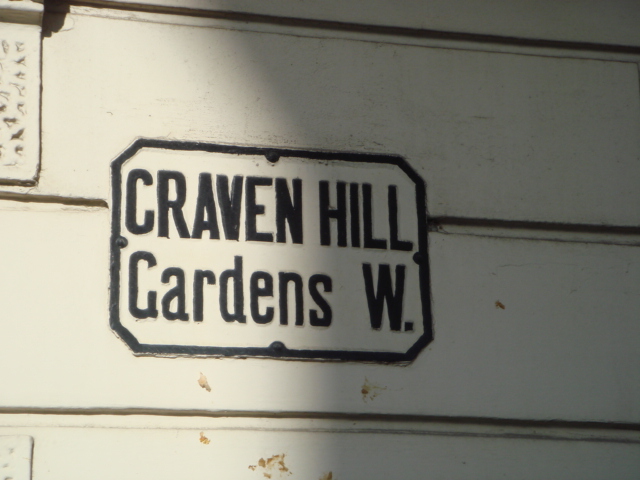
and round the corner, for London buffs, an old style London road sign
Posted: August 14th, 2012 | No Comments »
Foreign Policy has a special cities issue online and among the articles is a photo slide show of old Shanghai that’s worth a look. “Shanghai’s heyday as the Vegas of Asia” is a slightly odd title as obviously historically it’s more accurate to describe Vegas as the Shanghai of the United States – though of course this is to belittle Shanghai’s role. Vegas exists largely on the back of two industries (three if you include the number of people on CSI involved in cleaning up the city’s crime rate1) – gambling and entertainment. Shanghai was of course also the Wall Street of Asia, the largest port, a significant stock exchange and bullion dealing centre, the epi-centre of the cotton industry, the home of China’s Central Bank in the 1930s, the major centre for innovation and entrepreneurship in China in the 1930s and (and here Vegas slips a little I fear) a major centre of culture and learning.
Still, the pics are fun…..
Posted: August 13th, 2012 | No Comments »
A few pictures from the inside of the old British Legation in Peking from the late nineteenth century…

The Chancery

The road to the Chancery within the grounds of the Legation – known as Chancery Lane

The newer buildings, western in style, that formed the students’ compound – you can see the harsh weather and bare trees that typify Peking then and now

Inside the Student’s Mess in the Legation – the centre of the student interpreters life in Peking when they first arrived for the first couple of years of their service.
Posted: August 12th, 2012 | No Comments »
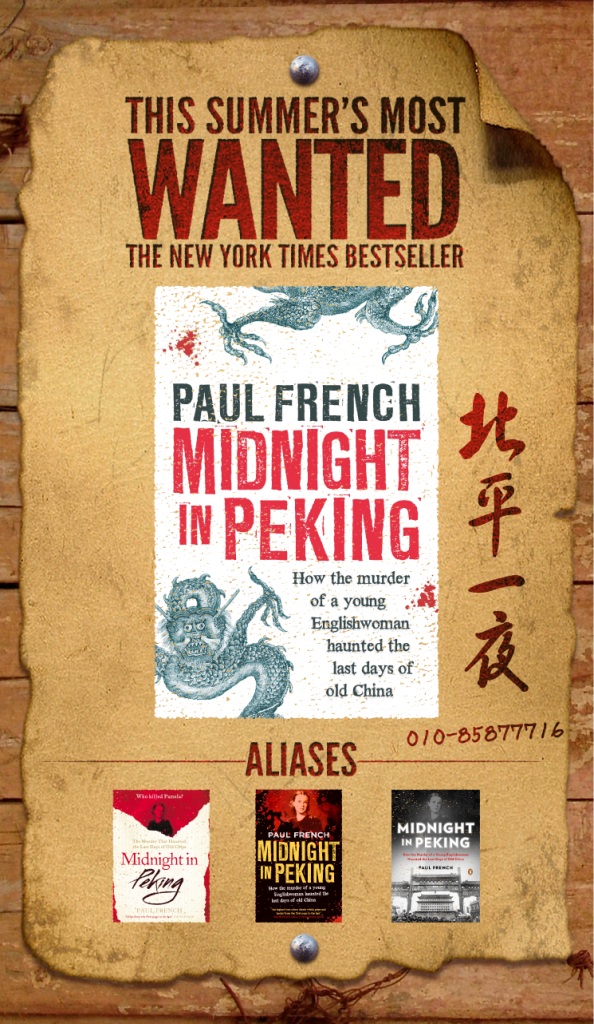
Now seen as a light box ad in Hong Kong Airport – decidedly cool…
Posted: August 11th, 2012 | No Comments »

In China’s Left-Behind Wives, Huifen Shen tells the extraordinary story of an overlooked group of women who played an important role in one of the largest waves of migration in history. For roughly a century starting around 1850, large numbers of young men from southern China travelled to Southeast Asia in search of work. Some were married and others returned to marry, but they routinely left their wives in China to handle family affairs. Drawing on in-depth interviews, archival materials, local gazetteers, newspapers and periodicals, the author describes the experiences of left-behind wives in the Quanzhou region of Fujian from the 1930s to the 1050s, a time when war and political change caused customary practices to break down.
Migrant marriages were nearly always arranged, and girls rarely met their husbands before the wedding. Normally a bride lived with her new husband for just a few weeks or months, after which he went abroad. The circumstances in the 1940s and 1950s were such that many of these young women rarely, or never, saw their husbands again. When the Pacific War cut off communications, the loss of remittance money meant that they faced a difficult struggle for survival. The war’s end brought a brief respite, but the communist ascendency led to further difficult adjustments. Ultimately, the experiences of the left-behind wives drew them into public life and business, and as Overseas Chinese policies, and attitudes towards women, changed in China, they came to play an increasingly significant part in the processes of development and modernization.
SHEN Huifen is an Assistant Professor in the Research School for Southeast Asian Studies and Faculty of International Relations at Xiamen University, China.
Posted: August 11th, 2012 | No Comments »
Happened to be relaxing the other night and watched the recent film Age of Heroes – played straight to my Boys Own heart with Sean Bean and Danny Dyer as soldiers in the behind -the-lines Commando forces of Ian Fleming dishing it out to the Nazi bastards up in Norway. Terrific stuff. Near the start of the film though there’s a scene where Sean Bean, a hard arsed Commando officer hands out the traditional Commando Fighting Knife – the defining accolade of the Commandos. However, he forgets to point out (though of course we can assume Sean Bean knows because he’s cool) that the Commando knife is indeed the double-edged Fairbairn-Sykes Fighting Knife developed before World War II by William Ewart Fairbairn and Eric Anthony Sykes, two of the hardest bastards ever to serve with the Shanghai Municipal Police. Fairbairn and Sykes developed their trademark knife after many years of watching , participating in and training recruits for knife fights in Shanghai – more here at Wikipedia.
Well, just thought I’d make the point….(geddit!)


Posted: August 10th, 2012 | No Comments »
Some advance warning about this event which is part of the Bristol Festival of Ideas…

Paul French & Robert Bickers
Old China’s Secret Worlds Revealed
17 September 2012, 18.30-19.30
Foyles, Cabot Circus, Bristol
China has often remained inscrutable to Westerners but new research is opening up aspects of Chinese history hidden for decades and centuries. In his The Scramble for China: Foreign Devils in the Qing Empire, 1832-1914, Robert Bickers, Professor of History at Bristol University, looks at the way China attracted the attention of British and European powers in the early nineteenth century. He discusses this with Paul French, author of Midnight in Peking: The Murder That Haunted the Last Days of Old China, the shocking story of Pamela Warner, teenage daughter of the city’s former British consul Edward Werner murdered in 1937. Despite an intensive search, the murder was soon forgotten amid the carnage of the Japanese invasion by all but her father. 75 years later, deep in the Scotland Yard archives, French accidentally came across his lost case file. Unveiling an undercover sex cult, heroin addicts and disappearing brothels, the truth behind the crime can now be told – and is more disturbing than anyone could imagine. Both talk of a hidden China and one that has much to tell us about China today.
More details here
Thanks to the support of Foyles, this event is free but pre-booking is essential. To reserve a place click HERE on the Eventbrite link. Please note that you will need to bring your ticket and present this on the door to gain entry.

Events start punctually and, out of consideration to other audience members and speakers, our policy is not to admit or issue refunds to latecomers. Please allow enough time to collect your ticket/s from the relevant box office (if these haven’t already been posted to you), and make sure to arrive before the advertised start time to take your seat/s. The Festival of Ideas endeavours to hold its events in venues that are accessible to all, but if you have specific access concerns it is advisable to contact the venue direct.

Posted: August 9th, 2012 | No Comments »
It’s been a while since we’ve had a new book on the Silk Road, but it’s good to see the old Silk Road industry is still churning…Valerie Hansen’s The Silk Road: A New History (presumably because we’ve all read or learnt the old history?). In fact this really is a new history and rather overturns the previous consensus of “internet of the ancient ages”, “transmission belt for silk” etc etc and sees it rather as a networked chain of trade routes. Here’s the book on Amazon, sadly no Kindle version I’m afraid.

The Silk Road is as iconic in world history as the Colossus of Rhodes or the Suez Canal. But what was it, exactly? It conjures up a hazy image of a caravan of camels laden with silk on a dusty desert track, reaching from China to Rome. The reality was different–and far more interesting–as revealed in this new history.
In The Silk Road, Valerie Hansen describes the remarkable archeological finds that revolutionize our understanding of these trade routes. For centuries, key records remained hidden-sometimes deliberately buried by bureaucrats for safe keeping. But the sands of the Taklamakan Desert have revealed fascinating material, sometimes preserved by illiterate locals who recycled official documents to make insoles for shoes or garments for the dead. Hansen explores seven oases along the road, from Xi’an to Samarkand, where merchants, envoys, pilgrims, and travelers mixed in cosmopolitan communities, tolerant of religions from Buddhism to Zoroastrianism. There was no single, continuous road, but a chain of markets that traded between east and west. China and the Roman Empire had very little direct trade. China’s main partners were the peoples of modern-day Iran, whose tombs in China reveal much about their Zoroastrian beliefs. Silk was not the most important good on the road; paper, invented in China before Julius Caesar was born, had a bigger impact in Europe, while metals, spices, and glass were just as important as silk. Perhaps most significant of all was the road’s transmission of ideas, technologies, and artistic motifs.
“An impressively well-researched book exploring the documentation of many different cultures and people along the many routes known as the Silk Road. Readers of Asian or world history will learn much from and thoroughly enjoy this book.” -Library Journal
“This book meets the challenge of being lively, readable, and at the same time extremely learned and up-to-date. In all respects a success.”–Etienne de la Vaissière, EHESS, Paris
“Valerie Hansen overturns the traditional view of the ‘straight and well-travelled’ Silk Road, as well as the notion that silk was of prime significance. Instead she reveals in detail the life, history, and culture of the different oasis centers of Central Asia, making the latest work by Chinese, Russian, Japanese, and other scholars available to us all. It is a triumph.”–Frances Wood, Curator of the Chinese Collections, British Library
“Erudite and engaging, this is no romantic tale of the Silk Road. Hansen challenges many of the conventional narratives of the crossroads of Eurasia. In place of large long distance commercial caravans, she finds subsistence living and local barter. Instead of merchants, she finds the Chinese military played the most important role in bringing silk onto the Silk Road. But the region is no less fascinating for all her debunking of old tropes. She skillfully weaves ancient records with modern explorations of the Silk Road to bring that past alive, especially the tolerant religious diversity of the region before Islam came to dominate around the year 1000. A wonderful read that will send you packing your bags!”– Gray Tuttle, Columbia University
“Valerie Hansen’s The Silk Road is the most readable and reliable historical account of the fabled trade routes that cut across the center of Eurasia in medieval times. Based upon original sources and the best scholarship, the author’s narrative is enriched by first-hand investigations in the field and extensive examination of artifacts in numerous museums. Handsomely illustrated, this volume brings to life as never before the men and animals who travelled from one Central Asian oasis to the next, conveying goods, ideas, art, music, and religions.”–Victor H. Mair, University of Pennsylvania
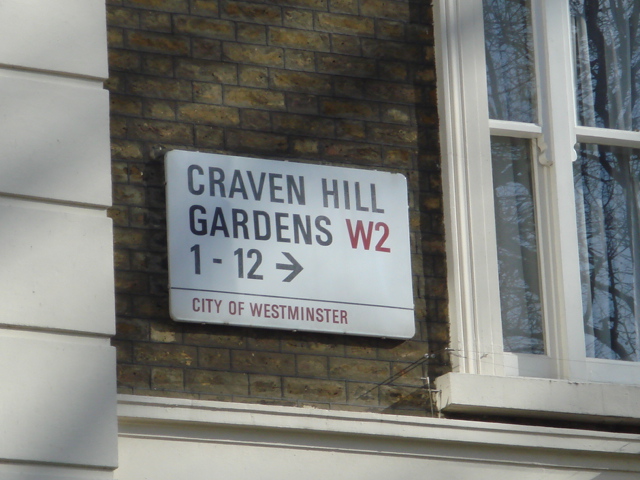 Quite a few people have asked me where DCI Dennis, one of the main characters in Midnight in Peking – a former Scotland Yard detective and then head of the British police force in Tientsin as well as one of the investigators into Pamela Werner’s murder – ended up when he returned to England after an exchange of nationals between Japan and the UK got him out of jail in Tientsin and back to London. Well, he ended up running the Dennis Hotel in that rather interesting area of central London, Bayswater. These days Bayswater is mostly (but not entirely!) posh again and the site of the old Dennis Hotel is now opposite the distinctly posh Hempel Hotel on Craven Hill Gardens (the Dennis Hotel was at No.8). Dick Dennis would have known the streets and communities of Bayswater in the 1930s when he was based in the Metropolitan police at Paddington Police Station nearby. Actually in the 1930s and through the war and its immediate aftermath Bayswater had fallen on slightly hard times – it’s gorgeous stucco fronted terraced houses were endlessly subdivided and the area was a little “seedy” and still a mess from bomb damage during the Blitz courtesy of the Luftwaffe. However, the Dennis was apparently a nice enough hotel – long term residents, older ladies (many of these sort of women still lived in the area through the 1960s and 1970s nto the 1980s and even I can remember them tottering around). Apparently there was a good card game and a drink available.