From Hebei to Holland – The Journey of One Letter from China in World War one
Posted: October 28th, 2026 | No Comments »An interesting letter sent in March 1914 from the Mines de Lincheng (Lincheng Mines Administration – Hebei Province) on the Pékin-Hankow Railway to a Mr Lionel Wiener in Holland. – Post Box 14, Scheveningue (Scheveningen), Hollande. Wiener appears to be a representative of the Compagnie Générale de Chemins de Fer et de Tramways en Chine (General Company of Railways and Trams in China).
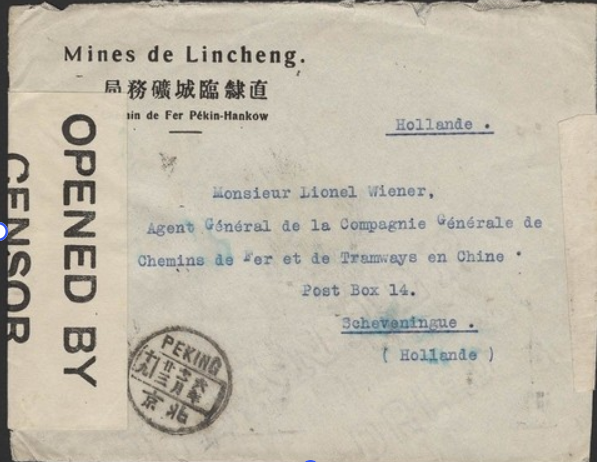
A number of interesting things about this letter…
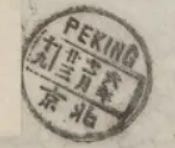
A circular PEKING postmark is visible in the lower-left corner indicating the letter went from Lincheng via the Pékin-Hankow Railway to Peking. The stamp indicates the letter passed through the Peking Post Office. Read vertically from right to left, the three columns show 三年 (Year 3), 廿三月 (23rd Month—which means November 23rd using a specialized numerical formatting shorthand common in Republican-era postal stamps where 廿 means 20), and 十九日 (19th Day).
From Peking the letter would normally have gone from China by train to Holland via the Trans-Siberian Railway through the new Russian Socialist Federative Soviet Republic (RSFSR). Russia was in obvious turmoil given the Bolshevik Revolution, withdrawal from the Allied side in the Great War and the onset of the Northern, Southern Russia and Siberian interventions (“Wars of Intervention”). Various nations, including China, had troops stationed in and around Vladivostok.
Hence, probably the letter went east via Japan (Kobe and Yokohama), crossed the Pacific or went via British-controlled shipping lanes, and entered the United Kingdom en route to continental Europe. Via British controlled territory seems most likely as, at some point, the letter was opened by a censor – I believe this is the reseal sticker of the “British Imperial Censor”.
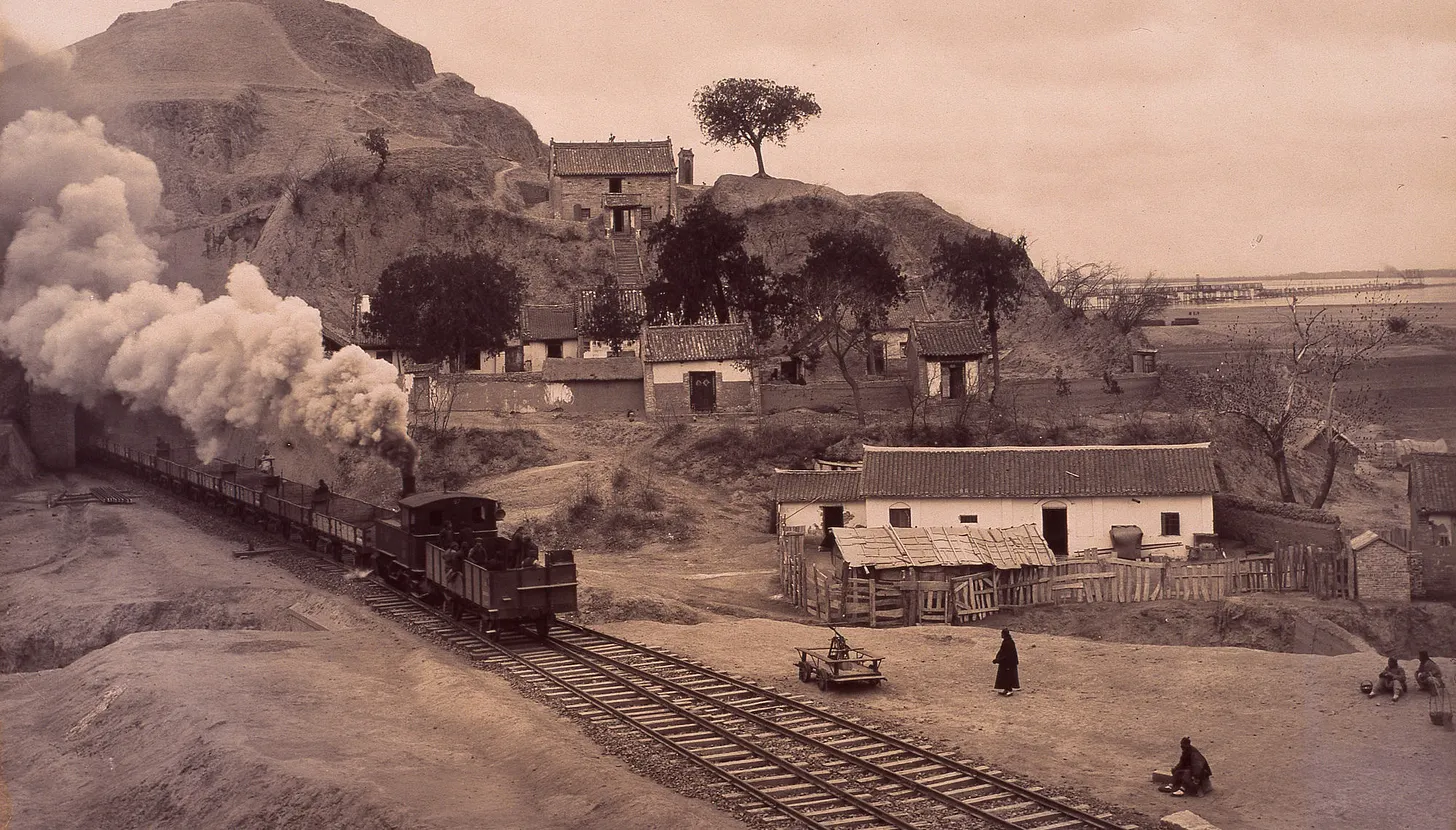
The Lincheng Coal Mines, formed in 1905 were predominantly a Belgian and French financial investment and employed many nationals of those countries. The Compagnie Générale de Chemins de Fer et de Tramways en Chine was a Belgian railway and tramway enterprise founded in Brussels in 1900 which built the link between Kaifeng (Kaifong-Fou) and Luoyang (Honan-Fou) with the major Pékin-Hankow Railway an 185 km link known as the Chemin de fer du Pien-Lo, which officially opened in 1909. The Lincheng Coal Mines supplied the railway with coal for the steam trains.
Sadly we don’t know who was writing to Lionel Wiener, but we do a little about the recipient. He was the Dutch representative of Compagnie Générale de Chemins de Fer et de Tramways en Chine and living in Scheveningen, a seaside resort 15 minutes from The Hague.
He was also the author of the 1923 paper Les écartements des voies de chemin de fer (something about railway gauges in China) that was included in the papers of the Congrés des Chemins de Fer (Railways Congress). He also wrote somewhat technically about railways in Brazil when he was the Secrétaire general et Chef du Service de la Traction de la Compagnie auxiliaire de Chemins de fer au Brésil (circa 1910). For his 1931 book, Articulated Locomotives, he is noted as a “professor”. Just to show his international reach Wiener also wrote Egypt and its Railways 1879-1940 (1932).
So who sent the letter and what it contained only the sender, Wiener and the British censor know….but it made it….
Leave a Reply