All things old China - books, anecdotes, stories, podcasts, factoids & ramblings from the author Paul French

Makers of Modern China: An Online event on Zheng Xiaoqiong – May 4 2026

Posted: May 2nd, 2026 | No Comments »

Join Eleanor Goodman and Kaiser Kuo for a discussion of Zheng Xiaoqiong, a poet and writer who depicts the world of Chinese migrant workers. 

Zheng Xiaoqiong burst onto the Chinese literary scene in the late aughts, after years toiling in the factories of Guangdong. Last June, NYRB Classics published In The Roar of the Machine, Eleanor Goodman’s translations of a wide-ranging selection of poetry from across Zheng’s career. And last December, Equator, a new magazine of politics and culture, published “The Makers of Modern China,” a selection of chapters from Woman Worker, Zheng’s oral history of migrant workers in Guangdong, with a contextualizing introduction by Kaiser Kuo.

This is a free virtual event co-hosted by Equator and NYRB Poets. To register click here


The Barbican at Bussiere Garden

Posted: April 30th, 2026 | No Comments »

One last post of Bussiere Garden – to see all the other just put “Bussiere” in the blog search engine….

The Bussiere Garden complex in Beijing’s Western Hills is a combination of Chinese and Western elements in three parts: the barbican tower, and then the northern wing and the southern wing villas (for Bussiere and his wife and the other for their tubercular daughter who needed the cleaner air of the Western Hills).

The barbican (a fortified outpost, tower, or gated structure built to protect a property) is perhaps the strangest part of the property’s architectural mix. A western style castle of stone and granite with three floors and facing toward the east. Quite what Dr Bussiere used the barbican for is not clear – presumably for views across the valley to Haidian and the nearby valleys of the Western Hills. It is not needed for defence or was ever used as accommodation and appears to have been purely an architectural folly on Bussiere’s land. 

Here it is under construction c.1923 when it seems to have been the first stricture to be tackled, shortly after completion of the tower and main villa and then today….


Some more Photographs from Bussiere Gardens, the Western Hills, Peking, in the 1920s/1930s….

Posted: April 30th, 2026 | No Comments »

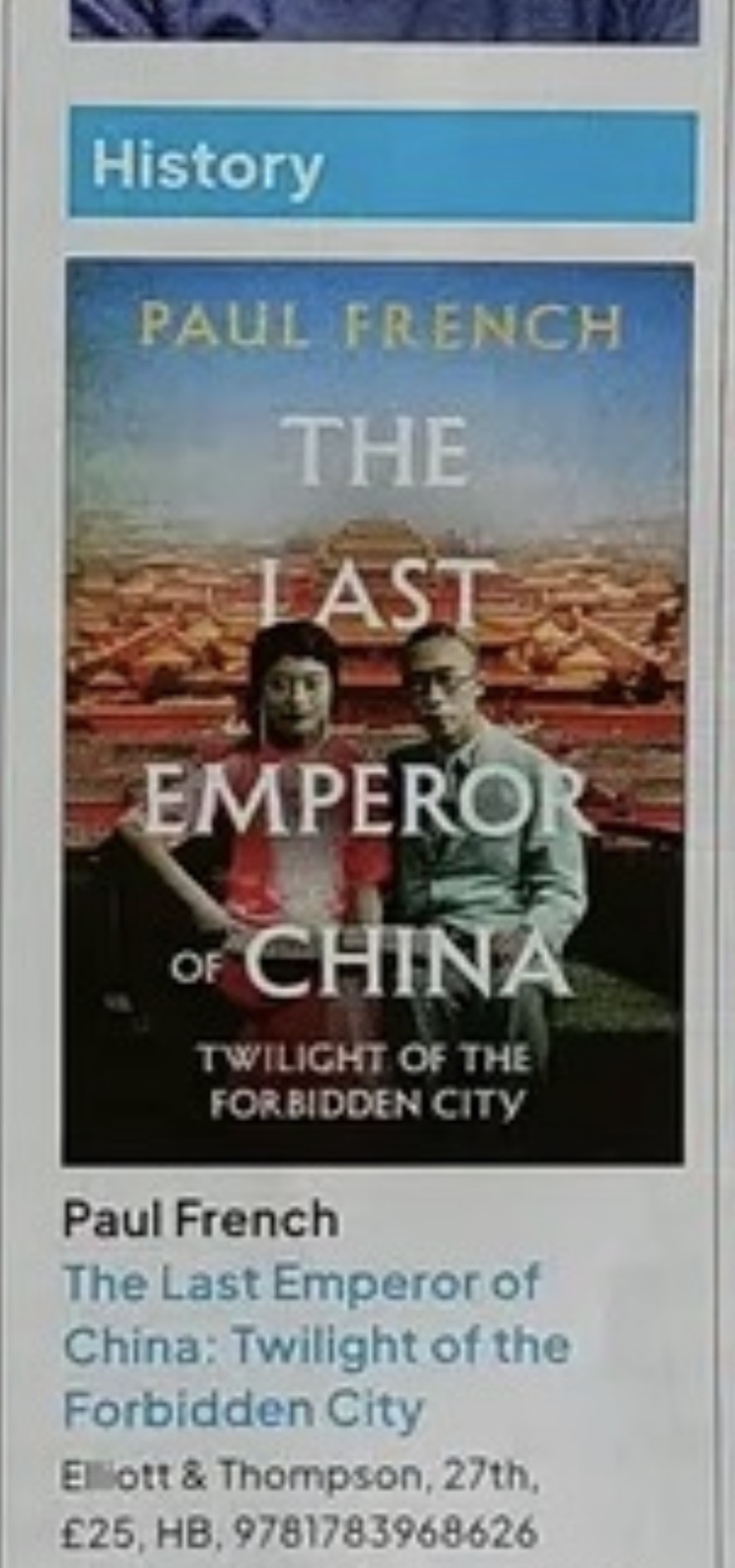
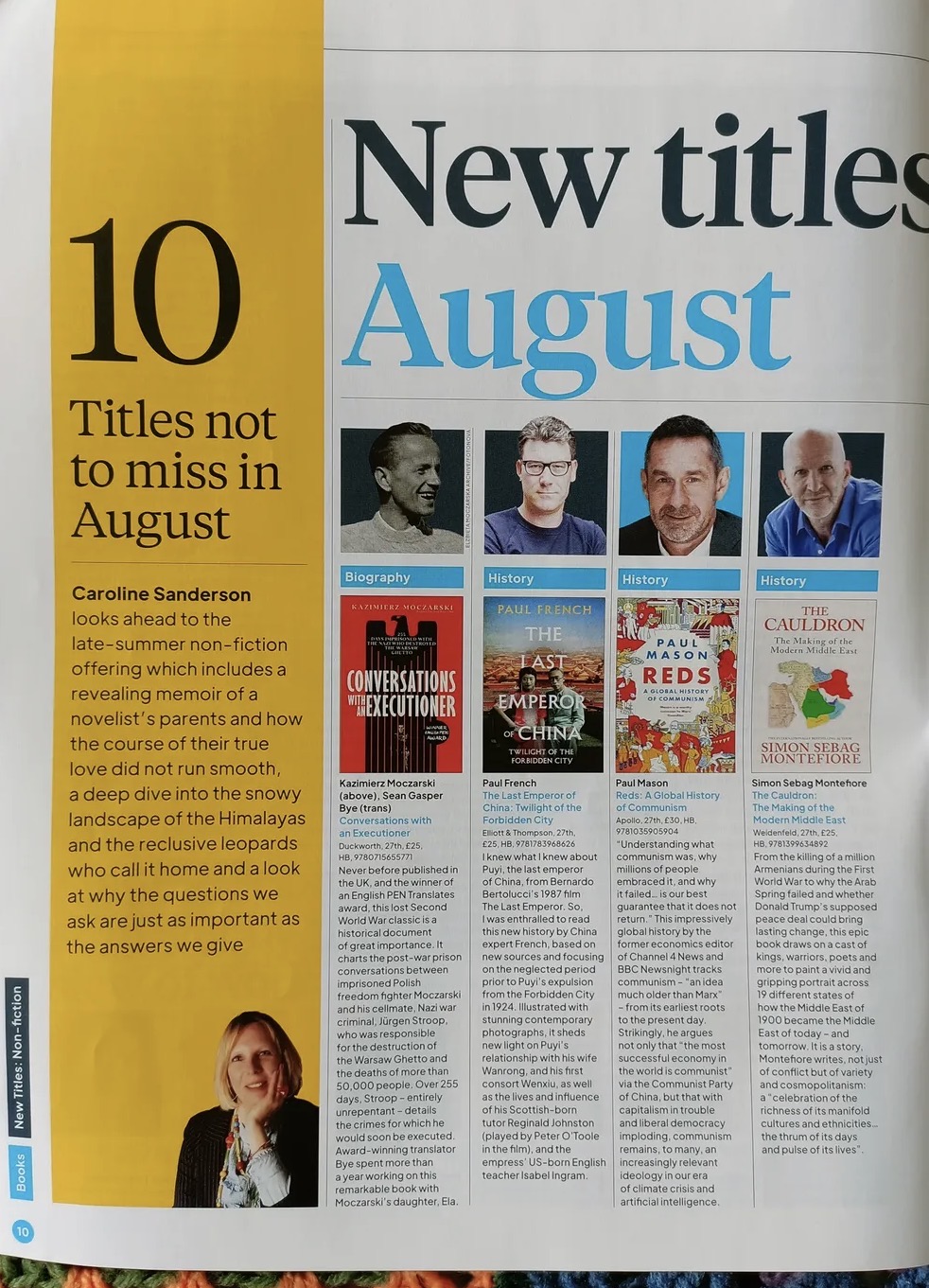
UK New Book Cover Reveal – The Last Emperor of China: Twilight of the Forbidden City – 27/8/26

Posted: April 29th, 2026 | No Comments »

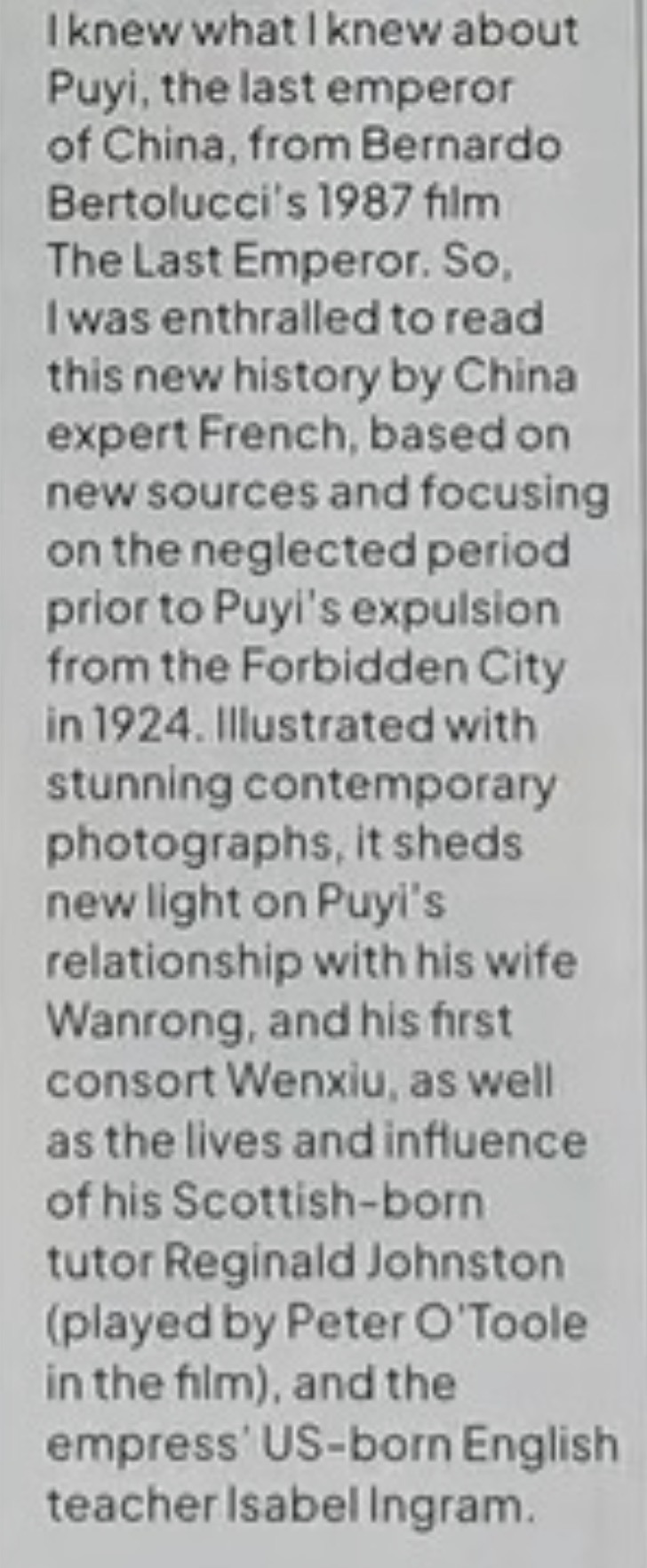
So here it is… my new book, The Last Emperor, out this August – a retelling with many new sources of the story of Puyi, Wanrong, their tutors and the last days of the Forbidden City…

Introducing the forthcoming UK edition of The Last Emperor of China: Twilight of the Forbidden City (Elliot and Thompson) – out this August 27th in the UK, Ireland and a few other places you guys might buy books such as Hong Kong. As usual the book’s in hardback and available as a e-book or audio-book too. There’s plenty of maps and photos of course… see the book blurb below…

You may think you know the story of the last emperor, seen the Bertolucci movie, done the tour… but there’s now so much more to know from newly unearthed archives – diaries, letters and photographs – in the US, UK and China that shed major new light on this old tale – the lives of Puyi and Wanrong as well as their tutors Reginald Johnston and the previously massively overlooked Isabel Ingram… these new sources reveal so much about the last days of imperial life in the Forbidden City…

PS: There will be a US edition along a little later in November, so fear not. For more details on that and pre-ordering links click here

Step into the otherworldly splendour of the Forbidden City, its red walls and golden rooftops shimmering at the heart of Peking…

In the early 1920s, China’s boy ruler Puyi and his child bride Wanrong were sequestered within the ancient citadel: a city-within-a-city, a haven prohibited to all except the imperial family and its scheming courtiers, fawning servants and corrupt eunuchs. An emperor without an empire, Puyi did not know from one day to the next whether he would experience restoration or assassination. Two years later, the couple was expelled into eternal exile, bringing an end to the centuries-old Manchu dynasty.

This extraordinary scenario has captivated us for generations – but we have not known the full story. Now, bestselling historian Paul French draws upon previously unpublished sources, including memoirs, diaries and letters, to take us deep inside the hidden world of Puyi and Wanrong and the cast of colourful characters that surrounded them. In this crucial period decisions of great consequence were made that would determine the future of the royal couple – and of China.

What emerges is a sweeping tale of tradition and revolution, of duty and intrigue – and a young married couple facing a hostile world. It is a mesmerising portrait of a dying regime: the final days of Imperial China as they have never been seen before.

Pre-order links for The Last Emperor of China

Pre-orders are of course a massive help to any author and have a real impact ensuring shops and online retailers really get behind a book and author. So if you’re able to pre-order please do with any of the major UK book retailers below, or get your local indie store to order it in as soon as possible….

More to Come….

I’ll post a list of launch events around the UK later in the year – Edinburgh and London for sure – and if anyone out there wants me to come and talk about the book at your bookshop, university of organisation, well here I am!


Reginald Hedgeland, Chinese Maritime Customs Commissioner & Quite the Tennis Player

Posted: April 28th, 2026 | No Comments »

Reginald Hedgeland (1874-1967) was a Chinese Maritime Customs Commissioner (with his archive at SOAS in London). He joined the CMCS in 1898, after Oxford. He retired in 1930 having worked in Hoihow [Haikou], Nanking [Nanjing], Tientsin [Tainjin], Macau, Hong Kong, Nanning, Aigun, Swatow [Shantou] and Canton [Guangzhou]. ere

Here some items recently up for auction that were owned by Hedgeland. A silver presentation sugar bowl, by Wing Chun of Hong Kong, c.1903 is inscribed ‘K M Shaw and R F C Hedgeland Men’s’ Handicap Doubles’ and ‘Tientsin Lawn Tennis Club 1903’ and a silver ‘dragon’ champagne bowl, by Tuck Chang, c.1904, engraved ‘Tientsin Lawn Tennis club men’s handicap doubles 1904.’ Quite the tennis player – he was also awarded a silver two (bamboo style) handled cup, c.1910, inscribed ‘Ladies Recreation Club Hong Kong Mixed Doubles Handicap December 1910 Mrs Armstrong & RFC Hedgeland’.

Also a pair of silver ‘dragon’ toothpick holders, two basket shaped salt cellars and five Chinese silver menu holders, by Wang Hing, c.1903 also belong to Hedgeland as well as a silver beaker , with inscriptions in Mandarin from an official in Nanning.


Young Sherlock & the Princess Gulun Shou’an

Posted: April 27th, 2026 | No Comments »

Enjoying Guy Ritchie’s Young Sherlock (on Amazon). Brilliant to see Taiwanese actress Zine Tseng as the Princess Gulun Shou’an running around, and doing a fair bit of cool fighting, in Victorian Oxford.

Screenshot
Screenshot
Screenshot
Screenshot

Presentation of the Victoria Cross by Rear Admiral Sir Michael Seymour, Commander in Chief of HM Ships and Vessels on the East India and China Station, Canton, 1858

Posted: April 26th, 2026 | No Comments »

An 1858 watercolour by the naval artist Frederick Le Breton Bedwell of the “Presentation of the Victoria Cross by Rear Admiral Sir Michael Seymour, Commander in Chief of HM Ships and Vessels on the East India and China Station” to:

  • Boatswain John Sheppard, HMS Cruiser;
  • Colour Sergeant John Pretty John, HMS Sans Pareil;
  • Able Seaman James Gorman, HMS Elk.

Present at the ceremony were:

  • His Excellency Sir John Bowring, Governor of Hong Kong;
  • Rear Admiral Sir C. Rigault de Genouilly, C-in-C of HM Naval Forces India and China;
  • Major General C T van Straubenzee, Commanding British Forces, Seamen and Royal Marines of the Allied Forces.

Now what is interesting is that this ceremony is taking place inthe Palace of the Tartar General in the City of Canton”, the official residence and administrative seat (yamen).

Yet Pretty John was awarded the VC in 1854 at the Battle of Inkerman against the Russians as part of the Crimean War. Gorman also earned his VC at Inkerman while Sheppard was got his for attempting to blow up the Russian Flagship at Sebastopol.

What happened was that all three men were on ships that left the Crimea at the end of the war in 1856 for China. In early 1858, British and French forces occupied Canton (Guangzhou) and the Palace of the Tartar General. So the medals finally caught up with the recipients who had then gone on to fight in the Second Opium War and received their Crimean War medals in occupied Canton.


VoiceMap GPS Walking Tour – Kowloon Tong: Art Deco and Hidden Heritage in Hong Kong

Posted: April 24th, 2026 | No Comments »

Before it gets perhaps a little too hot in Hong Kong you might like to take my VoiceMap GPS walking tour that takes you through Hong Kong’s little visited art-deco gems in Kowloon. Download here or use the app in the Apple store (here)… The blurb for the tour is below…

Kowloon Peninsula is a window onto Hong Kong’s architectural evolution.

On this walking tour, you’ll discover some of the most impressive yet overlooked Art Deco and Modernist structures near Hong Kong’s vibrant local markets. From villas commissioned by wealthy merchants to modernist apartment buildings, schools, and churches, you’ll see how avant-garde architectural trends reached this corner of the British Empire during a crucial period of its development in the 1900s.

The tour starts at Mary Knoll Convent School on Waterloo Road, with its fascinating blend of Art Deco and Gothic Revival styles. You’ll weave past the startlingly modern St. Teresa’s and see what is perhaps Hong Kong’s finest Art Deco treasure on Prince Edward Road West.

You’ll ascend Kadoorie Hill and the Braga Circuit to find an often overlooked enclave of Art Deco villas. Each property features distinctive architectural elements like wraparound balconies, curved edges, and nautical motifs.

The tour ends at Mong Kok East MTR Station, where working-class hustle-and-bustle contrasts with the exclusive residences of Kadoorie Hill.

On this 90-minute tour, you’ll also have a chance to:

Explore the once-significant Boundary Street, which formerly marked the border between British-controlled Kowloon and Qing Dynasty territory

Appreciate the detailed Art Deco wave patterns and cantilevered balconies of Prince Edward Road West’s meticulously restored apartments

Walk through Yuen Po Bird Market, where songbird enthusiasts still gather to socialise and compare their prized avian companions

Find out how the evolution of the Garden Cities Movement and the international style of Art Deco in Kowloon Tong influenced Kowloon’s architecture

  • Discover the Braga Circuit, a mews-like street named after prominent Macanese businessman José Braga
  • Admire Kadoorie Hill’s luxurious villas featuring Streamlined Moderne styling with high ceilings, Crittall windows, and curved edges
  • Visit St. Teresa’s Roman Catholic Church, an intriguing blend of Romanesque architecture and Art Deco influences
  • Browse the vibrant Mong Kok Flower Market, a glimpse of traditional Hong Kong culture that persists amid rapid urbanisation.

This tour is a rare opportunity to explore an overlooked architectural enclave that survived Hong Kong’s development frenzy. By the end, you’ll have a sense of how European design sensibilities were adapted to the tropical climate of this dynamic colonial port city.