Posted: April 9th, 2016 | 1 Comment »
Luise Rainer got the role in the film adaptation of Pearl Buck’s The Good Earth that Anna May Wong desperately wanted and was denied – O Lan. Rainer got the Oscar for Best Actress, in yellowface, which must have rankled with poor Anna May. The excuse was that as O Lan had to kiss Wang (played by white actor Paul Muni) the Hays Code, which prescribed miscegenation and inter-racial kissing, would prevent her from being cast. They offered Anna May the part of Lotus, a rather unsympathetic character – Anna May declined it pointing out that giving an unsympathetic character to an ethnically Chinese actress in a film who’s leads were all white actors in yellowface was ridiculous.
The year the film came out, 1937, Rainer sent six peach trees to Madame Chiang. Quite why I’m not sure, but apparently Madame Chiang had said she admired Rainer’s performance in the film. Dusseldorf-born Rainer, who was a staunch anti-fascist, did remain a friend of China – the Japanese invasion occurred in 1937 of course. In February 1938 Rainer hosted a benefit at Clara Bow’s It Cafe in Hollywood for Chinese war orphans and, in 1943, she attended a reception at the Ambassador Hotel for China’s Madame Chiang. It was held in connection with a starry China relief fundraiser staged at the Hollywood Bowl. She was later given an award of recognition from the China Relief Legion for her humanitarian efforts during World War II; the award (below) is signed at the bottom by Madame Chiang.


Posted: April 8th, 2016 | No Comments »
Owen Hatherley’s recent book The Ministry of Nostalgia made the point that the old Empire Marketing Board’s graphics were equally as good as the more famous images from London Transport and the Festival of Britain – it’s just they’re not so politically correct these days and so don’t make good prints to kwik-frame in London flats…Still the EMB’s art work was excellent and revealing….for instance the poster below… as you can see Britain accounted for approximately 10% (or less) of China’s imports….when you consider how many gunboats, regiments and the rest of the palava we stationed in Shanghai and around China it doesn’t seem overly worth it!

Posted: April 7th, 2016 | No Comments »
The recently published fourth volume of Pierre Loti’s journals (1896-1902) is a treat for French readers (or those struggling with schoolboy French) as it recalls Loti’s 1900 journey through India, French Indo-China, China itself and on to Japan. During this trip Loti spent some time in Peking, on which he comments, as well as Pei-ho, Ningpo and Ninghai (the surrounding area) and Takou, before heading on to Japan. There are also trips and comments on Saigon, Cambodia, Korea and Angkor.


Posted: April 6th, 2016 | No Comments »
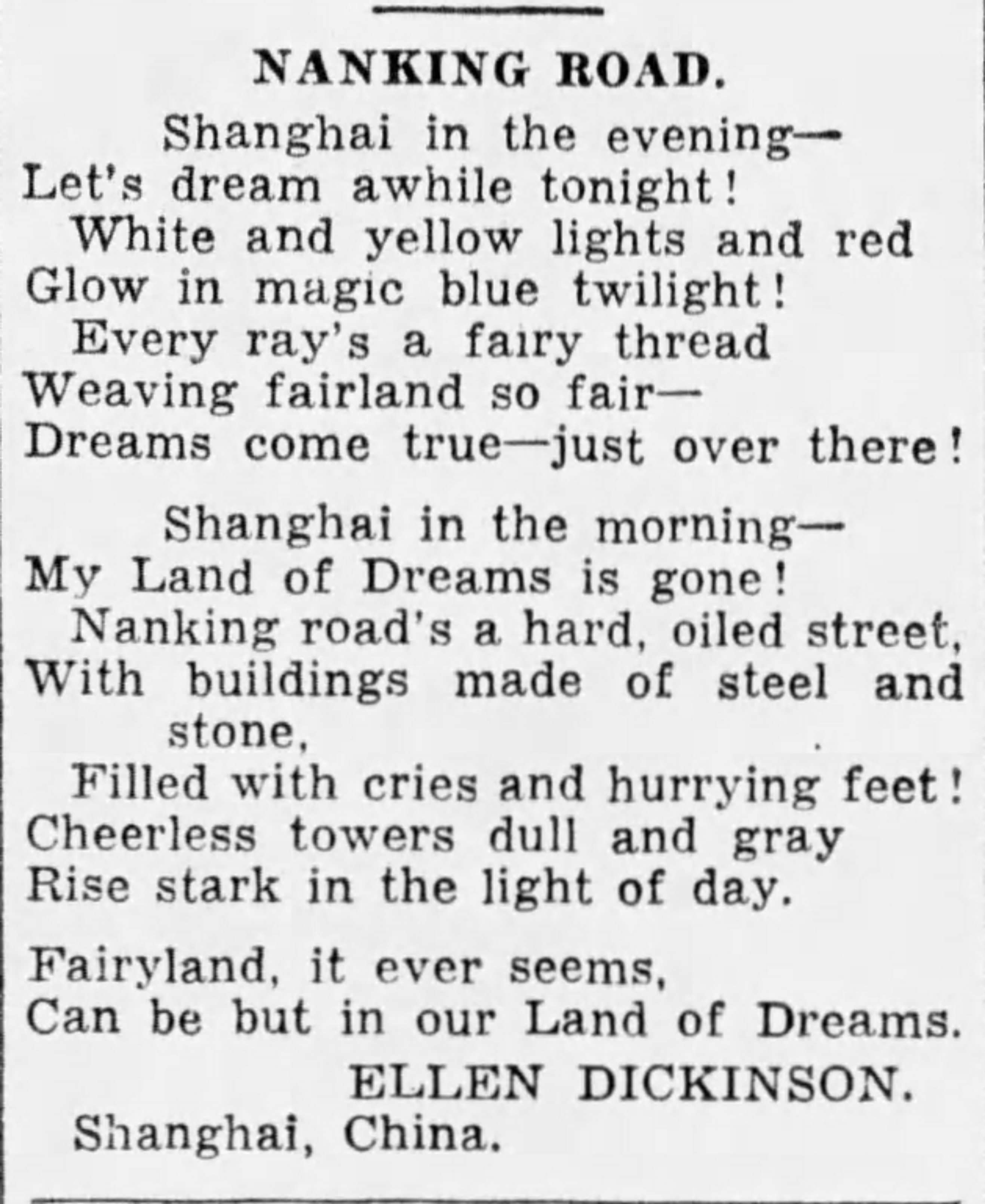
This ode to Shanghai’s Nanking Road appeared in 1933 and is penned by a certain Ellen Dickinson, resident of the city. I know nothing at all about Miss Dickinson I’m afraid…but here’s a small poem anyway….
Posted: April 5th, 2016 | No Comments »
I posted yesterday regarding Reuters’ offices on Avenue Edward VII (now Yanan Road) – by 1940 The Avenue Eddy and the cluster of newspaper and wire services offices, known as “Newspaper Row”, were a frontline in Shanghai – both as various sides threatened to bomb and snipe at the offices as well as being the border between the Settlement and Frenchtown – as you can see precautions were taken….

Posted: April 4th, 2016 | No Comments »
A letterhead for the Reuters news agency from 1937 Shanghai – headquartered on “Newspaper Row” aka Avenue Edward VII (The “Avenue Eddy” and now Yanan Road East). Especially handy as the traffic offices for cablegrams out of and into Shanghai were at 34 Avenue Edward VII too. However, some tensions may have been apparent as Japan’s Domei news agency was in the same building as was the German Trans-Ocean News Service.

Posted: April 3rd, 2016 | No Comments »
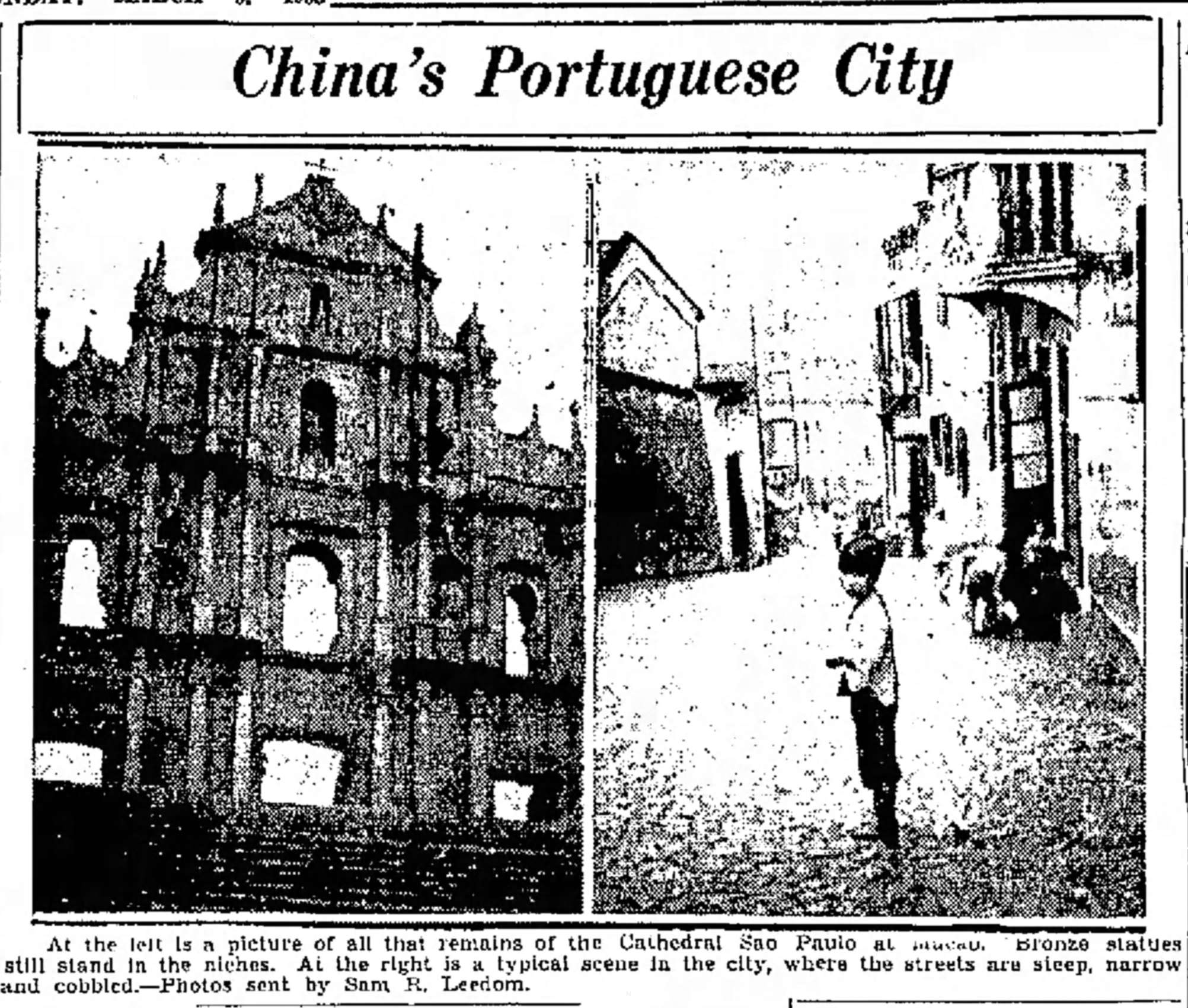
In 1935 American journalist Sam R. Leedom undertook a round the world reporting trip for the Californian newspaper, The Fresno Bee. He stopped off in Macao around March that year and sent back some photos…
Posted: April 2nd, 2016 | No Comments »
The shelf of Taiwan-US relations has got noticeably longer in recent years. Here’s another addition – Hsiao-ting Lin’s Accidental State...
Defeated by Mao Zedong, Chiang Kai-shek’s Nationalists fled to Taiwan to establish a rival state, thereby creating the “Two Chinas” dilemma that vexes international diplomacy to this day. This is the conventional narrative that Hsiao-ting Lin challenges in Accidental State. Drawing on recently declassified archives, he shows that the creation of a Taiwanese state in the early 1950s owed more to serendipity than careful geostrategic planning. It was the cumulative outcome of ad hoc half-measures and imperfect compromises, particularly when it came to the Nationalists’ often contentious relationship with the United States. Taiwan’s political status was fraught from the start. The island had been ceded to Japan after the First Sino-Japanese War, and during World War II the Allies promised Chiang that Taiwan would revert to Chinese rule after Japan’s defeat. But as the Civil War turned against the Nationalists, U.S. policymakers reassessed the wisdom of backing Chiang. Cold War realities and the fear of Taiwan falling into Communist hands led Washington to recalibrate. Yet American support of a Taiwan-based Republic of China remained ambivalent, and Taiwan had to eke out a place for itself in international affairs as a de facto, if not fully sovereign, state.